Free vaccination expands protection against cervical cancer
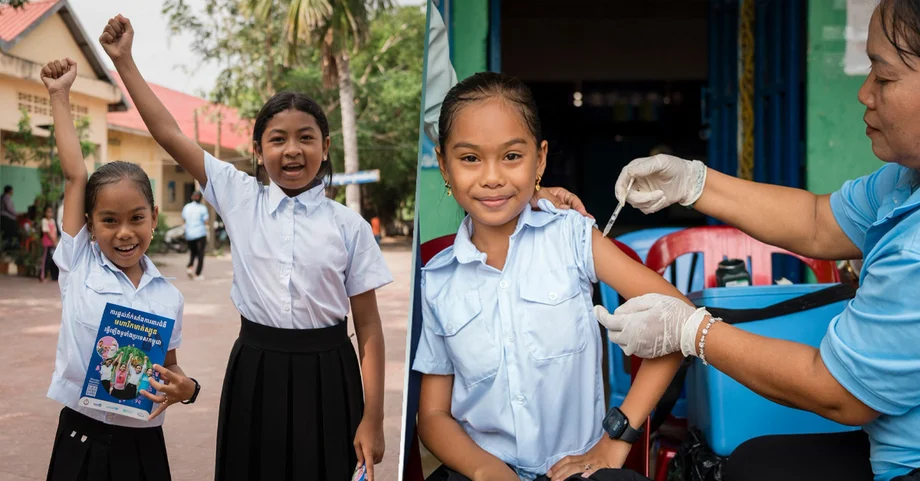
Cambodia launched a nationwide HPV vaccination campaign on November 10, 2026, aiming to protect more than 700,000 girls against a virus responsible for nearly all cervical cancer cases. The campaign brings free vaccination to schools, communities and health facilities, with more than US$3 million in support from Gavi, the Vaccine Alliance.
Contents
- Free vaccination expands protection against cervical cancer
- Which girls are eligible?
- When will vaccination reach each province?
- Why vaccinate girls before they are older?
- Reaching girls beyond the classroom
- What Cambodia is changing in delivery
- What the funding supports
- How the campaign fits the wider prevention effort
- Key Points
The Ministry of Health and National Immunization Programme are offering vaccination to girls aged 13 to 14 and catch-up vaccination to girls aged 10 to 12 who missed routine vaccination during 2023 to 2025. Routine vaccination for girls aged nine continues alongside the campaign. Together, these services cover eligible girls aged nine to 14.
The campaign has two regional phases, running from November 10 to 20 and December 1 to 18. Health teams will work with schools, village health groups and local authorities, paying particular attention to girls who have left school or live in remote communities.
The joint campaign announcement, published by UNICEF on November 10, describes the effort as an expansion of Cambodia's existing vaccination programme. HPV vaccination entered the national programme in 2023; the new campaign gives older girls and those previously missed another opportunity for protection.
Cervical cancer is the second leading cancer among women of all ages in Cambodia, according to the announcement. Preventing the infection that causes most cases is one part of the country's effort to reduce that burden, alongside screening and early treatment.
Which girls are eligible?
Cambodia's programme uses three routes to reach girls of different ages. For families, the practical starting points are a girl's age and whether she received the vaccine when previously eligible.
- Girls aged nine continue to receive HPV vaccination through the routine national programme.
- Girls aged 10 to 12 who missed routine vaccination during 2023 to 2025 are eligible for catch-up vaccination.
- Girls aged 13 to 14 are offered free vaccination through the expanded campaign.
The term multi-age cohort means that several age groups are being vaccinated during the same campaign. Catch-up vaccination means reaching girls who missed an earlier opportunity. Combining these approaches with routine vaccination allows Cambodia to protect a new group of nine-year-olds while also reaching older girls.
Health Minister Professor Chheang Ra called on parents, caregivers, teachers, health workers and local authorities to help vaccination teams reach eligible girls. At the launch, he stated:
Every girl deserves protection from cervical cancer.
For a girl who missed vaccination because she was absent from school or living far from a health facility, the campaign creates another opportunity to receive it. Community vaccination is central to reaching those children.
When will vaccination reach each province?
The campaign divides Cambodia's capital and provinces into two groups. Families are being urged to take eligible girls to schools, village vaccination locations or health centres according to the schedule for their area.
The programme's main dates are:
- 2023: Cambodia introduced HPV vaccination into its National Immunization Programme.
- 2023 to 2025: The routine vaccination period covered by the current catch-up effort for girls aged 10 to 12.
- November 10, 2026: The nationwide campaign launched.
- November 10 to 20, 2026: Phase one covers Phnom Penh, Pursat, Kampong Chhnang, Siem Reap, Kampong Thom, Oddar Meanchey, Preah Vihear, Stung Treng, Mondulkiri, Preah Sihanouk, Koh Kong and Pailin.
- December 1 to 18, 2026: Phase two covers Banteay Meanchey, Battambang, Kampong Cham, Kandal, Takeo, Kampong Speu, Kampot, Kep, Prey Veng, Svay Rieng, Ratanakiri, Kratie and Tboung Khmum.
The first phase covers 12 jurisdictions, including Phnom Penh, and the second covers 13. Together, the two phases cover the capital and all 24 provinces.
Exact vaccination times for individual schools, villages and health centres were not given in the national announcement. Families will need the local schedule from their school, health centre or community vaccination team.
Why vaccinate girls before they are older?
HPV stands for human papillomavirus, a group of viruses that can spread through sexual contact. Persistent infection with certain types of HPV can cause cervical cancer. The cervix is the lower part of the womb.
Vaccination is offered during childhood because it works best as prevention, before exposure to the virus. The campaign therefore focuses on protecting girls now against a disease that can develop later in life.
Dr Marianna Trias, the World Health Organization representative to Cambodia, explained the recommended age group:
WHO recommends vaccinating girls aged 9–14 years, before they are exposed to HPV.
The joint announcement says a single dose provides strong and durable protection against HPV infection and cervical cancer, in line with WHO recommendations. A schedule requiring one dose also means families have fewer vaccination visits to arrange.
Cervical cancer prevention still involves several services. Vaccination helps prevent the infection behind nearly all cases, screening looks for changes in the cervix, and early treatment addresses abnormal cells before they become cancer. Cambodia's campaign places childhood vaccination within that wider prevention effort.
Reaching girls beyond the classroom
Schools provide a way to reach many girls together, but the campaign also uses community locations and health facilities. Its stated priority includes girls who do not attend school and those living in places that vaccination teams find difficult to reach.
Teachers, Village Health Support Groups, local authorities and community leaders will help identify eligible girls and connect families with vaccination services. The Ministry of Education, Youth and Sport is working with the Ministry of Health, national and local authorities, and community partners.
UNICEF representative to Cambodia Maha Damaj described access for girls outside school as a central commitment:
Every eligible girl should have access to HPV vaccination, regardless of where she lives or whether she attends school.
This approach gives the campaign a task beyond organising vaccination days. Teams must find girls who may be absent from school records, explain when services are available and arrange delivery through locations their families can reach. Local participation matters because a school announcement alone may never reach a girl who has left education.
What Cambodia is changing in delivery
The campaign draws on earlier HPV vaccination activities in Cambodia. The official announcement identifies several areas for improvement: finding eligible girls, preparing detailed local delivery plans, involving communities and keeping accurate records during implementation.
Detailed local planning means deciding where teams should go, which girls they need to reach and how services will be organised. Accurate monitoring helps teams track vaccination and identify girls who still need an opportunity to receive it.
Lan Mao, acting director of the Clinton Health Access Initiative in Cambodia, described the work:
This campaign builds on that success by strengthening the systems needed to identify, reach and vaccinate all eligible girls, particularly those who may otherwise be missed.
The Clinton Health Access Initiative is supporting the campaign alongside Gavi, WHO and UNICEF. Their work sits within a government programme that links health services, education authorities and community networks rather than relying on one route to reach every child.
What the funding supports
Gavi is providing more than US$3 million toward the campaign targeting more than 700,000 girls. Its campaign funding statement places the investment within support for Cambodia's vaccination and cervical cancer prevention services.
Priya Gajraj, Gavi's director of core countries, said the funding also supports stronger connections between adolescent girls and essential health services. Gavi's wider support for national HPV programmes includes financing vaccines, delivery and campaigns, strengthening immunisation services and providing technical assistance.
The Cambodian campaign combines the purchase and delivery of vaccines with the work needed to find eligible recipients. For girls outside school or in remote communities, that delivery work is an essential part of making a free vaccine accessible.
The campaign's target of more than 700,000 girls is a planned reach. Vaccination totals will depend on implementation and monitoring through the two phases.
How the campaign fits the wider prevention effort
National HPV vaccination programmes are established in more than 162 countries, according to the joint announcement. By the end of 2025, Gavi had supported 53 countries in launching national programmes, fully immunising more than 95 million girls and helping avert an estimated 1.9 million future cervical cancer deaths.
Those figures show why the expected benefits extend far beyond the vaccination day. Girls receive protection during childhood, while much of the benefit comes later, through fewer cancers and deaths as they grow older.
The announcement also cites an estimate of 13 deaths averted for every 1,000 children vaccinated through interventions Gavi supports. The 1.9 million figure is an estimate of future deaths prevented across Gavi's supported programmes; Cambodia's campaign has its own delivery target of more than 700,000 girls.
Cambodia's immediate task is to turn that target into access across all provinces. Routine vaccination protects girls reaching the recommended age, catch-up services reach those previously missed, and the expanded age groups extend protection to older girls. Screening and early treatment remain part of the country's longer effort to eliminate cervical cancer as a public health problem.
Key Points
- Cambodia launched its nationwide HPV vaccination campaign on November 10, 2026, targeting more than 700,000 girls.
- Free vaccination covers girls aged 13 to 14, with catch-up services for girls aged 10 to 12 who missed routine vaccination during 2023 to 2025.
- Routine HPV vaccination for girls aged nine continues alongside the campaign.
- Regional phases run from November 10 to 20 and December 1 to 18, covering Phnom Penh and all 24 provinces.
- Schools, communities and health facilities will provide vaccination, with particular attention to girls outside school and in remote areas.
- Gavi has committed more than US$3 million to support the campaign.
- The official announcement says a single dose provides strong and durable protection in line with WHO recommendations.