Patient cells are helping turn laboratory discoveries into treatments
A Parkinson's medicine that may slow amyotrophic lateral sclerosis, a spinal cord transplant study in which two of four patients improved, and a newly approved treatment made from laboratory grown nerve cells are bringing Japan's iPS cell research closer to everyday medicine. Each advance addresses a different problem: finding useful drugs, repairing damaged tissue and producing treatments that hospitals can deliver.
Contents
- Patient cells are helping turn laboratory discoveries into treatments
- Two ways to use the same technology
- Why ALS researchers turned to human neurons
- What the ropinirole trial found
- Matching medicines to individual patients
- Spinal cord repair reaches the manufacturing stage
- A Parkinson's treatment shows the gains and tradeoffs
- Key dates in the move toward clinical use
- Psychiatric research tests another use for patient cells
- The Essentials
At Keio University, researchers led by Hideyuki Okano have used cells from people with ALS to identify ropinirole hydrochloride as a potential treatment. The university says a small clinical trial suggested that the drug, at a final dose of 16 milligrams, could delay disease progression by 27.9 weeks during a trial lasting one year. Larger trials are needed to establish its benefit.
Okano, director of the Keio University Regenerative Medicine Research Center, is also developing transplants for spinal cord injury. A manufacturing initiative announced in February 2026 involves K Pharma, where he serves as chief scientific officer, and Nikon Cell Innovation. The companies aim to begin a clinical trial by 2027.
Japan's progress extends beyond his team. On March 6, 2026, the country granted conditional approval to AMCHEPRY, a treatment containing dopamine producing nerve cell precursors for certain patients with Parkinson's disease. Its small clinical trial recorded improvements in some measures of movement, alongside adverse events and little average change in quality of life.
The common starting point is an induced pluripotent stem cell, usually shortened to an iPS cell. Scientists make these cells by reprogramming mature cells, such as those taken from blood or skin, into a state from which they can develop into many kinds of body tissue.
Two ways to use the same technology
Keio's ALS research uses iPS cells as a laboratory model. Scientists turn a patient's cells into motor neurons, the nerve cells that carry instructions to muscles, then test medicines on them. The patient receives a drug rather than a transplant.
Spinal cord and Parkinson's treatments take another route. Researchers guide iPS cells into particular types of nerve cells or their precursors, then transplant those prepared cells into the body. A precursor is an immature cell already developing toward a particular role.
Both approaches depend on controlling what the cells become. For drug discovery, researchers need cells that reproduce useful features of a disease. For transplantation, manufacturers also need consistent batches, suitable doses and checks for unwanted cells, immune reactions and tumor formation.
Why ALS researchers turned to human neurons
ALS progressively damages motor neurons, weakening the muscles needed for movement, speech, swallowing and breathing. Roughly 10,000 people in Japan live with the disease. Existing treatments offer limited help, and there is no cure.
Okano's team turned to patient cells after repeated disappointments with drugs tested in mice carrying genetic mutations associated with ALS. More than 10 candidates that appeared promising in mice failed to deliver effective treatment in human trials.
Okano explained why his team sought a model built from human cells:
Human and mouse neurons differ fundamentally in their properties and circuitry.
Motor neurons made from ALS patient iPS cells reproduced several features of the disease. Their extensions, which help carry signals between cells, were shorter. They were excessively electrically active and died earlier than expected. These changes gave researchers several measurable targets when testing medicines.
Ropinirole, already used for Parkinson's disease, improved those features in laboratory experiments. Keio's June 2023 announcement dates the identification of its potential against ALS to 2016; the laboratory findings were published in Nature Medicine in 2018. A clinical trial began that December.
Testing an existing medicine for another disease is called drug repurposing. Researchers can draw on earlier knowledge of how the medicine behaves in people, although its dose, safety and benefit still need testing in the new patient group.
What the ropinirole trial found
Keio's physician initiated ROPALS trial enrolled about 20 people with ALS. The university's June 2023 announcement said ropinirole could be administered safely and showed an effect in suppressing disease progression. Results appeared in Cell Stem Cell in June 2023.
The estimated delay of 27.9 weeks, about seven months, concerned disease progression during the trial. Researchers also compared the findings with international ALS clinical trial registry data, which Keio said supported the result.
Keio's clinical research summary identifies the study as a Phase 1/2a trial. This early stage examines safety and looks for signs that a treatment works before larger studies. Preparations for the next phase are underway, but no starting date was given.
Researchers made iPS cells from every trial participant and developed them into motor neurons. Responses to ropinirole in those laboratory cells correlated with the responses of the people from whom the cells came. Patients whose cells responded more strongly also tended to respond more strongly clinically.
The team identified inhibition of cholesterol production inside neurons as a mechanism of the drug's action against ALS. Cholesterol is a normal component of cells, including their outer membranes; here, researchers were examining how neurons regulate its production. They also identified a candidate biological marker that might help measure treatment response in future trials.
Matching medicines to individual patients
Okano's group has generated iPS cells from roughly 250 people with ALS, creating a much broader collection than the clinical trial alone. The aim is to understand why people with the same diagnosis can have different disease biology and different responses to treatment.
Okano described that variation as a central problem for drug development:
Even when patients share the same ALS diagnosis, the underlying pathology varies enormously from person to person and cannot be treated as a single, uniform condition.
The team is combining genetic information, measurements of how cells behave and analysis of small extracellular vesicles. These tiny packages released by cells carry biological material and may provide clues about what is happening inside them.
Okano hopes artificial intelligence can eventually help combine these measurements into treatment recommendations tailored to each patient. His proposed "AI prescription" remains a research goal. The ROPALS finding provides a practical starting point: a measurable relationship between a person's laboratory cells and their response to one medicine.
Spinal cord repair reaches the manufacturing stage
Keio's spinal cord research uses neural precursor cells made from human iPS cells. Rather than testing a medicine on neurons in a dish, the approach transplants cells intended to help restore function after injury. The university received Japanese government approval for Okano's clinical study in February 2018.
Four people with severe paralysis affecting all four limbs participated. Two showed marked improvement, and one recovered enough function to begin walking training. The small study has now led toward an industrial development program, with manufacturing needed to support further clinical testing.
K Pharma, a company established to translate Keio research into treatments, is working with Nikon Cell Innovation to manufacture the spinal cord product. Their target is a company sponsored trial beginning by 2027. Consistent production matters because hospitals need each batch to meet defined standards for cell identity, purity and safety.
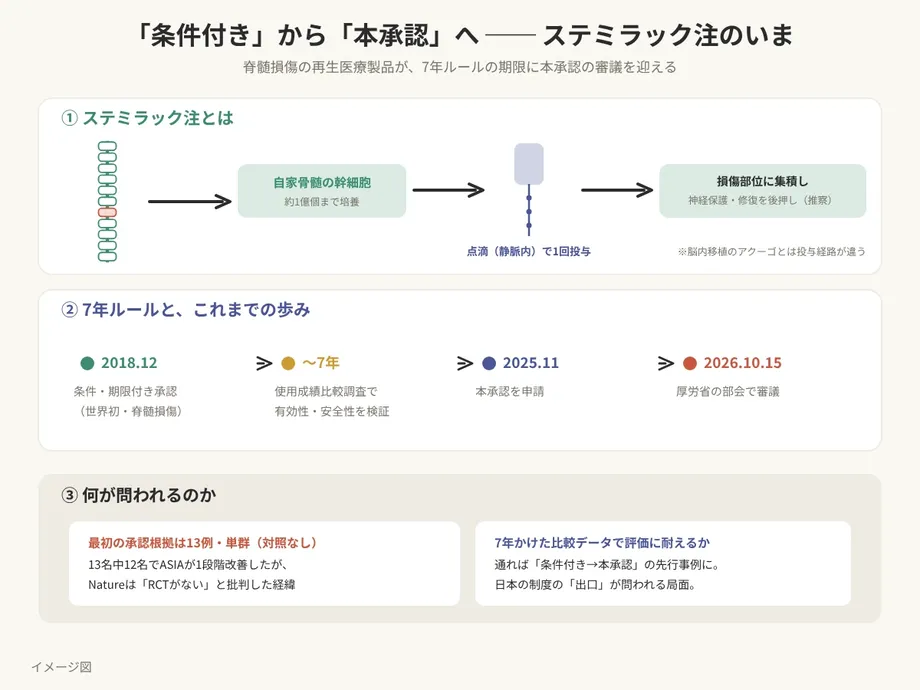
Okano has said he hopes to secure conditional approval within three to four years, ideally sooner. Japan's 2014 revision of the Pharmaceuticals and Medical Devices Act created a route for regenerative medicines to receive conditional approval for a limited period when safety and probable benefit have been demonstrated, while further evidence is collected.
Clinical development must examine whether transplanted cells form tumors, whether a dose causes harm and whether the immune system attacks the cells. Those questions continue beyond the first encouraging signs of recovery.
A Parkinson's treatment shows the gains and tradeoffs
AMCHEPRY, also known as raguneprocel, provides a closer view of what conditional access can involve. Japan approved it on March 6, 2026, for motor symptoms in Parkinson's disease that are inadequately controlled by existing medicines, including levodopa. The approval lasts seven years and requires patient tracking and a study after marketing.
Parkinson's disease involves the loss of neurons that produce dopamine, a chemical messenger needed for movement. AMCHEPRY contains cells derived from a healthy donor's iPS cells and developed toward dopamine producing neurons. Surgeons place them in the putamen, a brain region involved in controlling movement.
The Kyoto University Phase I/II trial included seven patients aged 50 to 69. All seven were assessed for safety, and six were assessed for effectiveness after 24 months. The study took place at one center, participants knew they were receiving treatment, and there was no control group. A larger comparison trial would help establish how much improvement comes from the cells.
Four of the six patients assessed for effectiveness improved on movement testing performed without their usual medication. The average improvement was 9.5 points, or 20.4%. Brain scans recorded a 44.7% average increase in dopamine production in the putamen.
Daily experience was less consistently improved. Average quality of life scores and the time patients spent with better or worse medication control showed no apparent improvement. Scores measuring involuntary movements, called dyskinesia, rose in six of seven patients.
No serious adverse events, tumors or excessive graft growth were observed during follow up. Every participant experienced at least one adverse event, with 72 mild events and one moderate event recorded. Tacrolimus, the medicine used to suppress immune rejection, was possibly linked to kidney or liver problems in three patients.
The first transplant after approval took place at Kyoto University Hospital in early October 2026. The recipient, a woman in her 50s, subsequently returned home and to work. Sumitomo Pharma projected treatment of only one or two patients in fiscal 2026, about 10 the following year and 10 to 20 in the year after that. The listed treatment price is ¥55,306,737, and national insurance coverage began in May 2026.
Key dates in the move toward clinical use
Japan's progress has unfolded through separate research programs. Early eye transplants, laboratory drug screening and recent brain treatments each contributed a different piece of the transition from experimental cells to medical products.
- 2014: Japan carried out its first transplant of retinal pigment epithelial cells derived from iPS cells, supporting the light sensing tissue of the eye.
- 2016: Keio says its researchers identified ropinirole's potential against ALS using iPS cell models.
- March 2017: A transplant of retinal pigment epithelial cells made from another person's iPS cells followed.
- 2018: Keio's spinal cord study received government approval in February, ALS laboratory findings were published, and the ropinirole trial began in December.
- June 2023: The ROPALS clinical findings were published in Cell Stem Cell.
- February 2026: The spinal cord manufacturing initiative involving K Pharma and Nikon Cell Innovation was announced.
- March and October 2026: AMCHEPRY received conditional approval, followed by its first transplant after approval.
- 2027: K Pharma aims to begin its company sponsored spinal cord trial.
Other programs are pursuing replacement cells for heart disease, diabetes, eye disorders and cancer treatment. Cynata's Phase 3 osteoarthritis trial plans to enroll up to 440 patients. Matricelf plans a first trial in humans in 2027 involving personalized neural tissue for spinal cord injury.
Psychiatric research tests another use for patient cells
Okano's team is also using neurons derived from people with schizophrenia to study electrical activity and cell structure. Its collaboration with Switzerland's MaxWell Biosystems uses advanced measurement technology to examine how these neurons behave.
Schizophrenia presents a particular difficulty for laboratory research because experiences such as hallucinations and delusions are usually understood through what a person says. Patient derived neurons give scientists a way to investigate cellular changes associated with the illness.
Okano described the treatment question his team hopes to pursue:
If we can identify the electrical abnormalities in these neurons and test whether drugs correct them, we may be able to move directly toward clinical application without relying on animal models.
He hopes such approaches could shorten some drug development work from the current 10 to 20 years to a year or two. The schizophrenia project remains focused on understanding cellular abnormalities and testing whether medicines correct them.
ALS, spinal cord injury and Parkinson's disease show why the next steps vary. Ropinirole needs further clinical testing. Spinal cord transplants need additional trials supported by reliable manufacturing. AMCHEPRY requires continued patient monitoring and evidence collection under its conditional approval. For patients, access depends on those practical steps as much as on the initial discovery.
The Essentials
- Keio's early ALS trial suggested ropinirole could delay progression by 27.9 weeks during a trial lasting one year; larger trials are needed.
- Drug responses in motor neurons made from participants' iPS cells correlated with their clinical responses.
- Two of four participants improved in Keio's spinal cord study, and K Pharma aims to begin a company sponsored trial by 2027.
- Japan conditionally approved AMCHEPRY for Parkinson's disease in March 2026, with seven years of approval and further evidence collection required.
- The Parkinson's trial recorded improved movement in some patients, alongside increased dyskinesia and no average improvement in quality of life.
- Manufacturing, safety monitoring, cost and specialist hospital capacity will shape how quickly these treatments reach patients.