137 Firecracker Fires in One Day Prompt Citywide Restrictions
Mumbai has banned rockets and other aerial firecrackers across public and private premises until 11.59 pm on November 25, 2026, after the city recorded 137 fires attributed to firecrackers on Diwali night. The restriction took effect on November 9 and covers the entire area administered by the Brihanmumbai Municipal Corporation (BMC), including terraces, balconies, courtyards, parking areas and slum settlements.
Contents
- 137 Firecracker Fires in One Day Prompt Citywide Restrictions
- What the Ban Covers
- Three Major Fires Burned Through the Night
- How the Emergency Unfolded
- Deaths, Injuries and Rescues Across Separate Incidents
- Thane Extends Restrictions Into January
- Rail Disruption Adds to the Damage
- Who Will Enforce the Order?
- What Changes for Mumbai Residents?
- Key Points
BMC figures show that the Mumbai Fire Brigade received 142 fire calls on November 8. Firecrackers accounted for about 96.5% of those calls, leaving just five attributed to other causes. Three major blazes in Dongri, Andheri and Vidyavihar damaged homes, shops, a garage and commercial premises, keeping firefighters at work into the following morning.
The Urban Disaster Management Authority, Brihanmumbai, issued the preventive order under the Disaster Management Act, 2005. Additional municipal commissioner Prajakta Lavangare-Verma signed it while acting as chairperson of the authority. Officials were directed to enforce the restriction and publicise its scope.
Neighbouring Thane district imposed a longer ban, lasting until January 8, 2027. Together, the Mumbai and Thane district orders cover seven of the Mumbai Metropolitan Region's nine municipal corporations.
No casualties were reported in the three major fires described in Dongri, Andheri and Vidyavihar. Other incidents during the festival period included a fatal fire in Andheri, injuries and the rescue of 50 residents from a building in Thane. The wider emergency also reached the railway network, where damaged signalling cables disrupted commuter services.
What the Ban Covers
Mumbai's order prohibits the use of rockets and similar firecrackers that fly into the air. It applies throughout BMC limits, whether the launch site is a public space or private property. Residential compounds, building rooftops, balconies, courtyards and parking lots all fall within its reach.
BMC identified a particular danger from burning rockets and fragments landing on roofs, entering windows or falling onto combustible material. Mumbai's closely packed buildings, narrow roads and dense settlements allow a fire started at one property to threaten people nearby.
Other types of firecrackers remain governed by existing laws, directions from competent authorities and court orders. Residents therefore still need to follow restrictions that apply beyond the temporary ban on aerial fireworks.
The Bombay High Court has also imposed a year round prohibition on bursting firecrackers on public roads, lanes and footpaths across Maharashtra. Mumbai's new order reaches into private premises as well, addressing the risk created when a rocket launched from a compound or terrace travels towards another building.
Three Major Fires Burned Through the Night
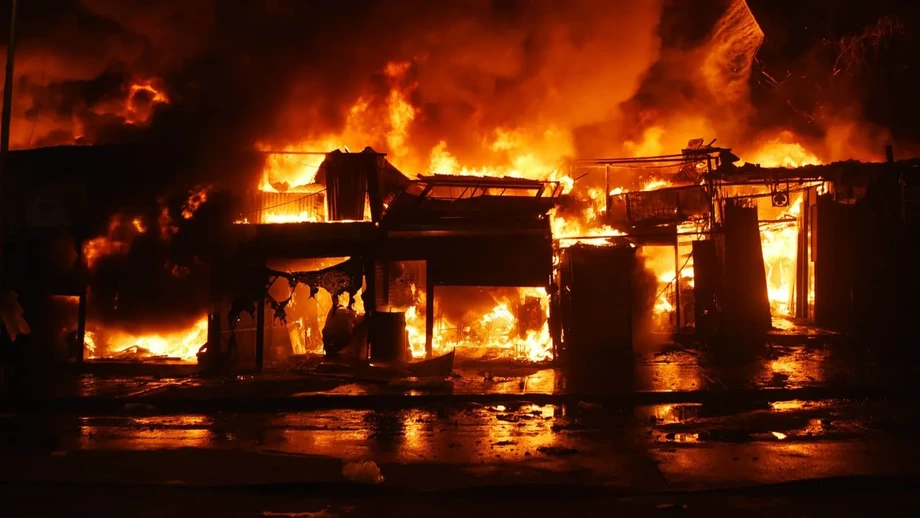
Dongri's Haji Kasam Chawl was among the hardest hit locations. A fire broke out at about 10 pm on November 8, damaging huts, shops and other premises. Firefighters initially classified it as Level I before upgrading it to Level II, a higher operational category used to mobilise a larger response. Operations continued until 7.23 am on November 9, more than nine hours after the alarm.
Andheri's Marol Military Road saw a second major fire at a garage at 10.51 pm. That Level II blaze was extinguished at 3.50 am, after nearly five hours.
Vidyavihar's commercial building fire began at 11.56 pm near Jolly Gymkhana. The building was identified as Skyline Vida in the initial incident details and as Skyline Epitome in another description. Fire spread from the seventh to the 10th floor of the building, with firefighting continuing until 5.55 am.
Local BJP legislator Parag Shah said offices in the Vidyavihar building were closed and that a police patrol suspected a firecracker from outside had started the blaze. Architect Manoj Daisaria's office was among the premises damaged.
Dongri legislator Amin Patel, of Congress, alleged that the first fire engine took 45 minutes to arrive despite nearby fire stations, and claimed that 500 industrial units were gutted. Those figures were his account of the damage and response, rather than a fire brigade assessment.
How the Emergency Unfolded
The fires overlapped across several parts of Mumbai, forcing crews to handle multiple prolonged operations at once. The sequence continued from Diwali evening through the next morning, when authorities introduced the restrictions.
- November 7: A fire at Runwal Tower in Andheri left a lift operator trapped in a passenger lift.
- November 8, about 10 pm: Fire broke out at Haji Kasam Chawl in Dongri.
- November 8, 10.51 pm: A garage fire was reported on Marol Military Road in Andheri.
- November 8, 11.56 pm: Fire began at the commercial building near Jolly Gymkhana in Vidyavihar.
- November 9, 3.50 am to 7.23 am: Firefighters completed operations at the three major incident sites.
- November 9: Mumbai's ban on rockets and aerial firecrackers took effect.
- November 25, 11.59 pm: Mumbai's order is scheduled to expire.
- January 8, 2027: The longer restriction in Thane district is scheduled to end.
Mumbai chief fire officer Ravindra Ambulgekar described the pressure on his department as calls increased, particularly after 8 pm.
We had deployed maximum staff, but were still finding it difficult to handle the situation. The calls kept increasing, particularly after 8 pm.
Ambulgekar said personnel had to be moved between regions according to demand. Mumbai also sent three specialist appliances for operations at tall buildings to assist firefighters in Thane, extending the response beyond the city's own incidents.
Deaths, Injuries and Rescues Across Separate Incidents
Andheri lift operator Dhanpat Mahatu, 46, died after becoming trapped in a passenger lift during the Runwal Tower fire late on November 7. Smoke from a flat on the 17th floor spread through the building of 27 storeys. Mahatu was declared dead at Cooper Hospital.
At the Hans Vallabh building in Andheri, smoke from a flat on the seventh floor caused breathing difficulties for Mahesh Mistree, 64. He was reported stable at Babasaheb Gawde Charitable Hospital in Vile Parle.
Two women were also reported injured during the November 8 firecracker emergencies. In Kurla, two firefighters suffered injuries while tackling a blaze at a warehouse in Sunrise Estate. Officials had not established the exact causes of all the individual fires, including the Andheri incidents.
Thane firefighters rescued 50 residents from a Raheja Garden building of 17 storeys during an overnight operation. Maharashtra deputy chief minister Eknath Shinde oversaw the response and directed that assistance be sent from Mumbai.
The incidents exposed several routes by which a fire could threaten residents: flames entering a flat, smoke spreading beyond the room where a fire began, and people becoming trapped above ground level. The death in the lift and the mass rescue in Thane show why the emergency extended beyond the damage visible on building exteriors.
Thane Extends Restrictions Into January
Thane district collector Shrikrishna Panchal, who chairs the district disaster management authority, issued the district's ban following directions from Shinde. It covers Thane, Navi Mumbai, Kalyan-Dombivli, Bhiwandi, Mira-Bhayandar and Ulhasnagar.
Navi Mumbai municipal commissioner Kailas Shinde also announced restrictions on flying firecrackers until January 8, 2027. The January expiry keeps those restrictions in place through the end of December, while Mumbai's order is scheduled to finish in November.
Mumbai and the six corporations in Thane district account for seven of the region's nine municipal corporations. Vasai-Virar and Panvel are outside the coverage of those two orders.
Fire departments elsewhere in the region recorded heavy demand. Navi Mumbai reported 62 fires over two days of Diwali, with no deaths or injuries. Vashi recorded 18 complaints and Nerul 14. Kalyan-Dombivli recorded 70 fire incidents, of which 68 were linked to firecrackers, roughly 97%.
Kalyan-Dombivli fire officials described rockets landing on balconies containing clothes, paper and other combustible material, as well as on rubbish. Across the metropolitan region, the reported number of firecracker accidents approached 390. Local figures covered different periods, including two days in Navi Mumbai and three days in Mira-Bhayandar.
Rail Disruption Adds to the Damage
Western Railway services were disrupted after a fire damaged signalling cables between Virar and Nallasopara late on November 8. Firecrackers were suspected of triggering the blaze, which affected seven signals.
Fourteen services were delayed on Sunday. On Monday, 35 services were cancelled and 150 delayed while railway workers restored the signalling system and laid additional cables.
Railway signals help keep trains separated and guide their movement. Damage to the cables supporting them can slow services across a busy route, carrying the effects of a fire far beyond the place where it started.
Residential buildings faced their own disruptions. At Hiranandani Gardens in Powai, a rocket landed in the bathroom duct of a flat on the 20th floor. A family member spotted it and alerted neighbours. A resident said police arrived but the fire brigade was occupied with other emergencies, leaving the complex's security personnel to extinguish the fire.
Actor Gurfateh Pirzada also described damage to his Mumbai home after firecrackers burned his balcony and part of a room. At Rustomjee Oriana in Bandra East, a fire prompted the housing society's secretary to advise residents against using aerial fireworks on nearby roads.
Who Will Enforce the Order?
Zonal deputy commissioners of police, BMC ward assistant commissioners and the chief fire officer have been instructed to implement Mumbai's ban. The civic body's public relations officer was also directed to give the order wide publicity.
BMC invoked the Disaster Management Act, 2005, citing provisions including Sections 26(2), 30, 34(M) and 41(A). The Act gives disaster management bodies powers to direct preventive action and coordinate public authorities. Officials warned that violations could lead to prosecution, imprisonment and fines.
Mumbai mayor Ritu Tawde urged residents to celebrate responsibly, avoid bursting firecrackers on footpaths or in public places, and keep them away from residential buildings and occupied structures. She warned that rockets could enter homes, damage property and endanger lives.
Shiv Sena (UBT) leader Aaditya Thackeray, a former Maharashtra environment minister, called for police action where rockets and aerial firecrackers entered homes and caused fires.
The police and administration must certainly take official action in such cases. An explanation is needed.
Thane's restrictions also drew questions about implementation. Anti noise campaigner Mahesh Bedekar asked whether the order would be enforced, while traders expressed confusion about its scope. Mumbai's written direction explicitly includes private compounds, terraces and parking areas, giving enforcement teams a broad area of responsibility.
What Changes for Mumbai Residents?
Residents within BMC limits must stop using rockets and similar aerial firecrackers for the duration of the order, including from their own homes or housing society grounds. Moving a launch from a public road to a private terrace still places it within the ban.
Housing societies and commercial property managers face the same restriction in courtyards, parking lots and other shared spaces. BMC's stated concern is the burning material that can travel from a launch site to somebody else's window, roof or balcony.
Mumbai's 137 firecracker fires out of 142 calls explain the urgency of the targeted restriction. Kalyan-Dombivli's comparable figure, 68 out of 70, shows that neighbouring fire services faced a similar pattern. The orders focus on airborne fireworks because those devices can carry a source of ignition across property boundaries and into places residents may struggle to reach.
The next fixed dates are the expiry of Mumbai's order late on November 25 and the end of Thane district's longer restriction on January 8. Until then, police, municipal ward teams and fire officials have been directed to turn the prohibition into action across public and private spaces.
Key Points
- Mumbai banned rockets and aerial firecrackers from November 9 until 11.59 pm on November 25, 2026.
- The restriction covers all premises within BMC limits, including private terraces, balconies, courtyards and parking areas.
- Firecrackers were blamed for 137 of Mumbai's 142 fire calls on November 8.
- Three major fires in Dongri, Andheri and Vidyavihar required hours of firefighting; no casualties were reported in those three incidents.
- Separate fires included a lift operator's death in Andheri and the rescue of 50 residents in Thane.
- Thane district's restriction covers six municipal corporations and runs until January 8, 2027.
- A suspected firecracker blaze damaged railway signalling cables, followed by 35 service cancellations and 150 delays on Monday.
- Other firecrackers remain subject to existing laws, official directions and court orders.