A new collar opens a window into the Southern Altai
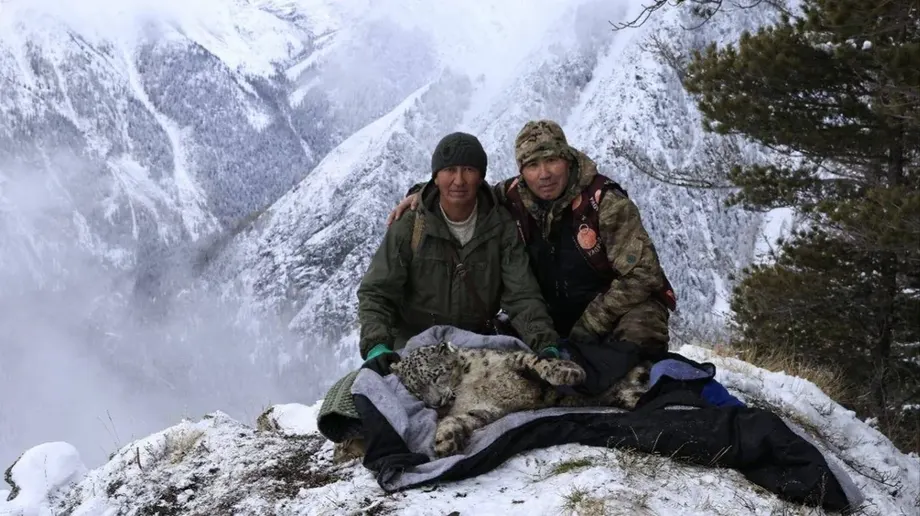
Kazakhstan now has an estimated 190 to 200 snow leopards, according to the Forestry and Wildlife Committee of the Ministry of Ecology and Natural Resources. The recovery comes with a new opportunity to understand where these rare predators travel: on October 19, scientists fitted a snow leopard named Altai with a satellite collar in Katon-Karagai State National Nature Park, the first such operation in Kazakhstan's Southern Altai.
Contents
- A new collar opens a window into the Southern Altai
- What researchers hope to learn from Altai
- How the population estimates fit together
- Cameras identify individual cats
- DNA adds evidence beyond the camera lens
- Following routes across national borders
- Turning movement maps into protected land
- Why roads and railways entered the discussion
- The milestones behind the recovery
- Key Points
The animal lives in East Kazakhstan Region, near the edge of the species' known range in the country. His collar will help researchers map travel routes and identify his home range, the territory he uses to find food, shelter and mates. Researchers had already obtained rare camera footage of a snow leopard family in the park in August.
The national population has more than doubled from the committee's estimate of 80 to 90 animals in the 1990s. The United Nations Development Programme (UNDP) gives a slightly different historical baseline, estimating 80 to 100 animals by 1995. Both place the recovery against a period when snow leopards had disappeared from several former habitats.
Altai is the latest of 16 snow leopards fitted with satellite collars in Kazakhstan since 2021. Another animal, collared in Ile-Alatau State National Nature Park in February, remains under monitoring. Together, these projects are moving conservation beyond occasional sightings toward a more detailed picture of how the cats use mountain landscapes.
What researchers hope to learn from Altai
Katon-Karagai belongs to a transboundary reserve, and its snow leopards form part of a population that crosses national borders. Following Altai could help identify the places that connect protected mountain habitats, including routes that are difficult to discover through cameras alone.
Park employees E. Kassymov and Zh. Amanbayev took part in the collaring operation alongside Institute of Zoology researchers A. Grachev, M. Bespalov, S. Bespalov and S. Saparbayev. Pernod Ricard Kazakhstan supports the project.
Satellite tracking sends location information from a device attached to an animal. Repeated positions allow researchers to build a map of its movements without following it on foot through remote terrain. For a solitary predator that may roam across hundreds of square kilometers, this provides a much broader view than a single observation.
The Southern Altai has long been considered a peripheral part of Kazakhstan's snow leopard range, with evidence accumulating largely through camera traps. No movement results from Altai's collar have yet been announced. The immediate task is to collect the information needed to describe his territory and identify areas that matter for protection.
How the population estimates fit together
UNDP's October 2024 conservation assessment estimated Kazakhstan's snow leopard population at 152 to 189. It attributed the increase over the preceding decade to habitat restoration, stronger wildlife protection, better equipment and improved research.
A United Nations publication issued in May 2026 also cited the 152 to 189 estimate for 2024, alongside an estimate of 130 animals in 2019. The Forestry and Wildlife Committee's latest figure of 190 to 200 extends that recorded recovery. At the Convention on Biological Diversity's COP17 summit in Yerevan on October 16, President Kassym-Jomart Tokayev put the population at about 190.
Snow leopard totals are estimates because researchers cannot gather every animal in one place or observe every mountain valley continuously. They combine evidence from photographs, field surveys and other monitoring methods. Better coverage also helps reveal animals in areas that previously received little attention.
Kazakhstan developed a snow leopard conservation strategy in 2011 and later national action plans. UNDP and the Institute of Zoology introduced an annual population reporting system in 2019, giving conservation agencies a more regular basis for tracking changes.
Cameras identify individual cats
UNDP and the Global Environment Facility worked with Kazakhstan's government on a forest ecosystem and biodiversity project from 2018 to 2024. The project installed 294 camera traps across 14 pilot protected areas and eight forestry enterprises, and supplied 28 thermal imagers for wildlife monitoring.
Camera traps automatically photograph or film animals passing a fixed point. Scientists compare the distinctive patterns of spots on snow leopards to identify individuals. A cat photographed several times can then be counted once, while repeated sightings help show where it travels.
The equipment has documented important changes in distribution. Cameras recorded a snow leopard in Merke Forestry in Zhambyl Region in 2019. Researchers discovered a breeding group in Altyn-Emel National Park in 2021, and cameras in Merke also recorded a family of three that year.
UNDP says snow leopards had previously been wiped out in the area that became Altyn-Emel National Park. The creation of the protected area, recovery of habitats and increase in prey allowed them to return. Finding animals raising young gave conservationists evidence that the park was supporting reproduction as well as visits by individual cats.
DNA adds evidence beyond the camera lens
Researchers can also identify snow leopards through DNA recovered from hair or scat. DNA carries biological information that can help distinguish animals, determine sex and investigate family relationships. This is useful when a cat leaves traces but never appears in a usable photograph.
A 2011 study in Nepal tested 71 scat samples suspected to come from snow leopards. Researchers confirmed snow leopard DNA in 19 samples, and 10 produced enough genetic information to identify nine individuals: three males and six females.
Two samples collected about four kilometers apart came from the same animal. Matching them allowed researchers to avoid counting that cat twice. Some other samples came from different carnivores, while others contained DNA too degraded for detailed analysis. Careful collection and storage therefore matter as much as finding the samples.
Genetics also helps explain the species' longer history. A 2025 study by Stanford University researchers and collaborators, including the Snow Leopard Trust, increased the number of sequenced snow leopard genomes from four to 41. The researchers found very low genetic diversity and suggested that populations had remained small for at least 900,000 years. Limited genetic variety can make adaptation to environmental change more difficult.
Following routes across national borders
Kazakhstan first used satellite telemetry for snow leopards in November 2021, when an animal in Altyn-Emel received navigation equipment. By the end of 2023, researchers had fitted 11 animals with tracking devices in the Northern and Central Tian Shan. The national total has since reached 16.
Tracking identified routes into China and Kyrgyzstan. Those movements give conservation agencies a practical reason to cooperate: an animal protected inside one park may spend another part of its life in a different country.
In 2024, four protected areas in Kazakhstan and Kyrgyzstan signed a memorandum covering five years of cooperation. The participants are Kazakhstan's Kolsai Kolderi State National Park, Almaty State Nature Reserve and Ile-Alatau State National Nature Park, and Kyrgyzstan's Chon Kemin State Natural Park. Their agreement coordinates research and protection of snow leopards and shared habitats in the Northern Tian Shan.
Kazakhstan's main snow leopard mountain systems continue into neighboring countries, including China, Kyrgyzstan, Russia and Uzbekistan. The Southern Altai collaring project adds a new region to an effort that had previously concentrated on the Tian Shan.
Turning movement maps into protected land
Snow leopards now live in nine specially protected natural areas in Kazakhstan, according to the Forestry and Wildlife Committee. UNDP's October 2024 assessment listed eight areas providing protection at that time. The committee says about 70% of the species' national range lies within protected territory.
UNDP measured a related share in 2024: it estimated that 104 to 135 snow leopards, about 70% of the national population, lived within protected areas. Together, the figures show why park management matters while also leaving a substantial conservation task beyond park boundaries.
Officials say satellite information helps define and justify protected area boundaries. Several territories have already been expanded, and further development of the network is planned. Movement maps can reveal that an animal regularly uses land just outside a boundary or travels through a narrow connection between larger habitats.
UNDP completed scientific and feasibility studies for six proposed protected areas covering more than 1.6 million hectares, as well as expansion studies for three existing areas covering more than 214,000 hectares. These studies form the planning basis for possible additions to the protected network.
Merke illustrates how a wildlife record can influence land protection. The discovery of snow leopards in Zhambyl Region helped justify plans for a regional nature park there. Habitat protection also needs to maintain the wild prey on which the cats depend, alongside preventing poaching and limiting damaging human activity.
Why roads and railways entered the discussion
At a COP17 side event in Yerevan, Forestry and Wildlife Committee Chairman Daniyar Turgambayev presented Kazakhstan's satellite tracking experience and discussed using movement data to reduce the effects of linear infrastructure on wildlife. This term covers long structures such as roads, railways and pipelines that cut across animal habitats.
Kazakhstan proposed considering animal movement information at the earliest stages of infrastructure planning, including environmental impact assessments. These assessments examine how a proposed project could affect nature before decisions are made. Knowing where animals travel gives planners a chance to account for those routes when choosing locations and designs.
The discussion also drew on Kazakhstan's work with saiga antelope. A spring 2026 aerial survey put their population above 4.6 million. Specialists have used satellite transmitters on saiga since 2009 and fitted about 50 animals in the Ustyurt population with GPS ear tags over the past two years.
Saiga tracking shows how migration routes interact with roads, railways, pipelines and other structures. Kazakhstan called for wider access to animal movement data and stronger international and regional cooperation, bringing the needs of both mountain predators and migrating antelope into the same planning debate.
The milestones behind the recovery
Kazakhstan's progress has developed through years of protection, equipment investment and cooperation. The latest collaring operation is one stage in a sequence that links population monitoring with decisions about land and infrastructure.
- 1995: UNDP estimates that only 80 to 100 snow leopards remained in Kazakhstan.
- 2018 to 2024: A UNDP and Global Environment Facility project strengthens monitoring and habitat conservation with Kazakhstan's government.
- 2019: Researchers introduce annual population reporting and record snow leopards in Merke Forestry.
- November 2021: Kazakhstan begins satellite tracking of snow leopards in Altyn-Emel National Park.
- 2024: UNDP estimates 152 to 189 animals, and four protected areas in Kazakhstan and Kyrgyzstan agree to cooperate for five years.
- October 16, 2026: Tokayev cites a population of about 190 at COP17 in Yerevan.
- October 19, 2026: Researchers fit Altai with the first satellite collar used on a snow leopard in Kazakhstan's Southern Altai.
International Snow Leopard Day falls on October 23, marking the adoption of the Bishkek Declaration in 2013. Representatives of all 12 countries where snow leopards live signed the declaration: Afghanistan, Bhutan, China, India, Kazakhstan, Kyrgyzstan, Mongolia, Nepal, Pakistan, Russia, Tajikistan and Uzbekistan.
The species remains listed in Kazakhstan's Red Book of endangered species and is classified as vulnerable by the International Union for Conservation of Nature. International trade is regulated under the Convention on International Trade in Endangered Species of Wild Fauna and Flora.
Poaching, declining prey, habitat loss and climate change continue to threaten snow leopards. Kazakhstan's larger population means more animals to protect, while the expanding monitoring network gives agencies better information about where that protection is needed.
Key Points
- Kazakhstan estimates its snow leopard population at 190 to 200, more than double the Forestry and Wildlife Committee's estimate for the 1990s.
- Altai received a satellite collar on October 19 in Katon-Karagai, the first snow leopard tracked this way in Kazakhstan's Southern Altai.
- Researchers have fitted 16 snow leopards with satellite collars nationally since 2021.
- A UNDP project installed 294 camera traps, helping identify individual animals and document breeding.
- Tracking has mapped routes into China and Kyrgyzstan, supporting cooperation across national borders.
- Kazakhstan wants animal movement data considered early in road, railway and other infrastructure planning.