A festive payout of more than Rs 20 lakh
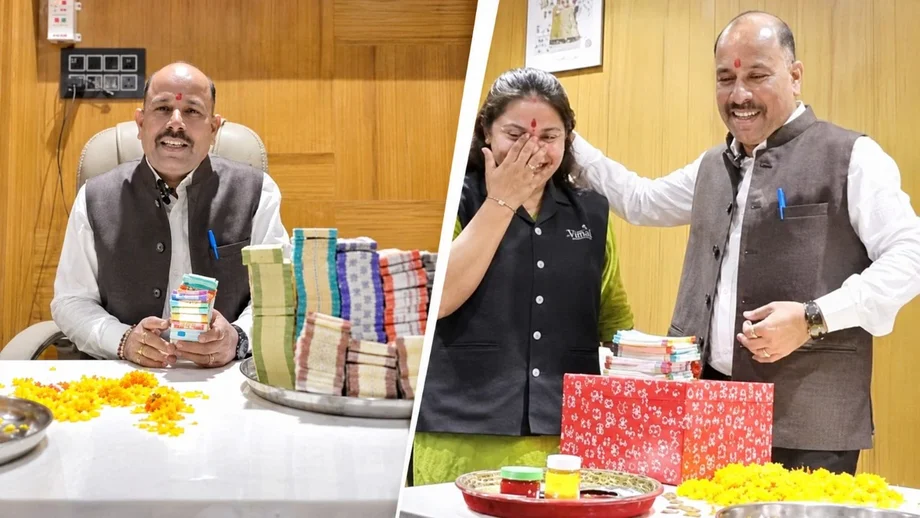
Twenty women working at Mahadev Cloth Center in Surat's Mota Varachha area received more than Rs 1 lakh each as a Diwali bonus from textile trader Ramswaroop Munde. The cash gifts together exceeded Rs 20 lakh, with bundles of fresh currency notes arranged on silver coloured puja trays and handed to employees by his wife.
Contents
The distribution at the business in Sudama Chowk left several employees emotional. A video circulating on social media showed surprise turning to smiles and tears, with at least one woman crying as she received her bonus. Munde's family members were present for the occasion.
For employee Rekhaben Bhalada, the money offered help with something beyond festive shopping: buying a home. She said the unexpected payment came when she needed financial support to move closer to that goal.
Munde linked the gifts to his childhood experience of poverty, his appreciation of the employees' work and a Rajasthani family tradition called mamera. He said all his employees were women and described the presentation as his version of the gifts a maternal uncle gives to women in his family.
What each employee received
Munde arranged bundles of Rs 10, Rs 20, Rs 50, Rs 100, Rs 200 and Rs 500 notes on the trays. The mix of denominations made the presentation especially striking: employees received stacks of currency rather than a cheque, an envelope or a notification of a bank transfer.
Each payment was described as more than Rs 1 lakh. In India's numbering system, one lakh means 100,000 rupees, so the payout to 20 employees exceeded Rs 2 million. The exact amount above that threshold and the date of the distribution were not disclosed.
The silver coloured trays were puja thalis, plates used to hold items during worship and other ceremonial occasions. Here, they gave the cash distribution a festive form. Munde's wife presented the bonuses to employees individually, bringing his family directly into the occasion.
The total follows from the individual payments: 20 employees receiving more than Rs 100,000 each means a distribution of more than Rs 2,000,000. For each recipient, the reward was money she could allocate according to her own household's priorities.
A childhood in poverty shaped the decision
Munde said his upbringing helped him understand the pressure families face when festival expenses arrive. He wanted employees to have enough money to buy what their families needed and celebrate Diwali without financial worry.
The trader, who has worked in textiles for several years, connected his business's success to the effort of his employees throughout the year. He described the payment as a way to recognise their work and dedication, rather than simply another expense associated with the festival.
Munde, the operator of Mahadev Cloth Center, explained his relationship with the staff in these words, translated from Gujarati:
These people are not just employees working at my shop, but my family.
His explanation joined two practical concerns: the work that keeps the shop running and the money employees need at home. He wanted the benefits of the business to reach the families of the people whose labour helped sustain it.
Why he called the gift mamera
Munde said the fact that all 20 employees were women shaped the way he presented their bonuses. He described the gifts as mamera, a Rajasthani custom associated with a woman's maternal family.
Under that tradition, a maternal uncle gives money and other presents to women in the family, particularly at important occasions such as weddings. Munde borrowed that family role for the Diwali distribution, saying he was giving mamera to each employee.
The custom helps explain why the presentation involved ceremonial trays and his wife's participation. Munde framed the event as both a reward for work and an expression of family affection, with the money presented personally rather than through an ordinary payment process.
Munde also acknowledged that he sometimes loses his temper at work, while saying he has always wished his employees well. He told the women that he would stand by them. Those remarks formed part of his explanation of the personal bond he wanted the gifts to convey.
One employee saw help toward a home
Rekhaben Bhalada said she had never imagined receiving such a bonus. She needed money to fulfil her ambition of owning a home and said the payment would be useful toward purchasing a new house.
Her response gives a concrete example of what the payout could change. Munde spoke about making festive purchases easier, while Bhalada described using the support for a much larger household goal.
A cash gift leaves that decision with the recipient. An employee can use it for immediate purchases, set it aside or put it toward an existing financial goal. In Bhalada's case, she identified housing as the priority; other employees' spending plans were not described.
The reactions during the distribution were emotional as well as practical. Several women appeared moved by the unexpected amount, and one cried while receiving it. Bhalada's account adds a specific financial purpose to the smiles and tears visible in the video.
The video brought attention to the shop
The footage was circulating publicly by November 7, 2026, when a social media post featured the distribution. It showed the neatly arranged currency and the employees receiving their gifts, drawing attention to the scale and presentation of the bonuses.
Viewers praised Munde for recognising his staff's contribution and sharing money with them before Diwali. Some jokingly asked for the shop's address or said they would like to work there. Instagram and Facebook were among the platforms where the video was shared.
The shop joined other workplaces attracting attention for festive gifts. In Delhi's Rohini area, a company gave employees iPhone 16 smartphones, placing phones tied with ribbons on their desks. Munde's choice was different: cash that employees could use according to their own needs.
The strongest personal detail in the Surat episode came from Bhalada. While the trays of notes drew viewers to the video, her plan to put the money toward a home showed how a festive payment could support a goal extending well beyond the holiday.
A small workforce in a major textile centre
Mahadev Cloth Center operates in a city where textiles support a vast network of businesses and jobs. Surat is estimated to produce roughly 65% of India's man made textiles, with annual textile trade valued at about Rs 70,000 crore to Rs 80,000 crore.
Man made textiles are fabrics produced using manufactured fibres rather than only natural fibres such as cotton. Surat's textile businesses handle products ranging from saris and dress materials to fabrics designed for technical uses.
Munde's distribution brought attention to 20 workers within that much larger commercial economy. His stated reasoning was specific to his shop: employees had helped the business grow, and he wanted their households to share in its success during Diwali.
Key Points
- Ramswaroop Munde gave 20 women employees more than Rs 1 lakh each, taking the total above Rs 20 lakh.
- The bonuses were distributed at Mahadev Cloth Center in Sudama Chowk, in Surat's Mota Varachha area.
- His wife handed employees silver coloured puja trays holding bundles of notes ranging from Rs 10 to Rs 500.
- Munde linked the gifts to his childhood poverty, the employees' contribution and the Rajasthani custom of mamera.
- Employee Rekhaben Bhalada said the unexpected payment would help her work toward buying a home.
- A video of the distribution circulating by November 7, 2026, drew praise on social media.