Fewer Shipments, Higher Costs and Millions of Livelihoods
Thailand expects to export 6.5 million tonnes of rice in 2026, below the Department of Foreign Trade's target of 7 million tonnes, as weak farm productivity, expensive shipments and competition from India put pressure on its most important agricultural industry.
Contents
- Fewer Shipments, Higher Costs and Millions of Livelihoods
- How the Export Slowdown Developed
- Why Thai Farms Produce Less Rice per Hectare
- A Small Trial With an Ambitious Yield Goal
- Why Higher Prices Are Not Lifting Total Export Earnings
- ASEAN Buyers Help Replace Lost Orders
- Iraq, Indonesia and China Present Different Problems
- Jasmine Rice Faces Competition From Cambodia
- Harvest Support Targets Cash Flow and Fair Buying
- Reform Must Reach Beyond the Farm
- Key Points
Department director general Arada Fuangtong gave the revised forecast on October 30. Thailand exported 4.99 million tonnes from January through September, down 19.26% from the same period a year earlier. Export earnings fell 16.84% to about $2.962 billion, or 94.9 billion baht.
The response reaches beyond finding more foreign buyers. Commerce permanent secretary Poonpong Naiyanapakorn is coordinating work with the Bureau of the Budget, Agriculture and Cooperatives Ministry and Industry Ministry on a food security strategy that uses rice as a pilot commodity. It would connect research, cultivation, milling, processing and sales, with farmer income at the centre.
Three figures explain the challenge. Thailand's average yield in the ministry's comparison is 456 kilograms per rai, less than half Vietnam's 979 kilograms. Thai white rice carried a price premium of about 21% over Indian rice in October. More than 4.6 million farming households depend on the crop.
Rice growers therefore face a difficult balance: higher selling prices can help their earnings, while expensive exports encourage foreign customers to buy elsewhere. The reform effort aims to improve what farmers keep after paying for fertiliser, labour, energy and machinery, while giving buyers reasons to keep choosing Thai rice.
How the Export Slowdown Developed
The Commerce Ministry's rice export statement recorded shipments of 3.28 million tonnes in January through June 2026, down 18.81%. Earnings fell 20.51% to more than $1.911 billion. It identified abundant global supplies and disrupted trade with Iraq as major pressures.
Thailand entered this slowdown after a strong 2024, when exports reached 10 million tonnes worth $6.5 billion. India's restrictions on rice exports had opened opportunities for other suppliers. India's return to international markets brought more rice into competition with Thai shipments.
The main developments span several years:
- 2024: Thai rice exports reached 10 million tonnes, up 13.9%, according to Krungsri Research.
- January through November 2025: Exports fell 21% to 7.3 million tonnes.
- March 2026: Shipments to Iraq were disrupted by conflict in the Middle East, according to the Commerce Ministry.
- August 2–6, 2026: The ministry scheduled a trade mission to the Philippines and Malaysia; officials subsequently confirmed visits during August.
- October 30, 2026: Arada put expected annual exports at 6.5 million tonnes.
- November 18, 2026: The Thai Rice Exporters Association plans talks with visiting rice buyers from Hong Kong.
Krungsri Research's rice industry outlook gives a more optimistic forecast range of 7.6 million to 8.1 million tonnes annually for 2026–2028. The department's October assessment points to a weaker immediate export outlook.
For January through September 2026, the department's figure is 4.99 million tonnes; Wanniwat Kitirienglap, deputy secretary general of the exporters association, cited 5.5 million tonnes for that period. The department's figure underpins its latest assessment of the shortfall.
Why Thai Farms Produce Less Rice per Hectare
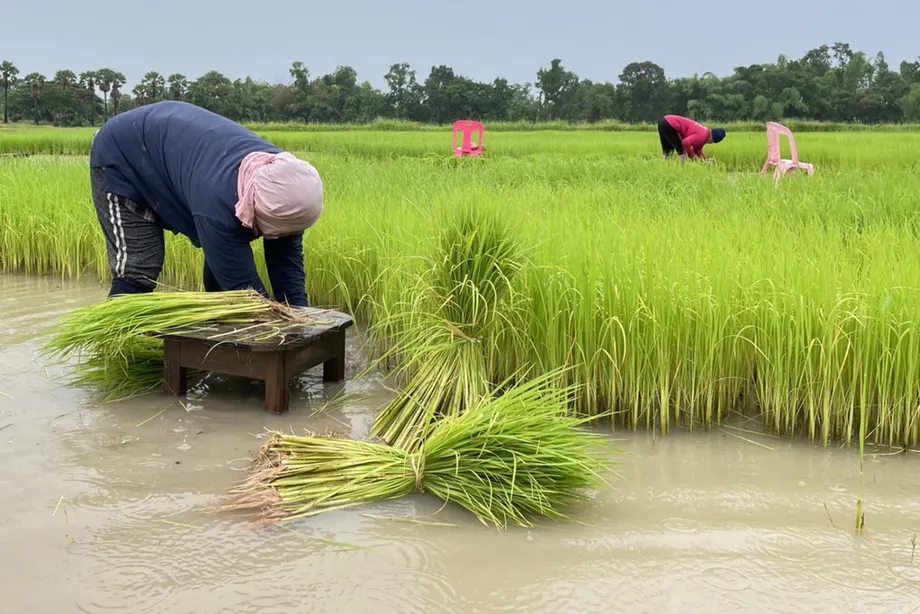
Thailand's yield disadvantage starts in the field. The ministry's comparison puts output at 2.85 tonnes per hectare, against 7.16 tonnes in China, 6.12 tonnes in Vietnam and 4.40 tonnes in India. A hectare contains 6.25 rai, the land measure commonly used in Thailand.
Vietnam produces roughly 2.1 times as much rice from the same area, while China produces about 2.5 times as much. Cambodia, at 578 kilograms per rai, and Pakistan, at 598 kilograms, also exceed Thailand's 456 kilograms in the ministry's comparison.
Farmers spreading cultivation expenses over a smaller harvest face higher costs for each tonne produced. Rice varieties, irrigation and growing conditions help explain the gap. Krungsri gives a different dated benchmark, recording Thailand's average yield at 476.2 kilograms per rai in 2024.
Thailand's reliance on rainfall makes water management especially important. Krungsri estimates that about 80% of national output comes from the main growing season. The remaining 20% comes from cultivation during the dry season, which depends on irrigation and is concentrated in central and northern areas.
A Small Trial With an Ambitious Yield Goal
The Agriculture and Cooperatives Ministry's proposed rice Sandbox covers about 100 rai, or 16 hectares. It will use the RD113 and RD85 varieties alongside precision farming, water management and cultivation methods intended to reduce carbon emissions.
Officials describe potential yields of 1.4 to 1.5 tonnes per rai under suitable growing conditions. Against the ministry's national average of 456 kilograms, that would be roughly three times as much rice from the same area. The figures are a stated potential for the trial, whose practical value will depend on growing conditions, expenses and farmer earnings.
Precision farming means using information about crops, soil and water to decide more accurately when and where to apply resources. The proposed approach combines those decisions with better seeds and water control, rather than relying on one change alone.
The trial also connects to a wider planning system called Klai Kep Kiao, meaning near harvest. Trade Policy and Strategy Office director Nuntapong Jiralerspong says it will use large datasets and artificial intelligence to forecast planted areas, harvest volumes, harvest timing and prices. The aim is to arrange storage, processing and buyers before large quantities arrive at once.
Why Higher Prices Are Not Lifting Total Export Earnings
Thai white rice containing 5% broken grains averaged about $470 a tonne in a ministry briefing, compared with an earlier average of $335. The grade describes the proportion of grains broken during milling and helps buyers compare products.
By November 5, Thai quotations had reached $490–$495 a tonne, their highest since January 2025. Vietnamese rice of the same grade was offered at $480–$490, while Indian white rice was quoted at $389–$393. Flooding in some Thai growing areas, Philippine buying and concern about future drought were supporting prices.
Arada said the baht strengthened 1.92% and freight charges rose 40% during January through September 2026. A stronger baht can make rice priced in dollars more expensive for foreign buyers when Thai businesses need to cover expenses in their own currency. Higher freight adds to the buyer's delivered cost.
Farm prices have also risen. Ministry briefings put ordinary paddy at 9,500 baht a tonne, up from 6,600 baht in the comparable month a year earlier, and jasmine paddy at 16,350 baht, up from 14,700 baht. Paddy is rice before its husk is removed. Farmers benefit from higher receipts, but their final income also depends on production expenses and the size of the harvest.
ASEAN Buyers Help Replace Lost Orders
The Philippines and Malaysia are providing much of the immediate support. Thai rice exports to the Association of Southeast Asian Nations rose 109% to about 1.25 million tonnes in January through September 2026, according to department figures. ASEAN's share of Thai shipments increased from 9.7% to 25.2%.
The Philippines bought about 630,000 tonnes and Malaysia 480,000 tonnes. Their purchases increased by 262% and 155%, respectively, adding more than 750,000 tonnes between them compared with the same period in 2025.
Arada linked demand to efforts to secure food reserves. She cited a 12.3% fall in Philippine paddy production in the third quarter and a Malaysian annual production forecast of about 2.1 million tonnes, below its average for the preceding five years.
Arada, the Department of Foreign Trade's director general, described the region's place in Thailand's export strategy:
"The department believes ASEAN will remain an important long-term strategic market for Thai rice, given its geographical proximity, diverse consumer demand and strong trade ties," Arada said.
Different preferences shape those opportunities. Philippine buyers tend to favour soft rice from a new harvest. Buyers in Peninsular Malaysia often prefer firmer rice that expands well during cooking. Singapore and Brunei provide outlets for jasmine rice and other premium varieties.
Heavy October rain delayed transport, prompting Thailand to request extensions to Philippine sanitary and plant health import clearances covering more than 36,000 tonnes. Thailand is also discussing government purchases with Singapore covering up to 100,000 tonnes over five years.
Iraq, Indonesia and China Present Different Problems
Iraq's disruption has removed a major outlet. Poonpong put shipments at about 90,000 tonnes in the first nine months of 2026, against 1.1 million tonnes during the previous year. Chookiat Ophaswongse, honorary president of the exporters association, said some trade had resumed through third countries, including Turkey, Jordan and Syria, adding at least $150 a tonne in logistics costs.
Indonesia has reduced its dependence on foreign supplies by supporting domestic production. Krungsri recorded a 92.2% fall in Thai exports to Indonesia during the first 11 months of 2025, to 90,000 tonnes. Arada said Indonesia was not importing rice for consumption in 2026.
China presents a pricing problem. Arada said negotiations for additional government purchases remained unfinished despite more than five price proposals. Thailand wants to sell another 500,000 tonnes. Under an existing contract for 1.22 million tonnes, it had delivered 760,000 tonnes, leaving 460,000 tonnes to supply. Talks are intended to continue through the final two months of 2026.
Africa remains essential to export diversification. The continent bought 1.73 million tonnes in January through September, accounting for 34.67% of Thai exports. South Africa alone purchased about 670,000 tonnes, and officials want to use it as a distribution point for other African markets.
Jasmine Rice Faces Competition From Cambodia
Thailand's premium rice is also under pressure. Chookiat put Thai jasmine rice offers at around $1,100 a tonne, compared with roughly $800 for Cambodian fragrant rice and $750 for new Cambodian supplies. The difference gives importers a strong reason to consider alternatives.
Wanniwat said Thai jasmine exports fell 8% during the first nine months of 2026. He cited declines of 18% in the US market and 3.4% in Hong Kong. Cambodian shipments to Hong Kong reached 23,100 tonnes in those nine months, already exceeding the 18,900 tonnes shipped during all of 2025.
Cambodia's Phka Rumduol fragrant rice is a particular competitor. Chookiat said investment in Cambodian milling had improved quality, while border closures encouraged more Cambodian rice to be processed and exported domestically rather than sent to Thailand for processing. He warned that Thai jasmine exports could fall another 10–15% in 2027.
The United States is especially important because it bought 43.9% of Thai jasmine exports in 2024, according to Krungsri. Arada also identified a 12.5% US tariff and concerns involving forced labour under Section 301 as obstacles to access. She said an agreement for Japan to increase purchases of US rice by 75% within its existing quota would reduce opportunities for Thailand there.
Harvest Support Targets Cash Flow and Fair Buying
Domestic Trade Department director general Wattanasak Sur-iam outlined five measures for the 2026/27 crop year. They combine help with holding stocks, finance for collecting rice and support for products that can earn more.
- Loans to delay paddy sales, targeting 3 million tonnes, with storage assistance for farmers.
- Loans for farmer organisations to collect rice and create additional value, targeting 1.5 million tonnes with interest compensation of 3.5%.
- Interest compensation of 3% for businesses storing rice, targeting 4 million tonnes.
- Purchases for processing into packaged rice for government agencies, targeting 3 million tonnes.
- A second phase of the quality rice programme, intended to add 266 farmer groups.
The programmes address pressure during harvest, when many farmers sell together and buyers receive large volumes at once. Storage and credit can give growers more time to choose when to sell.
Deputy commerce permanent secretary Chakra Yodmani said provincial offices would monitor prices and volumes daily. Checks will cover displayed purchase prices, deductions for actual moisture, certified weighing equipment and deductions for impurities, which officials say may apply only to the portion exceeding 2% within legal limits.
Reform Must Reach Beyond the Farm
Thailand's current ministry estimate places rice farming across 73.82 million rai, supporting more than 4.6 million households; Krungsri recorded 5.1 million households in 2024. The Northeast has the largest concentration, with about 3.1 million households, followed by the North with 1.04 million.
Higher yields alone will leave other business pressures unresolved. Krungsri identifies excess milling capacity, high labour and energy expenses, and rising charges for selling packaged rice through modern retail chains. Those charges include marketing fees and payments for shelf space. Smaller mills and retailers face particular pressure on their profits.
The ministry's New Rice Economy approach seeks more value from a domestic packaged rice market worth about 66 billion baht and from products such as ready meals, snacks, beverages and food ingredients. Thailand also has 24 rice products registered under geographical indication protection across 30 provinces. GI protection identifies products whose qualities or reputation are linked to a particular place.
Weather adds urgency. Krungsri forecasts 2026 paddy production at 35.4 million to 35.7 million tonnes, supported by water availability, followed by production declines of 7.4–8.4% during 2027–2028 as drought risks return. Its outlook points to an industry that could move from intense competition over abundant supplies to shortages of raw material.
Poonpong's proposed strategy connects those risks: improve production, reduce losses, match varieties to buyers and help farmers receive a fair share of the final selling price. Officials have yet to give a firm timetable for nationwide implementation of the combined food security plan.
Key Points
- Thailand expects rice exports of 6.5 million tonnes in 2026, below the department's 7 million tonne target.
- January through September shipments fell 19.26% to 4.99 million tonnes, while earnings fell 16.84%.
- Low yields, expensive freight and a stronger baht are weakening price competitiveness.
- Growing Philippine and Malaysian purchases are helping replace lost demand elsewhere.
- Cambodian fragrant rice is competing with Thai jasmine rice in premium markets.
- Reforms combine a cultivation trial, harvest finance, quality improvements and coordinated production and marketing.