Procurement approval advances a program still waiting on fuel arrangements
South Korea approved the basic acquisition strategy for its Jang Bogo N nuclear submarine program on November 6, 2026, setting up a formal start in 2027 even as talks with the United States over reactor fuel remain stalled. The first vessel is intended to enter the water in the mid-2030s, with operational deployment targeted for the late 2030s or beyond.
Contents
- Procurement approval advances a program still waiting on fuel arrangements
- Why the usual feasibility study was waived
- Domestic shipbuilders will compete for the contract
- Seoul plans to build the hull and reactor at home
- Political approval and fuel delivery follow different tracks
- A long route from approval to operational service
- What the submarines would change underwater
- Longer range missiles and other naval programs also advance
- Presidential helicopters will be replaced from 2031
- Key Points
The Defense Acquisition Program Administration (DAPA) said its 179th Defense Acquisition Program Promotion Committee meeting endorsed the project, also known as KSS-III Batch-III. The decision moves the plan unveiled in May toward competitive bidding, a construction contract and government procurement of the reactor and certain weapons.
Planning and Budget Minister Park Hong-keun estimated the program at 28.9 trillion won, about $21.3 billion, in May. DAPA says the total budget is still being discussed. A fleet of at least three submarines of about 8,000 tons each is under consideration, making the project a major commitment extending well beyond the current government.
Washington has given political consent to South Korea's pursuit of submarines powered by reactors using uranium enriched to below 20 percent. Practical arrangements for obtaining that fuel remain unfinished: bilateral security talks opened in June, but a second round planned for Washington in July has not taken place.
The vessels would carry conventional weapons. Nuclear propulsion describes the energy source that moves a submarine and powers its equipment; South Korea's plan is to use a reactor for those tasks while retaining conventional armaments.
Why the usual feasibility study was waived
The Ministry of Planning and Budget granted the program an exemption from the standard preliminary feasibility study in August. Such studies normally take one to two years and examine whether a major acquisition should proceed before the government commits to development.
Procurement rules allow the defense minister or DAPA chief to request an exemption for highly classified projects. The ministry used a national security exception because of the secrecy required for the submarine program. A separate detailed assessment is still planned.
DAPA's approval therefore speeds the administrative route into development, while leaving substantial work on design, fuel supply and construction. The government will still need to turn an acquisition strategy into a submarine that can be built, tested and accepted by the Navy.
The Navy has already begun preparing for that work. At its October 20 parliamentary audit, it described a temporary submarine task force established on May 1, with 17 personnel across three teams. Those preparations, outlined alongside the Navy's submarine roadmap, cover construction, testing, deployment and the units needed to operate the vessels.
Domestic shipbuilders will compete for the contract
Hanwha Ocean and HD Hyundai Heavy Industries are expected to compete for hull design and construction. Both have built submarines for the South Korean Navy, and DAPA says domestic shipbuilders have sufficient design and construction capabilities to support a competitive tender.
The agency plans to prepare its basic system development plan and begin bidding in the first half of 2027, with a formal contract targeted by the end of that year. The precise selection timetable is less settled: the initial announcement places manufacturer selection in the first half, while a more detailed procurement schedule puts contractor selection in the second half after the tender and evaluation.
The winning company would act as the system integrator, bringing the hull, propulsion equipment, weapons and other systems together into a working submarine. The government plans to develop or acquire the small modular reactor and certain missile systems separately, then supply them to the shipbuilder.
That division gives the government direct responsibility for some of the most sensitive equipment. It also makes the construction schedule dependent on more than the shipyard: the hull and the equipment supplied by the government must be ready to come together at the right time.
Seoul plans to build the hull and reactor at home
South Korean officials have set out a domestic construction policy, despite earlier discussion of a possible American building site. A senior presidential office official said the hull and reactor would be manufactured in South Korea, while enriched uranium fuel would come from the United States.
Wi Sung-lac, director of the National Security Office, described the government's position during a National Assembly appearance:
Right now, we are not considering building them in the United States. We are considering building them ourselves.
The presidential office also said the submarine should be tailored to South Korea's operational needs and differ from the U.S. Virginia-class design. That points toward a domestic development effort rather than simply purchasing an existing American submarine.
Construction location had become a public issue after President Donald Trump named Philadelphia, where Hanwha owns a shipyard, when announcing U.S. approval in 2025. The current acquisition strategy instead places hull design and construction in competition among South Korean shipbuilders, with the government separately responsible for the reactor.
Political approval and fuel delivery follow different tracks
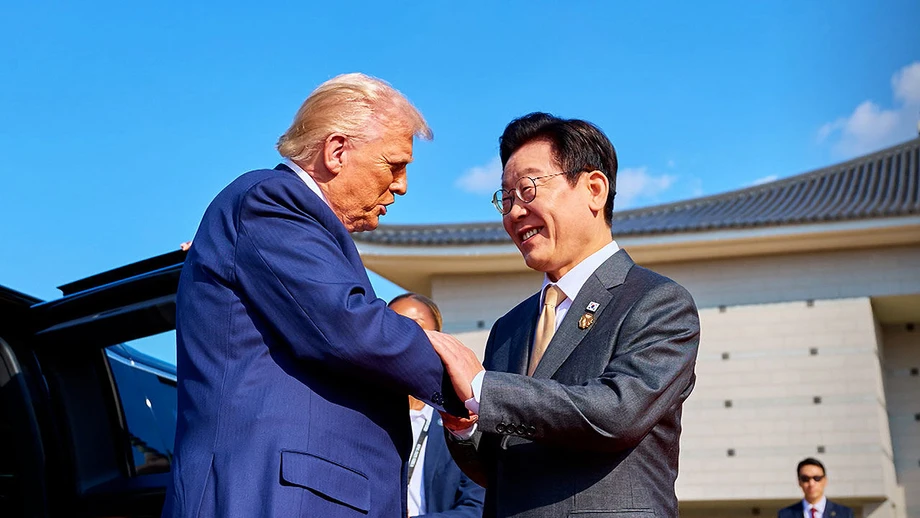
The fuel question connects the submarine program to a wider set of negotiations with Washington. The joint fact sheet following President Lee Jae Myung's October 2025 summit with Trump committed the United States to working with South Korea on the project, including arrangements to obtain fuel.
Vice ministerial talks in Seoul in June covered submarine construction, uranium enrichment and the reprocessing of spent nuclear fuel. Enrichment increases the share of uranium-235, the form of uranium that sustains a reactor's chain reaction. Reprocessing separates materials from fuel after it has been used.
South Korea plans to use high-assay, low-enriched uranium enriched to below 20 percent. A reactor and its fuel supply have to be planned together, making a dependable legal and commercial route to that fuel central to the submarine's development.
A Defense Ministry official said the existing South Korea-U.S. nuclear cooperation agreement concerns civilian uses and might not need revision for the submarine project. A separate agreement, comparable in approach to Australia's arrangements under AUKUS, is another option under consideration.
The presidential office has treated enrichment and spent fuel reprocessing as issues to be addressed separately from the submarine itself. During preparation of the joint fact sheet, it also said Washington needed input from departments beyond the White House and State Department, slowing the document's release.
No date has been given for the postponed second round of talks. A DAPA official said starting the project before negotiations conclude would require a policy and political judgment. For Seoul, the immediate challenge is coordinating a domestic acquisition timetable with an international fuel agreement.
A long route from approval to operational service
The mid-2030s launch target describes the point when the first submarine enters the water. Operational service comes later, following testing, evaluation and acceptance by the Navy. DAPA's initial description places fielding after the late 2030s, while the more detailed development schedule targets deployment in the late 2030s.
A DAPA official used South Korea's existing domestically designed submarine to illustrate the time required:
The existing Dosan Ahn Chang-ho took about four years to design and five years to build.
The official expects a submarine powered by a reactor to take somewhat longer. The proposed 8,000-ton vessel would also be roughly 2.7 times the reported tonnage of the 3,000-ton Dosan Ahn Chang-ho. That comparison shows the scale of the vessel being considered alongside the new propulsion technology.
The main milestones stretch across more than a decade:
- October 2025: The South Korea-U.S. summit opens the political route for cooperation on nuclear propulsion.
- May 2026: Seoul unveils the Jang Bogo N roadmap.
- June 2026: Bilateral security talks begin in Seoul.
- August 2026: The government grants the feasibility study exemption.
- November 6, 2026: The acquisition committee approves the basic strategy.
- 2027: Formal development, competitive bidding and a construction contract are planned.
- Mid-2030s: The first submarine is targeted for launch.
- Late 2030s or beyond: Operational deployment is planned after testing and evaluation.
What the submarines would change underwater
DAPA says Jang Bogo N would strengthen deterrence against North Korea's nuclear and missile threats and expand underwater capabilities within South Korea's Kill Chain system. Kill Chain is the part of the country's three pillar defense architecture intended to detect preparations for an attack and strike threatening targets before weapons are launched.
A reactor would give the Navy longer periods underwater and greater freedom of movement than its existing diesel electric submarines. Conventional vessels must manage stored electrical power and periodically replenish it; nuclear propulsion can keep supplying energy without drawing air from above the surface for that purpose.
Longer submerged operations would support surveillance, tracking and strike missions. Those are the concrete capabilities DAPA connects to stronger deterrence: submarines able to remain on task underwater for longer and operate over greater distances.
The Navy's October parliamentary audit also exposed disagreement over priorities. Lawmakers questioned whether the government had defined the submarines' missions sufficiently and whether other vessels could perform those missions at a lower cost. The November acquisition decision advances the program while those spending choices remain part of the political debate.
Longer range missiles and other naval programs also advance
The committee approved development of the Korean Tactical Surface-to-Surface Missile-I Block-II, intended to counter North Korean artillery threatening the Seoul metropolitan area. The existing Block-I version is known as Ure, and the new version is intended to increase range by 30 percent.
For a simple comparison, a target 100 distance units away under the existing range would become 130 units away under the proposed increase. DAPA did not give an absolute range in the announcement. The program is scheduled for 2028 through 2035 at an estimated cost of 537 billion won, about $395 million.
The committee also approved a revised plan for large scale production of the tactical multiband and multirole radio system, known as TMMR, to improve military communications. Harbor patrol boat replacements and an upgrade involving an unmanned surface vessel for mine clearance received approval as well.
The Harbor Patrol Boat-II program is valued at 611 billion won, while the mine warfare unmanned surface vessel program is valued at 591 billion won. Together, the decisions cover coastal patrol, the removal of dangerous mines, communications and strikes against artillery, alongside the much longer submarine development effort.
Presidential helicopters will be replaced from 2031
Sikorsky's S-92A+, also described as the S-92A Plus, was selected to replace aging presidential helicopters. Sikorsky is a Lockheed Martin subsidiary, and Lockheed Martin was the sole bidder.
The replacement program is valued at 873 billion won, with new helicopters due to begin replacing the current fleet from 2031. The aircraft met the required performance standards and is intended to provide greater range than the existing model.
The helicopter procurement has an identified aircraft, supplier and program value. Jang Bogo N is at an earlier development stage, with a competitive construction contract still ahead and the reactor fuel arrangements awaiting agreement. Both approvals create future spending commitments, but their delivery paths are different.
Key Points
- South Korea approved the Jang Bogo N acquisition strategy on November 6, 2026, targeting a formal program start in 2027.
- A national security exemption removes the usual feasibility study, while a separate detailed assessment is planned.
- Domestic shipbuilders will compete for construction, with the government supplying the reactor and certain weapons separately.
- U.S. fuel negotiations have stalled since June, and the planned July follow-up meeting has not taken place.
- The first launch is targeted for the mid-2030s, followed by operational deployment in the late 2030s or beyond.
- The estimated 28.9 trillion won submarine program budget has not been finalized.
- The committee also approved missile improvements, communications equipment, patrol boats, mine clearance work and replacement presidential helicopters.