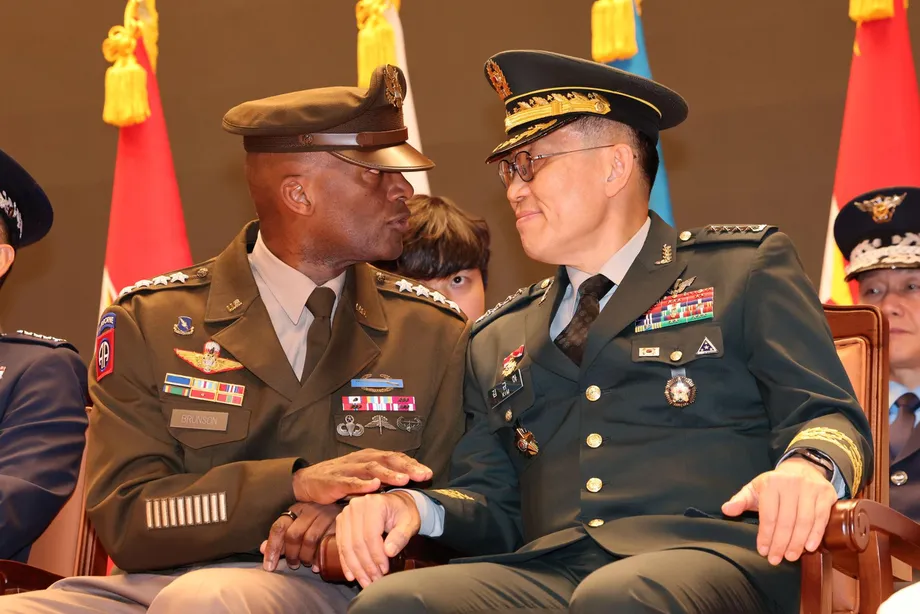
Seoul Objects Over Where South Korea Begins
South Korea has conveyed concerns to Washington over remarks by Gen. Xavier Brunson, commander of U.S. Forces Korea, that placed the country's beginning at the southern fence of the Demilitarized Zone. The dispute has drawn in President Lee Jae Myung and senior military officials while exposing another disagreement over Seoul's goal of taking wartime operational control by 2028.
Contents
- Seoul Objects Over Where South Korea Begins
- What Brunson Said in Washington
- The Fence and the Border Are Different Lines
- Army Chief Rejects the Wording
- What the United Nations Command Clarified
- Mine Injuries Give the Dispute Immediate Stakes
- A Second Dispute Over Wartime Command
- President Lee Calls for an Early Transfer
- How the Dispute Unfolded
- Key Points
A South Korean government source said on Monday, October 19, that Seoul had raised its objections through multiple channels and that the U.S. side had expressed understanding and shared its concerns. The diplomatic exchange followed Brunson's October 14 appearance at a Washington seminar hosted by the Gold Institute for International Strategy.
Brunson, who also commands the United Nations Command and the South Korea-U.S. Combined Forces Command, was describing his responsibilities under the 1953 Korean War Armistice Agreement. His explanation nevertheless touched a sensitive issue: South Korean territory extends north of the southern fence to the Military Demarcation Line, or MDL, inside the buffer zone.
Daeseong-dong, a village in Paju, Gyeonggi Province, makes the stakes concrete. Its residents are South Korean citizens living inside the southern half of the DMZ, beyond the fence Brunson described.
The United Nations Command issued a clarification on Sunday, saying its military and administrative responsibilities leave South Korean sovereignty unchanged. Seoul's defense ministry maintained its objection to Brunson's wording while pledging continued cooperation with the command on administering the armistice.
What Brunson Said in Washington
Brunson approached the boundary from his role as United Nations Command commander, explaining where the command administers territory to maintain the agreement that halted the 1950-53 Korean War. At the seminar, he described South Korea's beginning through that institutional perspective.
That's where the Republic of Korea begins because I administer that area in order to maintain a state of armistice.
The armistice created the DMZ as a military buffer separating the two sides. The United Nations Command controls access and activities under that agreement, including responsibilities in the southern portion of the zone. Sovereignty concerns which country the territory belongs to; administration concerns who carries out particular duties there.
South Korean officials objected because Brunson used a description of administrative responsibility to describe where the country begins. The defense ministry called the remarks his personal views and said its position on territorial sovereignty remained firm.
The Fence and the Border Are Different Lines
The DMZ stretches roughly 250 kilometers from east to west across the Korean Peninsula. The MDL runs through it and serves as the effective land boundary between North and South Korea. The southern fence stands farther south, leaving a strip of South Korean territory inside the buffer zone.
The southern limit is generally described as about two kilometers south of the MDL. Brunson described tactical fence lines 2,500 meters north and south of the MDL in his seminar explanation. The central objection concerns his placement of South Korea's beginning at the southern fence rather than at the dividing line inside the DMZ.
Daeseong-dong residents live within that space. Democratic Party lawmaker Hwang Myeong-seon invoked their citizenship during the parliamentary audit, challenging the consequences of describing their village as lying beyond the country's beginning.
Critics also pointed to South Korea's Constitution, which defines national territory as the Korean Peninsula and its adjacent islands. That constitutional claim reaches beyond the territory Seoul currently governs. In this dispute, officials focused on land south of the MDL that falls within the DMZ.
Army Chief Rejects the Wording
Army Chief of Staff Gen. Kim Kyu-ha publicly disagreed with Brunson during the October 19 National Assembly Defense Committee audit at Army headquarters in Gyeryongdae, South Chungcheong Province. Democratic Party lawmaker Min Hong-chul asked whether he agreed with the commander's description of South Korea's territory.
Kim said he did not and affirmed the position of both his service and the defense ministry.
The position of the defense ministry and our Army on territorial sovereignty is firm.
Kim also agreed when asked whether Brunson's wording had been inappropriate. Ruling Democratic Party lawmakers called for Brunson to withdraw his remarks and apologize, taking the dispute beyond a technical explanation of the armistice.
South Korea's defense ministry sought to preserve cooperation alongside its objection. An official said Seoul would continue working with the United Nations Command so that South Korea's exercise of sovereignty within the DMZ remains compatible with the command's administration of the armistice.
What the United Nations Command Clarified
The United Nations Command responded on Sunday, October 18, with a statement addressing the sovereignty controversy directly.
The Republic of Korea's sovereignty is not in question.
The command said Brunson had been explaining responsibilities assigned to its commander under the Armistice Agreement in the DMZ and Joint Security Area. Those duties include military and civilian administration, as well as civil relief, in the portion of the DMZ south of the MDL.
The statement then described the scope of those duties.
Those responsibilities are military and administrative; they do not alter, and were not intended to address, the sovereignty of the Republic of Korea.
The command also affirmed its commitment to strengthening the alliance and defending the South Korean people. Its clarification leaves two responsibilities operating together: South Korea's sovereignty over its territory and the command's specific duties under the agreement governing the military buffer.
Mine Injuries Give the Dispute Immediate Stakes
Three South Korean soldiers were injured in DMZ mine explosions on September 21, placing military activity inside the buffer zone under scrutiny before Brunson's remarks. A joint investigation by South Korea's military and the United Nations Command concluded that North Korean antipersonnel mines had been deliberately buried south of the MDL.
The investigation located the blast sites and another mine roughly 10 meters south of the line. Two soldiers were seriously injured. South Korea subsequently conducted an operation on October 5 to detonate mines confirmed to be south of the boundary.
The earlier mine response dispute also exposed difficulties identifying the dividing line on the ground. South Korea's defense ministry acknowledged that its coordinate references and those used by the United Nations Command differ across roughly 60 percent of the boundary.
More than 1,200 markers were installed along the MDL after the armistice, but only about 200 were said to remain intact. For troops clearing paths or inspecting suspected mines, agreement on the boundary and on operational authority affects where they can work and how they coordinate their movements.
A Second Dispute Over Wartime Command
Brunson's comments on wartime operational control, commonly called OPCON, added another source of friction at the same Washington seminar. South Korea seeks to complete the transition from U.S. to South Korean leadership by 2028, while Brunson cited the first quarter of 2029.
Operational control means authority to direct assigned military forces in carrying out missions. The transition concerns leadership of combined wartime operations involving South Korean and U.S. forces. It involves military command arrangements, rather than the territorial boundary at issue in the DMZ controversy.
Brunson said he supported the transfer but argued that military requirements must guide its timing. He linked changed plans and standards to North Korea's advancing missile capabilities.
Because the conditions have changed, because we've changed our plan, we have new standards which we have to uphold.
North Korea's improved missiles affect the threats that allied forces must prepare to counter. Brunson's position was that the arrangements for transferring command must account for those threats. Seoul's concern was whether changing requirements would continually postpone its objective.
A South Korean defense ministry official said the transfer would never be possible if the conditions and standards kept changing. The competing dates carry political weight: Seoul's 2028 target falls before Lee's term ends in 2030, while Brunson's reference would move the transition into the following year. No agreed completion date or detailed list of the new standards was announced.
President Lee Calls for an Early Transfer
President Lee addressed wartime operational control at a press meeting marking his administration's 500th day in office on October 19. He did not name Brunson, but his comments responded to the argument that Washington should first confirm South Korea's readiness.
Lee acknowledged the stated American intention to ensure that South Korea could defend itself and conduct operations, then stressed South Korean responsibility for the transition.
I appreciate that, but I think this is something we should do ourselves. It will work out.
Lee also said consultations with the United States were progressing toward the return of wartime operational control and called for an early transfer. His intervention brought the debate from military planning into the president's public agenda.
The two controversies share a concern about South Korean authority, although they involve different decisions. The DMZ dispute concerns how an American commander describes sovereign territory while administering an armistice. The OPCON dispute concerns when a South Korean commander will assume leadership under revised wartime arrangements.
How the Dispute Unfolded
The public disagreement developed over several days, moving from a Washington seminar to a command clarification and then to diplomatic, parliamentary and presidential responses.
- October 14: Brunson spoke at the Gold Institute for International Strategy seminar in Washington about the United Nations Command's DMZ responsibilities and changing requirements for wartime operational control.
- October 18: The United Nations Command said South Korean sovereignty was not in question and explained the military and administrative scope of its duties.
- October 19: Kim rejected Brunson's territorial wording during the Army audit, while Lee called for an early transfer of wartime operational control.
- October 19: A government source disclosed that Seoul had conveyed concerns to Washington and that the U.S. side had expressed understanding.
Kim nevertheless urged a measured assessment of Brunson, drawing attention to military ties dating to the Korean War. He said his personal meeting with the commander had shown Brunson's commitment to defending South Korea.
Looking at this from the standpoint of the alliance and military-to-military relations, I believe we need to be careful and measured in how we assess him.
Seoul's response therefore combines a firm objection on sovereignty with continued military cooperation. The immediate tasks are to maintain coordination inside the DMZ and negotiate the requirements and timing for transferring wartime command.
Key Points
- South Korea raised concerns with Washington after Brunson described the country's beginning as the DMZ's southern fence.
- South Korean territory extends north of that fence to the MDL, including Daeseong-dong village.
- The United Nations Command said its armistice duties are military and administrative and leave South Korean sovereignty unchanged.
- Army chief Kim Kyu-ha rejected Brunson's wording but urged care in assessing the commander.
- Seoul seeks wartime operational control by 2028; Brunson cited the first quarter of 2029 and changing military requirements.
- President Lee called for an early transfer and said consultations with Washington were progressing.