A larger computing engine for Hyundai's driving AI
Hyundai Motor Group is expanding its internal cloud with NVIDIA Blackwell graphics processing units as it advances a plan to use 50,000 of the chips for autonomous driving, robotics and smart factories. The expansion builds on an agreement announced on October 31, 2025, in Gyeongju, South Korea, where Hyundai and NVIDIA outlined an AI factory and a wider Korean physical AI initiative involving approximately $3 billion in investment.
Contents
- A larger computing engine for Hyundai's driving AI
- What the 50,000 GPU commitment covers
- Why 42dot needs more processing power
- How Hyundai's own cloud supports development
- Three platforms connect training to the vehicle
- Virtual roads offer more places to test
- Factories and robots share the infrastructure
- Hyundai's share of South Korea's larger chip expansion
- Chip supply and the race to improve driving AI
- Key Points
Hyundai already operates thousands of GPUs, with its Gasan data center in Seoul serving as a main computing base, according to industry information. Its cloud currently uses NVIDIA Hopper processors and is gradually adding the newer Blackwell architecture. Further additions are planned, including B300 processors from the Blackwell Ultra series.
Some autonomous driving development teams at 42dot, the group's global software center, are expected to be among the first to use the Blackwell cloud. They are developing AI that connects an understanding of a road scene with decisions about how a vehicle should move.
Hyundai's AI factory announcement sets out a target covering model training, validation and deployment. In simple terms, that means teaching AI, checking how it behaves and putting it into use. The company has not published a detailed delivery schedule or a precise count of Blackwell GPUs already operating. The 50,000 figure is the planned scale of the program, while the operating cloud is being expanded in stages.
What the 50,000 GPU commitment covers
Hyundai and NVIDIA describe the AI factory as shared infrastructure for several parts of the automotive business. Autonomous driving is one major use, alongside robots, factory automation and AI features inside vehicles. Physical AI is their term for systems that interpret information and act in the real world, such as a car braking or a robot moving a component.
The approximately $3 billion investment belongs to the wider Korean physical AI initiative. Hyundai's announcement connects it with a Physical AI Application Center, an NVIDIA AI Technology Center and physical AI data centers. The Ministry of Science and ICT, Hyundai and NVIDIA signed a memorandum of understanding on October 31, 2025, to formalize the collaboration.
The planned centers have different roles within that effort. They are intended to support practical applications, technical cooperation and computing capacity, while exchanges with NVIDIA engineers and technicians would help train Korean AI specialists. The agreement therefore extends beyond purchasing processors to developing the people and software needed to use them.
NVIDIA founder and chief executive Jensen Huang described the breadth of the technology's intended reach at the announcement:
AI will revolutionize every facet of every industry.
For Hyundai, the practical test will be whether the shared infrastructure helps teams develop useful systems across vehicles and production lines.
Why 42dot needs more processing power
42dot is developing an autonomous driving model based on vision-language-action technology, usually shortened to VLA. These models connect visual information, language based understanding and actions. For a vehicle, the task is to interpret a scene and determine an appropriate response, rather than simply identify objects in an image.
A pedestrian approaching a crossing illustrates the challenge. A driving system must recognize the person, account for the road layout and nearby traffic, and decide whether to slow down or stop. Complex intersections and unexpected movements create many situations that developers must train and test the system to handle.
42dot executive Lee Hee-seok said in September that VLA uses large language models, increasing the need for computing resources and more powerful hardware. Training such systems involves repeatedly processing extensive driving data and adjusting the model as it learns patterns.
GPUs help because they perform many calculations at the same time. Blackwell is a newer architecture than Hopper and is designed to improve the training and operation of large AI models. For 42dot, access to a larger computing pool could make it possible to run more training and validation work as development proceeds.
How Hyundai's own cloud supports development
Hyundai's internal GPU cloud lets research teams share, manage and allocate computing resources within the group. Instead of each project arranging its own external computing service, teams can draw on a common pool of processors for their workloads.
Training jobs often need large amounts of capacity for concentrated periods. A shared cloud gives Hyundai a way to assign resources across projects, including autonomous driving, robotics and manufacturing. The company is expanding that pool from a Hopper base rather than replacing its infrastructure in a single step.
Operating the cloud internally also reduces reliance on outside cloud services. That gives Hyundai more direct control over the allocation of its computing capacity as different teams prepare experiments, train models and assess results.
Hyundai is pursuing two connected routes in autonomous driving: using NVIDIA's platform while developing its own technology through 42dot. Its Atria AI work and next generation VLA models sit within that strategy. More shared computing capacity supports the development work behind those systems, while NVIDIA supplies parts of the broader hardware and software platform.
Three platforms connect training to the vehicle
Hyundai's official plan assigns distinct jobs to three NVIDIA computing platforms. DGX and other NVIDIA infrastructure support large AI model training and software development. Omniverse and Cosmos support simulation. DRIVE AGX Thor provides computing inside vehicles and robots.
The sequence matters. A model can first learn from data on powerful computers in a data center. Developers can then examine its behavior in simulated situations. A processor in a vehicle must ultimately run the relevant software quickly enough to respond to changing conditions on the road.
DRIVE AGX Thor is intended to support advanced driver assistance, safety functions and other vehicle AI features. Hyundai's announcement says it will run with NVIDIA's safety certified DriveOS operating system. Its role is different from that of the large GPU clusters used to train models.
Hyundai and NVIDIA also plan to cooperate on models using Nemotron and NeMo. Potential applications include personalized digital assistants, infotainment and comfort settings that adapt to occupants. Hyundai says such models could support updates delivered wirelessly to vehicles, allowing capabilities to change after a car has been sold.
Virtual roads offer more places to test
Hyundai says it is testing Omniverse and Cosmos on NVIDIA RTX PRO Servers equipped with RTX PRO 6000 Blackwell Server Edition GPUs. The work involves digital twins of regional driving environments and conditions.
A digital twin is a virtual representation of a real place or system. For driving development, it can provide a simulated road environment in which software encounters different layouts, traffic movements and conditions. Developers can repeat a situation and compare how different versions of a model respond.
That creates a connection between the GPU expansion and the validation work needed for autonomous driving. Training changes the model; simulation gives developers another setting in which to examine its decisions. Hyundai's announcement places both activities within the planned AI factory.
The company describes the driving environment work as testing underway. The broader ambition is to build a development process in which training, simulation and deployment are linked, allowing teams to carry improvements through successive stages.
Factories and robots share the infrastructure
Hyundai plans to use Omniverse Enterprise to create digital twins of manufacturing environments. Those virtual factories would bring production data together and support checks of machinery, control systems and production processes before changes are introduced on a physical line.
One planned use is virtual commissioning, which means testing equipment and its controls in a simulation before starting it in the factory. Another is predictive maintenance, in which operating data helps identify equipment that may need attention before it fails.
NVIDIA Isaac Sim extends the work to robots, including humanoid systems. Hyundai's announcement describes virtual checks of task assignments, movement planning and ergonomic safety before robots are deployed on production lines. A team could examine how a robot reaches for a part or moves through a workspace before making physical changes.
These uses help explain why Hyundai is building infrastructure for several business areas together. Driving systems, factory simulations and robots have different jobs, but all require computing resources to develop and test AI behavior. The planned centers would support that wider industrial program rather than serve autonomous driving alone.
Hyundai's share of South Korea's larger chip expansion
The 50,000 GPU plan forms part of a wider national push to expand advanced computing. The announced allocation covered 260,000 processors: 50,000 each for the government, Samsung, SK and Hyundai, plus 60,000 for Naver Cloud. Hyundai's share is about 19% of that total, calculated from 50,000 divided by 260,000.
South Korea's national chip expansion, detailed on November 7, 2025, envisaged deliveries beginning in 2026 and continuing in phases. That wider program aimed to increase the country's advanced AI chip stock from roughly 65,000 to more than 300,000, supporting domestic AI development as well as manufacturing applications.
The sequence shows how Hyundai's current cloud expansion fits into the larger commitment:
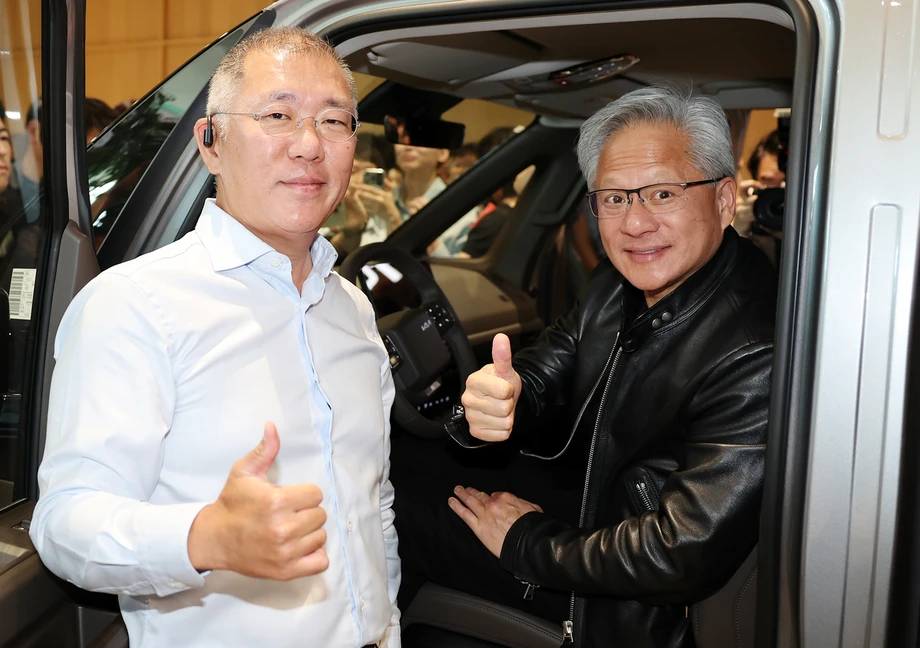
- October 30, 2025: NVIDIA chief executive Jensen Huang met Hyundai Executive Chair Euisun Chung and Samsung Electronics Chair Lee Jae-yong in Seoul, and separately met SK Chair Chey Tae-won.
- October 31, 2025: Hyundai and NVIDIA announced the Blackwell AI factory in Gyeongju, and the science ministry joined them in signing the physical AI memorandum.
- November 7, 2025: Details of the broader national rollout described deliveries starting in 2026 and expanding in phases.
- During the current expansion: Hyundai is adding Blackwell capacity to its existing Hopper cloud and planning further GPU additions, including B300 chips.
The national rollout and Hyundai's internal deployment move on related but distinct tracks. Korea's program covers public computing and several corporate operators, while Hyundai is organizing capacity around its own development teams and industrial applications.
Chip supply and the race to improve driving AI
Hyundai's investment comes as automakers, including Mercedes-Benz and General Motors, increase their commitment to autonomous driving technology. The competition is moving beyond identifying nearby vehicles and road markings toward models that can select appropriate actions in complicated situations.
Access to powerful processors has become part of that contest. More computing gives development teams greater capacity to train large models, process driving data and run simulations. Hyundai's internal cloud brings those resources closer to 42dot and other group teams working on the software.
US export policy has also drawn attention during the Korean chip expansion. After the supply announcement, President Donald Trump made comments about keeping the most advanced chips in the United States. Treasury Secretary Scott Bessent separately discussed the possibility of Blackwell sales to China in one or two years as newer technology arrived. Those remarks brought supply timing and access to current hardware into the discussion surrounding the Korean agreements.
Hyundai's program now has several concrete tasks: expand the operating cloud, give development teams access, test models in simulated environments and carry suitable software into vehicles and factories. The company's partnership with NVIDIA provides a framework for that work, while 42dot continues developing Hyundai's own driving AI.
Key Points
- Hyundai is adding NVIDIA Blackwell GPUs to an internal cloud already operating thousands of processors, mainly from the Hopper generation.
- The group aims to use 50,000 Blackwell GPUs for AI training, validation and deployment across driving, robotics and factories.
- Some 42dot autonomous driving teams are expected to use the expanded cloud early as they develop vision-language-action models.
- The October 31, 2025 agreement supports a wider Korean physical AI initiative involving approximately $3 billion in investment.
- Hyundai is testing virtual driving environments and plans digital factory and robot simulations alongside its vehicle AI work.
- The company has not disclosed a precise installed Blackwell count or a detailed schedule for completing its 50,000 GPU program.