A milestone reached, with a bigger expansion ahead
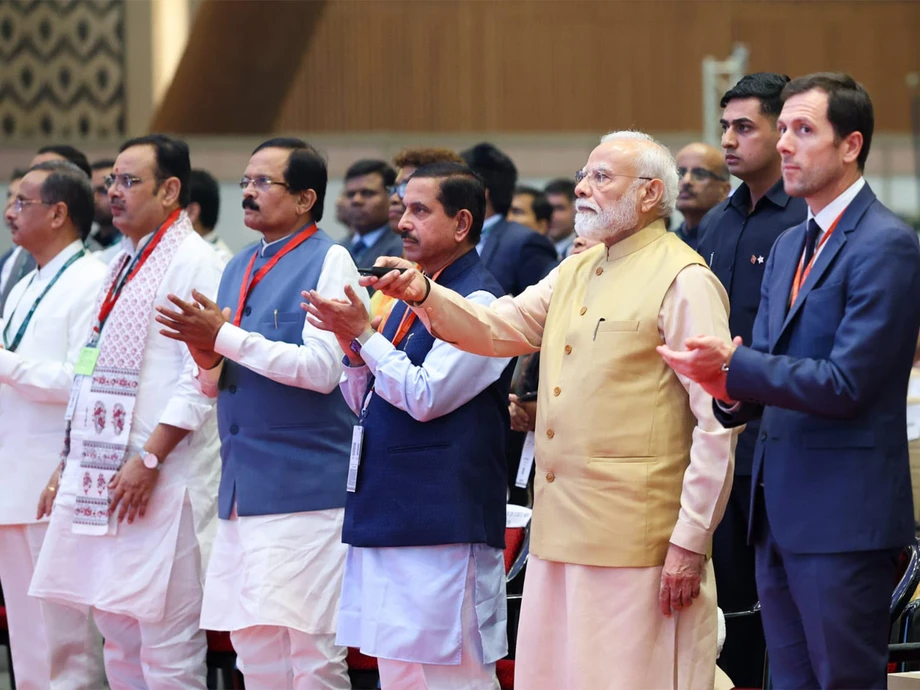
India crossed its target of drawing half its installed electricity capacity from non-fossil sources in 2025, five years before its 2030 deadline, Prime Minister Narendra Modi said at the opening of the India Renewable Energy Summit and Expo 2026 in New Delhi. Rajasthan used the gathering to seek investors for a planned expansion to around 125 gigawatts of renewable capacity by 2030.
Contents
- A milestone reached, with a bigger expansion ahead
- What the 50% threshold means
- Two national goals with different deadlines
- Rajasthan seeks more than twice its current capacity
- Investment grows, while demand keeps rising
- Households, farms and public buildings join the expansion
- Storage and transmission must grow together
- Factories and green hydrogen widen the agenda
- International partnerships meet state priorities
- Key Points
The national milestone puts a larger share of India's electricity infrastructure in solar, wind, hydropower, nuclear power and other sources that do not burn fossil fuels. Ministry of New and Renewable Energy figures put installed non-fossil capacity at 308.03 GW on September 30, 2026, including 299.25 GW of renewable energy and 8.78 GW of nuclear power.
Modi opened the November 2–5 summit at Bharat Mandapam with a further ambition: adding 500 GW of new non-fossil capacity over the next 10 to 11 years. That expansion would come alongside India's existing goal of reaching 500 GW of total non-fossil capacity by 2030.
Rajasthan Chief Minister Bhajanlal Sharma, meanwhile, met more than 50 investors with Union Minister for New and Renewable Energy Pralhad Joshi. Representatives of Brookfield, ReNew, Aditya Birla Renewables, the Jindal Group and Avaada attended the discussion.
The two announcements connect a national achievement with the work still required in individual states. More generating equipment must be matched by land, financing, transmission lines and storage so that electricity reaches homes, farms and businesses when they need it.
What the 50% threshold means
Installed capacity measures the maximum output that power equipment is designed to produce under specified conditions. Actual electricity generation depends on how often and how strongly that equipment operates. Solar panels produce electricity during daylight, while wind turbines depend on wind conditions.
India's Paris Agreement commitment concerns the share of installed capacity from non-fossil sources. The amount of electricity those sources deliver through the year is a separate measurement, shaped by weather, plant operation and demand.
Solar accounted for 171.05 GW of installed capacity on September 30, according to the ministry's figures, while wind accounted for 59.20 GW. Together, they made up 230.25 GW, or about 75% of the country's 308.03 GW of non-fossil capacity. Solar alone represented roughly 56%.
Joshi told the summit that non-fossil capacity had subsequently passed 310 GW, compared with 200 GW in September 2024. His figures describe an increase of more than 110 GW, or over 55%, from that earlier level.
India's sequence of commitments and milestones shows how the focus is shifting from reaching a percentage to building much more capacity:
- 2021: India announced its ambition at COP26 to reach 500 GW of non-fossil electricity capacity by 2030.
- February 2024: The PM Surya Ghar rooftop solar programme began, targeting installations for 10 million households.
- 2025: India reached the 50% non-fossil share of installed electricity capacity, according to Modi.
- September 30, 2026: Ministry figures recorded 308.03 GW of non-fossil capacity.
- November 2–5, 2026: The New Delhi summit brought together governments, investors and manufacturers to discuss the next expansion.
Two national goals with different deadlines
India's 500 GW target for 2030 concerns the total amount of non-fossil capacity installed by that date. Using the September figure of 308.03 GW, the remaining distance to that goal was 191.97 GW.
Modi's longer ambition concerns another 500 GW of new capacity over the following 10 to 11 years. The scale is larger than the entire non-fossil fleet recorded in September 2026.
Prime Minister Narendra Modi described the challenge and expressed confidence in India's ability to meet it:
Over the coming 10–11 years, our effort will be to add 500 GW of new non-fossil capacity. The target is somewhat difficult, but I have faith in the capabilities of my country. That is why I say, we will do it,
Modi linked the expansion to energy security, pointing to disruptions from the COVID-19 pandemic and conflict in West Asia. His argument was that greater use of domestic clean energy could reduce India's exposure to fuel supply interruptions and international price changes.
Rajasthan seeks more than twice its current capacity
Rajasthan has installed more than 51,000 megawatts, equivalent to 51 GW, of renewable capacity, including over 45 GW of solar power. Sharma said the state ranked first in India for renewable electricity generation and installed solar capacity.
The state's ambition of around 125 GW by 2030 is roughly 2.5 times the reported current level. Using 51 GW as a reference, that would require about 74 GW of additional capacity. Solar already accounts for roughly nine tenths of the renewable capacity cited by the state.
Sharma invited investment across solar, wind, hybrid projects and energy storage. Hybrid projects combine more than one generating source, such as solar and wind, which can produce power at different times and make better use of shared connections to the grid.
Rajasthan's Integrated Clean Energy Policy and Right to Use policy are intended to make land access easier for large projects. Investors can also seek incentives under the Rajasthan Investment Promotion Scheme 2024. The state is expanding solar parks, rooftop installations, wind and biomass projects while preparing a plan to store surplus solar electricity.
The investor meeting brought major developers and financial groups into the discussion, but the announcements described investment opportunities rather than a total value of newly signed projects. For Rajasthan, the practical task is to turn interest into plants, storage systems and grid connections before 2030.
Investment grows, while demand keeps rising
Joshi said renewable energy had attracted more than ₹6 lakh crore over the previous two years, equivalent to more than ₹6 trillion. He also cited $67 billion in investment and $6.2 billion in foreign direct investment over that period.
Modi put investment over the past decade at more than ₹15 lakh crore, or ₹15 trillion. He estimated that clean energy investment opportunities could exceed ₹20 lakh crore, or ₹20 trillion, by the end of the decade. Those opportunities span generation, manufacturing, storage and the networks needed to carry electricity.
State representatives described why more supply is needed. Uttar Pradesh Power Minister Arvind Kumar Sharma said the state had supplied more than 32,600 MW to meet summer peak demand and had doubled its electricity consumers over six to seven years. He invited investors to consider rooftop solar across households, shops, factories, schools and hospitals.
Delhi Cabinet Minister Ashish Sood said the capital's peak electricity demand had exceeded 8,600 MW and was expected to reach 9,000 MW the following year and 11,500 MW by 2034–35. The longer projection is about one third above the current level.
Delhi plans 220,000 rooftop solar installations free of cost and aims for 750 MW of solar generation, Sood said. Rajasthan's large generating projects and Delhi's rooftop plans address different parts of the same problem: supplying a growing number of users without relying solely on new fossil fuel plants.
Households, farms and public buildings join the expansion
Modi said more than 6.5 million households had joined PM Surya Ghar, the programme targeting rooftop solar for 10 million homes by the financial year ending in 2027. On those figures, participation has passed 65% of the target.
Modi cited a study finding electricity bill reductions of about 76% among participating households. He said some families had brought their bills to zero and others were earning money by selling surplus electricity to the grid. The study's scope and methods were not detailed in his account.
More than 44,000 government buildings had also been connected to solar power, Modi said, producing estimated annual savings of about ₹700 crore, or ₹7 billion. He urged wider installation at schools, colleges, hospitals and street lighting systems.
For agriculture, Modi said PM-KUSUM had provided irrigation powered by solar energy to more than three million farmers. He cited estimated savings of around ₹100,000 a year for a farmer using a solar pump. He also encouraged panels on unused farmland and field boundaries so farmers could produce electricity as well as crops.
Modi called for solar equipment suited to dairy work, fodder preparation, harvesting and processing after harvest. He also described rooftop electricity as a possible source of power for household cooking and charging electric vehicles. Those uses would extend solar energy beyond lighting and appliances into daily spending on transport and fuel.
Storage and transmission must grow together
Rajasthan's plan to store surplus solar energy addresses a basic timing problem. Solar output rises during daylight, while homes and businesses may need more electricity after sunset. Storage can hold energy for later use, and transmission lines can move it to places where demand is higher.
Modi said the next phase of Green Energy Corridors would target around ₹2 lakh crore, or ₹2 trillion, in investment. These corridors use transmission lines and substations to carry electricity from areas with strong renewable resources to areas that need more power.
India has linked its five regional grids into a national network operating at a common frequency, Modi said. Frequency is the rhythm of alternating electric current; keeping it steady helps equipment and the wider power system operate reliably.
Battery storage, domestic hardware and new technology were central to Modi's appeal to researchers, startups and the Indian Institutes of Technology. He called for systems capable of meeting more household energy needs across different weather conditions and throughout the day.
Rajasthan's proposed mix of solar, wind, hybrid projects and storage brings these requirements together. Generating more electricity is one task. Making it available at the right location and hour requires investment in the wider network as well.
Factories and green hydrogen widen the agenda
India's solar module manufacturing capacity has exceeded 200 GW, Modi said, while solar cell manufacturing capacity has reached around 40 GW. Cells are the individual devices that turn sunlight into electricity; modules are the panels assembled from those cells.
The figures show module manufacturing capacity at more than five times cell capacity. They describe factories' production capability, while the country's installed solar capacity measures generating equipment already in place. Building out more of the supply chain is part of the government's domestic manufacturing push.
Modi also highlighted the National Green Hydrogen Mission, which targets five million tonnes of green hydrogen production by the end of the decade. Green hydrogen is produced by using renewable electricity to split water into hydrogen and oxygen.
Hydrogen gives clean electricity a role beyond direct power supply, including potential uses in industry and transport. Modi said India had launched its first green hydrogen train a few months earlier and urged further work connecting the fuel to transport.
The summit's manufacturing and hydrogen discussions broadened the investment agenda beyond new power stations. Modi pointed to employment across equipment production, installation, maintenance and transportation, without giving a numerical forecast for new jobs.
International partnerships meet state priorities
The summit ran under the theme Invest, Innovate, Inspire, alongside the ninth International Solar Alliance Assembly and the fourth International Conference on Green Hydrogen. More than 400 exhibitors were presenting technologies in solar, wind, hydrogen, storage and other clean energy sectors.
The event programme described participation from more than 130 countries and over 40 ministers; Joshi, speaking on the sidelines, cited representatives from more than 30 countries. Rajasthan and 12 other states and Union Territories were showcasing investment opportunities and manufacturing capabilities.
Partners included Australia, Denmark, the European Union, France, Germany, the Netherlands, Norway, Sweden and the United Kingdom. Modi also proposed a $200 million Africa Solar Facility, extending the discussion to financing solar development outside India.
India's next stage brings these international and local priorities together. Global finance and technology can support expansion, while states must arrange land, connections and reliable delivery. The 50% capacity milestone marks progress against one national commitment; the next targets require a much larger volume of equipment and infrastructure.
Key Points
- Modi said India reached a 50% non-fossil share of installed electricity capacity in 2025, five years before its deadline.
- Ministry figures recorded 308.03 GW of non-fossil capacity on September 30, 2026, including 171.05 GW of solar.
- India retains its 500 GW total capacity goal for 2030 and aims to add another 500 GW over the next 10 to 11 years.
- Rajasthan is seeking investment to expand renewable capacity from more than 51 GW to around 125 GW by 2030.
- Joshi said renewable energy attracted more than ₹6 trillion in investment over the previous two years.
- Storage, transmission, domestic manufacturing and rooftop solar are central to the next expansion.