Millions of notices, followed by fresh requests for proof
Delhi voters who submitted Aadhaar cards during a special review of electoral rolls are being asked for more documents, even after local election workers verified their addresses and recommended that they remain registered. The renewed checks affect people whose records could not be linked to older electoral rolls, including elderly residents who say they have few other papers.
Contents
- Millions of notices, followed by fresh requests for proof
- What election workers say they were asked to do
- Why Aadhaar is at the centre of the dispute
- How the search for old voter records works
- Two calendars require careful attention
- Migrant workers face the cost of staying registered
- Residents describe years of unsuccessful applications
- Who decides whether a voter stays on the roll?
- What the official process offers voters
- Key Points
Of nearly 97 lakh electors, or 9.7 million people, on the draft roll described in the notice exercise, 33.1 lakh received notices. That is about 34% of the draft electorate. Of those notices, 13.9 lakh concerned missing links to previous electoral rolls, while the remaining 19.2 lakh concerned logical discrepancies, meaning inconsistencies in recorded information.
Data shared by the Delhi Chief Electoral Officer's office showed that more than 94% of the 33.1 lakh cases had been marked for inclusion in the final rolls. Yet booth level officers, known as BLOs, said voters who supplied only Aadhaar were still being flagged in the system used by Electoral Registration Officers and their assistants.
The central issue is how officials assess eligibility when a voter has an identity document and a favourable local verification report, but lacks other records. Election officials say Indian citizenship, an age of at least 18 and ordinary residence in the constituency are the requirements. A senior official said missing links to old rolls and logical discrepancies do not themselves affect eligibility.
What election workers say they were asked to do
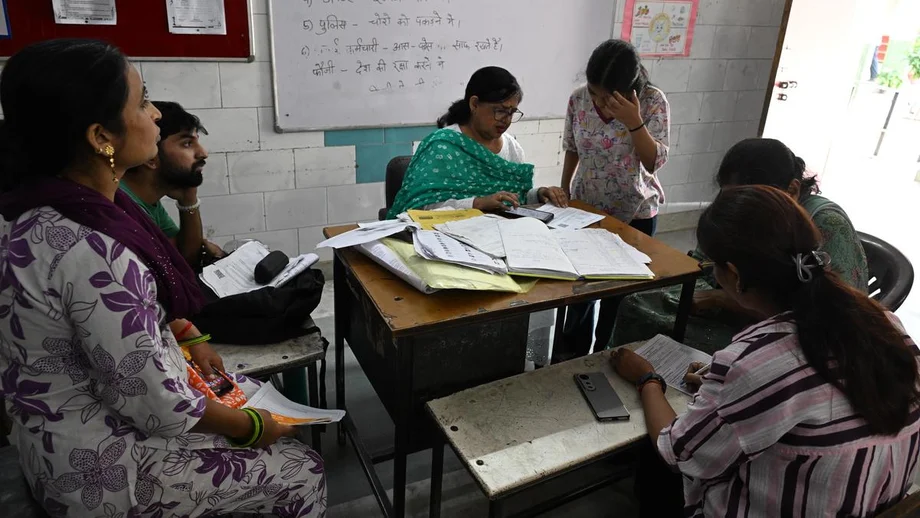
BLOs across Delhi said Electoral Registration Officers, or EROs, directed them to revisit voters and collect further documents, despite earlier field reports and written undertakings confirming eligibility and years of residence. Some said they were asked to establish that voters were not Bangladeshi or Rohingya.
Election officials denied issuing those instructions and said no records identifying alleged illegal immigrants on the electoral roll were being prepared. An ERO said instructions during the initial enumeration had included identifying foreign nationals, but that those directions changed soon afterwards and no such list was being made.
Several election workers described uncertainty over what would satisfy the review. One said instructions had shifted from collecting any available document and providing a verification undertaking to seeking citizenship proof. Another said even a voter who had submitted a passport was asked for documents again.
For elderly residents and people who never attended school, finding educational certificates or other records can be difficult. One BLO in Northeast Delhi said some voters had no additional documents and did not even have bank accounts. Repeated visits therefore leave both residents and field workers trying to resolve the same cases without a consistent understanding of what is required.
Why Aadhaar is at the centre of the dispute
Aadhaar is an identity document, while electoral registration also requires a decision about citizenship, age and residence. A senior election official said Aadhaar alone was insufficient, but an ERO could still find a voter eligible if satisfied with the BLO's field report.
The Delhi Chief Electoral Officer's SIR 2026 FAQ describes a process with separate stages. No documents are required with the Enumeration Form during the initial household survey, and giving an Aadhaar number on that form is optional. Supporting documents may be requested later, when an ERO issues a notice.
The FAQ lists 12 supporting document entries. Its twelfth entry covers Aadhaar and says Election Commission directions dated September 9, 2025 apply. The notice exercise described by election workers refers to 11 prescribed documents, including birth certificates, educational certificates and passports. The official FAQ therefore presents the list differently, placing Aadhaar under its own specified directions.
Other entries in the FAQ include permanent residence certificates, caste certificates issued by competent authorities, government land or house allotment certificates, family registers prepared by state or local authorities, and certain government employment or pension records. It also includes specified records issued before July 1, 1987 by government bodies and institutions such as banks, post offices and the Life Insurance Corporation.
For a resident answering a notice, the practical question is which records the ERO will accept alongside local verification. The official's explanation leaves room for a satisfactory field report, while the requests described by BLOs suggest that some cases are returning for further paperwork.
How the search for old voter records works
Delhi's last Special Intensive Revision before the exercise described in the official FAQ was held in 2002. The FAQ asks electors to search that roll and, where applicable, connect their details to entries for themselves or relatives in earlier revisions elsewhere.
A voter who moved to Delhi after 2002 may need to search the relevant earlier roll in another state. The form seeks details such as the relative's name, state, Assembly constituency, polling station and serial number. Finding those entries can require information that families have not used for decades.
The FAQ allows links through parents or grandparents on either side of the family. For a married woman whose name was absent from the earlier roll, it specifies her parents or grandparents rather than her husband's parents.
Voters unable to find an entry for themselves or a qualifying relative can return the form with their personal details and leave the earlier roll information blank. The FAQ says they must provide a prescribed document when they receive an ERO notice. A missing historical link therefore moves the person into a later verification stage.
Two calendars require careful attention
The notice exercise involving 33.1 lakh voters had a disposal deadline extended to December 15, ahead of final roll publication on December 22. It also included a September 25 warning against deletions on weak grounds and an October 1 meeting about accepting BLO undertakings.
The Chief Electoral Officer's FAQ explicitly gives a different calendar for SIR 2026, ending on November 4, 2026. The relationship between that schedule and the December deadlines has not been explained. Voters need the deadline attached to their own notice or applicable official schedule.
- September 25, in the notice exercise: the Chief Electoral Officer's office warned against deletions on flimsy grounds and directed thorough verification.
- October 1, in that exercise: BLOs said a meeting advised that their undertakings could be accepted when voters lacked prescribed documents.
- December 15 and December 22, in that exercise: the extended notice disposal deadline and scheduled final roll publication.
- June 30 to August 17, 2026: household visits under the official FAQ schedule.
- August 31, 2026: draft roll publication and opening of the claims, objections and notice stages.
- September 30 and October 29, 2026: the respective deadlines for claims and objections, and for notices and their disposal.
- November 4, 2026: final roll publication under the FAQ.
Migrant workers face the cost of staying registered
Delhi's migrant workers often have documents tied to their hometowns while spending most of their working lives in the capital. Some travel between states regularly, and others retain their original registration because their housing or employment in Delhi is uncertain.
Sitapant Jha, 74, has lived in Delhi since 1974 but retains documents linked to Bihar. He previously travelled to Darbhanga to vote and had been unable to do so for the past two years. Unaware of the revision, he assumed his name remained on Bihar's roll.
Manoj Yadav, a 28 year old factory helper in Govindpuri, described how an address on a document can collide with the demands of daily work:
My Aadhaar has my Bihar address, but I am here all day working. Who will go stand in line for me?
Vikram Singh, a cab driver, said long queues and requests for letters from landlords were difficult to fit around working hours. Sita, a domestic worker from Bihar, said a medical emergency prevented travel and that a BLO told her the process required her presence.
The official FAQ provides some ways to handle absence. It allows an adult family member to complete and sign an Enumeration Form for someone working elsewhere, and describes online submission. Its online process requires a registered mobile number and matching names in electoral and Aadhaar records. Families with missing documents or mismatched details can therefore face extra practical barriers.
Residents describe years of unsuccessful applications
In Rangpuri Pahari, near Delhi's Indira Gandhi International Airport, several residents describe registration problems that began before the current revision. Their experiences show how a new document request can arrive on top of unresolved applications or an earlier loss of records.
Shaheen, 19, said her documents were lost when her former home in Ghosiya Colony, Mehrauli, was demolished. She later lost an Aadhaar slip during a move. Her father died soon afterwards, and her family struggled to obtain replacement papers.
Bano and Issaq Khan moved from Chattarpur to Aligarh after their marriage in 2008, then returned to Delhi in 2014. They updated their Aadhaar and PAN details but did not transfer their electoral registration. Their names were subsequently removed from the Chattarpur rolls, and they say attempts to register again have been rejected without a clear explanation.
Chiranji Lal Meena, the ERO for Bijwasan, which covers Rangpuri Pahari, attributed application rejections to documents being uploaded incorrectly or applicants missing appeal deadlines. Explaining the office's position, he said:
There is no reason that the applications will get rejected if you have all the documents right.
Ashiq Ali, 56, said he had lived in Delhi since before 1980 and voted there from 2000. After his registration and those of his son and daughter in law were cancelled, he submitted forms and was told someone would visit. He said no verification visit followed.
Who decides whether a voter stays on the roll?
EROs make eligibility decisions, while BLOs carry out local visits and submit verification reports. Officials said an ERO dissatisfied with a voter's documents could find the person ineligible through a speaking order, a written decision that records the reasons.
An initial administrative report recorded 350 electors as found ineligible. The September 25 letter from the Chief Electoral Officer's office subsequently warned against deletions on flimsy grounds and required thorough verification. BLOs said the October 1 meeting allowed their undertakings to be accepted where voters lacked prescribed records.
Sabir Ahmed, cofounder of the Sabar Institute, an independent research organisation that has tracked deletion patterns in West Bengal, questioned the speed of the wider exercise. He said a process previously conducted over at least a year was being attempted in three months, forcing some migrant workers to travel home for hearings.
Ahmed also described notices arising from name mismatches in a process using artificial intelligence to flag logical discrepancies. The Election Commission has not disclosed the technology or procurement details behind that flagging. Residents must still answer the resulting notices through the verification process, where the quality of the explanation and the opportunity to correct a record matter directly.
What the official process offers voters
The Chief Electoral Officer's FAQ says BLOs should make at least three visits to collect Enumeration Forms. Voters should receive an acknowledgement on a duplicate copy and retain it. Help is available through the 1950 voter helpline, BLO contact details printed on the form, and district and Assembly constituency helpdesks. SEWA Delhi is also helping residents arrange documents.
Returning the form is essential under the FAQ: only electors whose completed forms are received are included in the draft roll. Where a form is not returned, the BLO is instructed to investigate whether the person is absent, deceased, has shifted or has a duplicate entry.
Eligible people missing from the draft can submit Form 6 with a declaration and supporting documents during the claims and objections period. The FAQ also directs people who have moved to use that route to seek registration at their new address. Sections 17 and 18 of the Representation of the People Act, 1950 prohibit registration in more than one constituency or more than once in the same constituency.
Voters are asked to check the draft roll after publication, rather than rely solely on having handed in a form. Under the FAQ, an applicant whose name is still missing from the final roll can appeal to the relevant District Election Officer or District Magistrate within 15 days. For residents already making repeated visits, those checks and deadlines determine the next opportunity to resolve their registration.
Key Points
- Of nearly 97 lakh voters on the draft roll in the notice exercise, 33.1 lakh received notices, about 34%.
- BLOs say some voters who submitted Aadhaar face fresh document requests despite favourable field verification.
- Officials deny directing checks targeting Bangladeshi or Rohingya people and say no such list is being prepared.
- The official SIR 2026 FAQ makes Aadhaar numbers optional on Enumeration Forms and requires no documents during enumeration.
- The FAQ lists 12 supporting document entries, with Aadhaar subject to separate Election Commission directions.
- The December deadlines described in the notice exercise differ from the FAQ's November 4, 2026 final publication date.
- Migrants and residents with lost or outdated papers face travel costs, missed work and repeated applications.
- The FAQ provides Form 6 for eligible people missing from the draft and an appeal within 15 days for applicants absent from the final roll.