Dry fields meet rising food bills
India finished its 2026 monsoon with rainfall at 87% of the long period average, leaving reservoirs less full and farmers short of water for winter planting. By October 1, reservoir storage stood at 71.8% of capacity, compared with 90.3% a year earlier and a normal level near 82%. The consequences are reaching beyond farms into the prices of wheat, sugar, milk and chicken.
Contents
- Dry fields meet rising food bills
- Less rain, arriving at the wrong time
- How the pressure built through 2026
- Why grain stocks provide only partial relief
- Chicken, milk and pulses squeeze household diets
- Sugar imports face a gap larger than the allowance
- Imports and competing demand add pressure
- Crop losses vary, complicating the response
- Food costs test growth and interest rate policy
- Key Points
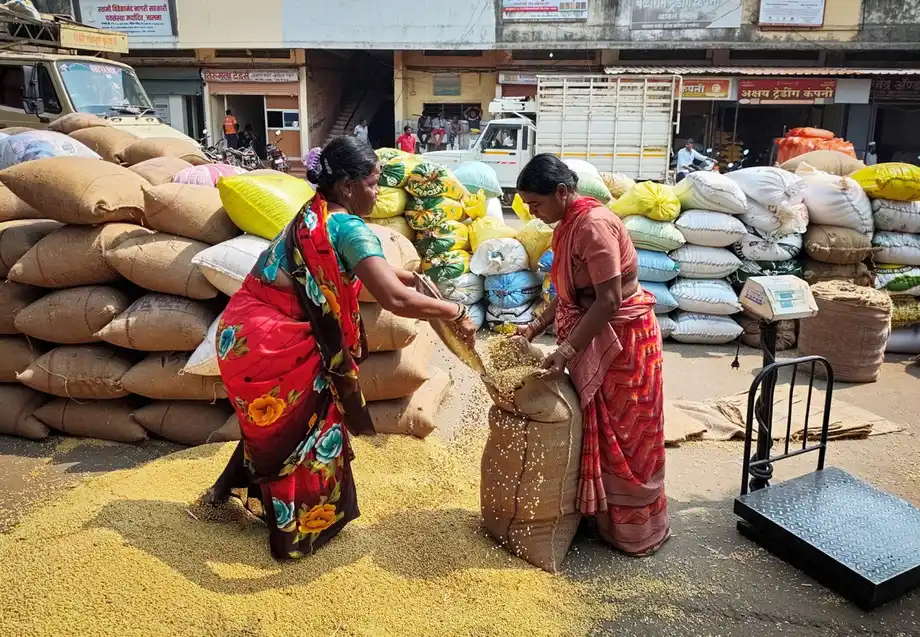
In Rajewadi, about 400 kilometers east of Mumbai, Amarsingh Gushinge wants to plant wheat and chickpeas while prices are attractive. Water shortages have stopped him from sowing either. The local weather office says Maharashtra's Jalna district, which includes his village, received about 48% less rain than average.
Gushinge, a farmer aged 78, described the combined pressure on his land and finances:
There's not enough moisture in the soil to sow the next crop, and no money left to do so either.
September's annual retail food inflation reached 7.74%, while headline inflation, the broader measure of consumer price increases, stood at 5.54%. Devendra Pant, chief economist at India Ratings and Research, expects food inflation could reach about 10% during October to December as weak rains combine with higher international prices and a weaker rupee.
Farmers and consumers face different sides of the same squeeze. Higher crop prices can reward growers who have a harvest to sell. For those unable to plant, those prices offer little help, while their own household food bills continue rising. Consumers are also paying more for onions, pulses and other staples, leaving less money for purchases outside the grocery basket.
Less rain, arriving at the wrong time
India's national rainfall deficit was 13%, but local shortages were much sharper. Jalna's 48% shortfall shows how a national average can hide severe stress in particular farming districts. Reservoir storage was also 18.5 percentage points below its level a year earlier, reducing the water available to support crops after the rains ended.
Sumit Gupta, chief executive of WASEDA Global Commodities, said much of the season's rain arrived in a few short periods rather than being spread across four months. A sudden monsoon withdrawal added to the difficulty. Intense rain in parts of Odisha, Jharkhand, Uttar Pradesh and eastern India caused disruption while other agricultural regions remained dry.
Andhra Pradesh declared drought in 388 mandals, local administrative areas representing 56% of the state's total. Maharashtra's Vidarbha region reported heavy losses in cotton and paddy. Drought assessment was also underway in parts of Rajasthan, where damage affected crops including soybean, bajra and green gram.
Water shortages now connect two growing seasons. Kharif crops are generally planted during the summer monsoon, while rabi crops, including wheat and chickpeas, are planted afterward and grown through winter. Poor summer rainfall can damage the first harvest and leave too little soil moisture or stored irrigation water for the next.
How the pressure built through 2026
India's planting difficulties appeared well before the monsoon ended. By the end of June, the area sown with kharif crops was nearly 22% below the level a year earlier. An earlier India Meteorological Department forecast had put seasonal rainfall at 90% of the long period average; the season finished at 87%.
The sequence shows how an early planting problem developed into a wider concern about food supplies and winter irrigation:
- By the end of June 2026, kharif sowing area was nearly 22% lower than a year earlier.
- The monsoon season ended with a national rainfall deficit of 13%.
- On October 1, reservoir storage was 71.8% of capacity, down from 90.3% a year earlier.
- During October to December, Pant expects food inflation could reach about 10%.
- From January 2027, poultry producers could increase broiler prices as costs and supply pressures build.
The government prepared a reserve of 174,000 quintals of seeds to support delayed planting or replanting, alongside the 1.73 million tonnes required for the kharif season. The reserve equals 17,400 tonnes, roughly 1% of that seasonal requirement. Seeds can help farmers restart planting, but they still need water and money to grow the crop.
Why grain stocks provide only partial relief
India has a substantial cushion in its two main cereals. Rajesh Paharia, chief manager of business development at Kribhco Agri Business, put Food Corporation of India holdings at around 44 million tonnes of wheat and nearly 55 million tonnes of rice. He described those stocks as comfortable against buffer requirements.
Government grain reserves give policymakers supplies they can release to help manage shortages and prices. Their usefulness varies across the food market, however. Stocks of wheat and rice offer less direct help when the pressure is in pulses, edible oils, milk or sugar.
Consumer preferences also matter within a grain category. B.V. Krishna Rao, president of the Rice Exporters Association, said dry weather had reduced supplies of rice varieties favored in southern India. Prices for those varieties can rise even when the country has plentiful rice in storage.
Wheat has reached a nearly two year high amid concern that El Nino could bring warmer winter weather and reduce production early in 2027. El Nino is a warming of parts of the tropical Pacific Ocean that can change weather patterns far away, including rainfall and temperatures affecting Indian agriculture. For wheat growers, low moisture at planting and excessive warmth later would create pressure at different stages of the crop.
Chicken, milk and pulses squeeze household diets
Food inflation is spreading through the cost of producing animal protein. The Reserve Bank of India's September Monetary Policy Report attributed nearly half of the two percentage point rise in food inflation between March and August to animal protein and spices. It identified higher feed, fodder, transport, packaging and energy costs, along with poultry deaths after a heat wave.
Uday Singh Bayas, president of the poultry equipment industry body IPEMA-Poultry India, said feed, mainly corn and soybeans, accounts for 60% to 70% of poultry production costs. That makes chicken prices especially sensitive to changes in grain and oilseed markets.
Uddhav Ahire, chairman of Anand Agro Group, said poultry producers had yet to pass all their higher feed costs to customers. Broiler prices could rise from January as those costs combine with tighter supplies.
September's meat inflation eased to 8.7% from 12.0% in August, largely because prices were being compared with an already high level a year earlier. Milk, other dairy products and eggs moved in the opposite direction, with inflation rising to 5.1% from 4.8%.
Madan Sabnavis, chief economist at Bank of Baroda, warned that prolonged increases in the prices of pulses, poultry and dairy could force poorer households to change their diets, with consequences for health over time. When several major protein sources become more expensive together, families have fewer affordable substitutes.
Sugar imports face a gap larger than the allowance
Sugar prices have risen nearly 30% over the past year. Rahil Shaikh, managing director of Mumbai trader MEIR Commodities India, expects production to fall short of domestic consumption for a second consecutive year. Consumption is expected to exceed 29 million metric tons, against output below 27.5 million tons.
Those figures put the gap between domestic production and consumption at more than 1.5 million tons. The government has allowed duty free imports of 1 million tons, an amount equal to less than two thirds of that gap. Stocks and other supply decisions will also matter to the market balance.
Shaikh said higher international prices limit the relief imports can provide and make a return to last year's domestic prices unlikely. Removing an import duty lowers one part of the bill, but buyers must still pay the overseas price and shipping costs.
Shaikh's recovery forecast extends well beyond the approaching winter harvest. He said sugar output may recover only in late 2028, depending on favorable rainfall in 2027. His outlook makes the next monsoon important for a commodity whose prices are already climbing sharply.
Imports and competing demand add pressure
India can purchase sugar, pulses and vegetable oils abroad when domestic harvests fall short. Those purchases are becoming more expensive because of higher global prices, rising freight costs and rupee depreciation. A weaker rupee means Indian buyers need more local currency to pay the same bill in dollars.
Sandeep Bajoria, chief executive of Mumbai brokerage Sunvin Group, linked higher vegetable oil prices to international production pressures and disruptions affecting Black Sea supplies. El Nino is affecting agriculture outside India too, while the Russia-Ukraine war has hit supplies of grain and sunflower oil from that region.
Fertiliser presents another cost concern. Paharia said India's dependence on imported fertiliser leaves farmers exposed to logistical and geopolitical problems affecting prices and availability. That pressure arrives while some growers are already short of cash for planting.
Maize faces demand from several directions: food, animal feed and ethanol used in fuel. Gupta said shortages of sugar and rice, together with the E20 mandate for petrol containing 20% ethanol, could increase pressure on maize. More expensive maize would also feed into poultry costs because it is a major ingredient in chicken feed.
Crop losses vary, complicating the response
Soybean offers a more mixed picture than the hardest hit districts suggest. Maharashtra has suffered damage, but Madhya Pradesh, the state with the largest soybean area, and Rajasthan have reported better crops. DN Pathak, executive director of the Soybean Processors Association of India, expects those gains to offset some or potentially all of Maharashtra's losses.
Pathak said field surveys were still underway and gave no firm national production estimate. He expected soybean meal exports to be limited to between 800,000 and 1 million tonnes at current prices, while anticipated supplies, imports and carryover stocks should help prevent a severe domestic shortage.
Cotton creates a different policy tension. Farmers in Vidarbha who lost part of their crop want better prices for what remains. Textile producers need a steady, affordable supply of fibre and may require imports if domestic production falls short.
Policymakers therefore face choices that affect groups differently. Cheaper imports can help consumers and manufacturers, while growers trying to recover from crop losses depend on adequate selling prices. The uneven harvest means support needs vary by crop and region.
Food costs test growth and interest rate policy
Food accounts for about 46% of India's consumer price index basket, according to Deloitte India economist Rumki Majumdar. That weight gives sustained grocery price increases a strong influence on headline inflation and household purchasing power.
September's headline inflation of 5.54% was 0.46 percentage points below the RBI's upper tolerance limit of 6%. Pant expects the central bank to raise interest rates by a further 50 to 75 basis points, equivalent to 0.5 to 0.75 percentage points. He anticipates a second consecutive increase at the December meeting after an October rise.
Higher interest rates make borrowing more expensive and can slow spending. They operate alongside a separate drag from rural incomes: farmers with smaller harvests have less to spend, while rising grocery bills absorb more of household budgets. Sales of tractors and farm equipment are already feeling weaker rural demand.
Ranen Banerjee, partner and leader of economic advisory at PwC India, said reduced household spending spreads into lower demand across other industries, including consumer goods. Agriculture and allied sectors grew an estimated 3% in FY26, but weaker production could slow growth in FY27.
The RBI's earlier projection put average retail inflation for FY27 at 5.1%, with quarterly estimates of 4.2%, 5.1%, 5.9% and 5.4%. The government's October monthly economic report identified sustaining economic activity and protecting price stability as priorities for the second half of the financial year.
Historical experience shows why rainfall alone cannot determine the eventual inflation rate. Food inflation stayed below 5% during the drought years of 2002-03 and 2004-05, but reached 18.8% in 2009-10. For the coming months, winter planting, reservoir use, import costs and the availability of specific foods will shape how far the current pressure spreads.
Key Points
- India's 2026 monsoon ended 13% below average, with sharper shortages in parts of western and southern India.
- Reservoir storage was 71.8% of capacity on October 1, compared with 90.3% a year earlier.
- September food inflation reached 7.74%; economist Devendra Pant expects about 10% during October to December.
- Large wheat and rice stocks provide a cushion, while preferred grain varieties and other foods face tighter supplies.
- Sugar prices rose nearly 30%, and allowed imports are smaller than the gap between domestic output and consumption.
- Poultry producers could raise broiler prices from January 2027 as feed costs and supply pressures build.
- Winter crop conditions and the 2027 monsoon will influence how long pressure on farmers and household budgets lasts.