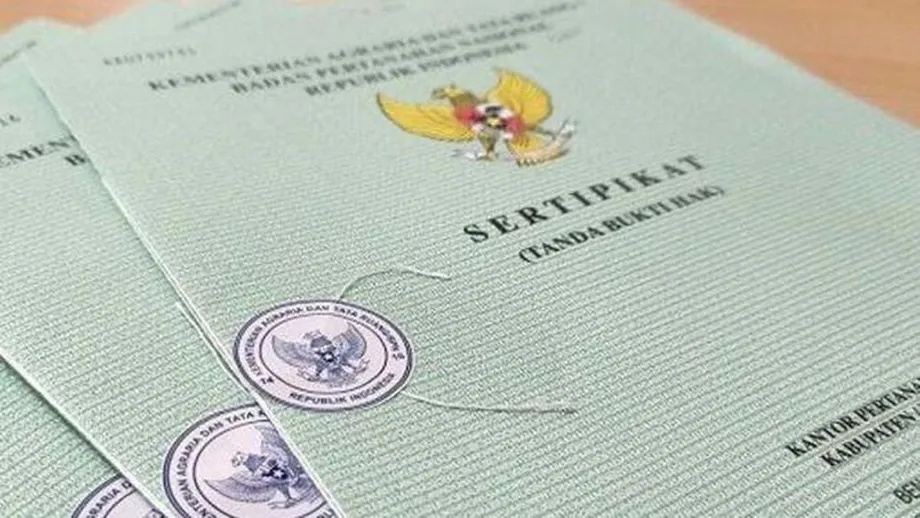
Three million certificates planned for lower income households
Indonesia plans to provide 3 million free housing certificates to lower income households in 2027, up from a target of 1 million in 2026, through a partnership between the Housing and Settlement Areas Ministry and the Agrarian Affairs and Spatial Planning Ministry/National Land Agency (ATR/BPN).
Contents
- Three million certificates planned for lower income households
- Who can receive a free certificate?
- What changes when HGB becomes SHM?
- How income eligibility will be checked
- Which documents should households prepare?
- Mapping land through Sentuh Tanahku
- When will the expanded program begin?
- Home repairs face a much larger target
- Business financing is part of the plan
- What households can do now
- Key Points
Housing Minister Maruarar Sirait outlined the expansion alongside two other priorities: repairing 400,000 homes and supporting family businesses through financing from state company PT Permodalan Nasional Madani (PNM). Together, the measures address three practical household needs: documents recording property rights, a safer home and money to support a livelihood.
The certification target would rise by 2 million, a 200 percent increase. Those figures are government goals, rather than a count of certificates already delivered. For households waiting for formal documentation, the next steps involve checking eligibility, assembling land records and having their plots mapped and verified.
The program covers several routes into home ownership. Recipients of government housing assistance, qualifying borrowers under the subsidized mortgage scheme and lower income people who build their own homes are among the intended beneficiaries.
Who can receive a free certificate?
Agrarian Affairs Minister Nusron Wahid identified three groups when the ministries agreed on the housing certification program in July 2026. The categories connect the initiative to existing housing support while also including families who have built without that assistance.
- Recipients of government housing assistance, including the home renovation program.
- Eligible borrowers under the Housing Financing Liquidity Facility (FLPP), whose building use rights can be upgraded to ownership rights.
- People who build their own homes and meet the definition of a lower income household.
For the mortgage group, Nusron specified that the building use right must already be registered in an individual's name before it is upgraded free of charge. Families in this category therefore need to check both their mortgage eligibility and the name recorded on their existing property document.
What changes when HGB becomes SHM?
The planned upgrades involve two Indonesian land rights: Hak Guna Bangunan (HGB), or building use rights, and Hak Milik, ownership rights documented through a Sertifikat Hak Milik (SHM). Understanding the difference helps explain why some households with an existing certificate are included.
HGB gives its holder the right to construct and own a building on land for a specified period. Hak Milik provides a stronger form of land ownership without the same fixed term. For an eligible household, the program would change the legal status recorded for its property.
Nusron explained the mortgage provision when discussing the agreement on July 14, 2026. The FLPP scheme supports access to subsidized housing loans, while the certificate measure addresses the rights attached to the property after purchase.
His requirement that HGB already be registered to an individual is particularly relevant to borrowers checking their paperwork. The announced benefit concerns upgrading that individual's existing right to SHM, so the current registration is part of determining whether the household qualifies for this route.
How income eligibility will be checked
The Housing Ministry is working with Statistics Indonesia (BPS) to identify recipients. BPS chief Amalia Adininggar Widyasanti described different verification methods for people with payslips and those earning a living outside formal salaried employment.
Workers with payslips will be assessed under Housing Ministerial Regulation No. 5 of 2025, which sets the relevant criteria for lower income households, known in Indonesia as MBR. A payslip gives officials a documented income figure to compare with the applicable rules.
Informal workers without payslips will be checked through the National Single Socioeconomic Data system (DTSEN). Amalia said the assessment includes households in the eighth decile or below.
A decile is one of 10 groups used to rank households by socioeconomic circumstances. The eighth decile and below covers the first eight groups in that ranking. Officials will use the database to assess people whose earnings may come from trading, casual work or other activities without a regular salary record.
Income verification and land verification serve different purposes. BPS helps establish whether a household meets the economic criteria, while land officials examine the property records and boundaries needed to issue or upgrade a certificate.
Which documents should households prepare?
Andi Tenri Abeng, ATR/BPN's staff expert for community participation and regional government, described the practical requirements in Palmerah, West Jakarta, on October 31, 2026. A clear history of the land is central to the process.
The documents she identified include records showing who holds the land, who is applying and whether the relevant land and building tax has been paid:
- A clear account of the land's ownership history.
- An identity card (KTP) and family card (KK).
- Proof of payment of Land and Building Tax (PBB).
- A land history document, such as a girik.
A girik is a traditional land record that can help officials trace a property's history. Abeng said that, for land supported by girik records, the chain of ownership should be traceable back to the 1960s. She also said officials would assist residents through the process.
For families whose land has passed between generations, this requirement makes older paperwork relevant to a present application. Identity documents identify the applicant, while the land history helps officials follow how the property came into that person's possession.
Mapping land through Sentuh Tanahku
Abeng directed residents to ATR/BPN's Sentuh Tanahku application after gathering their documents. Its Swaplotting feature helps map parcels that have not yet been recorded in the ministry's digital system.
The certification work was described as part of Pendaftaran Tanah Sistematis Lengkap (PTSL), Indonesia's systematic land registration program. In simple terms, officials need to connect the person and ownership documents to a particular piece of land on a map.
Residents are asked to enter the requested information through the application. Local kelurahan officials, including village heads, will help oversee data collection and validation. Their role connects the digital submission with checks in the community where the land is located.
The process also includes installing boundary markers, collecting documents and publicly announcing the land data so the details intended for the SHM can be checked. Plot location, boundaries and ownership history all need attention before the certificate is completed.
For applicants, the practical sequence is to prepare the records, map the parcel and cooperate with local verification. The announcement of land data provides a stage for checking the recorded details before the process moves forward.
When will the expanded program begin?
The national target is 3 million certificates in 2027, following the target of 1 million in 2026. Abeng said the registration effort she was discussing might not be ready for 2026 and would instead be budgeted for 2027, with local officials helping to oversee the work.
The main policy and implementation milestones span several months:
- July 14, 2026: Nusron explained the three beneficiary groups and the conditions for upgrading an individual's HGB to SHM.
- October 31, 2026: Abeng outlined document requirements, digital mapping and local oversight in West Jakarta.
- November 1, 2026: Maruarar's official statement set out the 3 million certificate target for 2027.
- November 2, 2026: His call to accelerate the 400,000 home renovation target was publicized.
- 2027: The government aims to expand free housing certification to 3 million certificates.
The Klender, East Jakarta, renovation visit associated with Maruarar's announcement was also dated October 1, 2026, while the official statement was dated November 1. The exact visit date was not clarified. No detailed national application timetable or regional allocation was announced.
Abeng's comments point to preparation taking place before the larger 2027 effort. Collecting records and identifying unrecorded parcels are tasks that local offices can organize while the budget and implementation arrangements are being prepared.
Home repairs face a much larger target
The certification drive accompanies a sharp expansion of Bantuan Stimulan Perumahan Swadaya (BSPS), the home renovation assistance program. Its target increased from 45,000 homes in 2025 to 400,000 in 2026.
That is an increase of 355,000 homes, making the 2026 goal about 8.9 times the previous year's target. The increase in planned renovations is proportionately larger than the tripling planned for free certificates between 2026 and 2027.
BSPS focuses on improving inadequate housing through stimulus assistance, household participation and community cooperation, known as gotong royong. Residents are encouraged to take part in improving their homes rather than receiving a newly built house through this particular program.
Maruarar urged regional implementation to be completed so the government could reach the 400,000 target. He identified Jakarta, West Java, Central Java, East Java, North Sumatra and Yogyakarta among the places where progress would be checked.
For a recipient household, renovation assistance and certification address separate needs. Repairs improve the condition of the dwelling, while a certificate records the rights attached to the property. Housing assistance recipients are among the groups eligible for the certification initiative.
Business financing is part of the plan
Maruarar also promoted support through PNM to strengthen family businesses. He described government support involving a reduction in financing interest from 22 percent to 8 percent.
The change amounts to 14 percentage points. For a household borrowing to support a business, a lower interest rate can reduce financing costs, although the amount payable also depends on the loan size, repayment period and product terms.
Maruarar, the housing minister, presented certification, economic assistance and renovation as connected parts of support for families:
The certificates are provided free, the family's economy is supported so their business can grow, and their house is renovated.
The approach brings together several government functions. The Housing Ministry handles housing support, ATR/BPN oversees land registration, BPS helps assess household eligibility and PNM provides business financing. A household's access to each measure depends on the requirements of the relevant program.
What households can do now
Families considering the certification program can begin by checking which beneficiary category fits their circumstances. Government housing assistance recipients, eligible FLPP borrowers and people who built their own homes have different starting points, even though all must meet the applicable requirements.
Applicants can also check whether their identity records, tax payment evidence and land history documents are available. Those seeking an HGB upgrade should check whose name appears on the existing certificate. Residents with older land records may need help tracing the ownership chain.
Local kelurahan officials and ATR/BPN have roles in collecting and validating information, while Sentuh Tanahku provides the digital mapping route described by Abeng. Preparing documents and checking property details gives households concrete tasks ahead of the planned expansion.
The government's challenge is to turn a much larger target into completed registrations while also accelerating home repairs. For residents, the most immediate issues are whether they qualify, whether their land records are complete and when their local registration work is scheduled.
Key Points
- Indonesia targets 3 million free housing certificates in 2027, up from 1 million in 2026.
- Eligible groups include housing assistance recipients, qualifying subsidized mortgage borrowers and lower income people who build their own homes.
- Income checks will use regulatory criteria for salaried workers and DTSEN data for informal workers.
- Applicants need identity documents, tax payment evidence and a clear land history, followed by mapping and verification.
- The home renovation target rose from 45,000 units in 2025 to 400,000 in 2026.
- A detailed national application timetable and regional certificate allocations have not been announced.