A Rs 30,213 crore debut with a pricing question
Jio Platforms is scheduled to begin trading on India's BSE and National Stock Exchange at 10 am on October 28, 2026, after a Rs 30,213 crore initial public offering drew bids for 22.19 times the shares available to public applicants. For its roughly 553 million mobile subscribers, the bigger question is whether the company that helped make internet access affordable will now push harder for higher bills.
Contents
- A Rs 30,213 crore debut with a pricing question
- New shares, rather than an investor exit
- Institutions drove the bidding surge
- How cheap data reshaped the market
- Airtel shows another way to earn from data
- Faster networks need stronger financial returns
- What subscribers could face next
- Growth extends beyond the phone bill
- A huge valuation, with different expectations
- Key Points
The company, controlled by Mukesh Ambani's Reliance Industries and backed by Meta and Google, fixed its offer price at Rs 1,119 a share. It is issuing 270 million new shares, with Rs 27,500 crore earmarked for repayment or prepayment of borrowings at its telecom subsidiary, Reliance Jio Infocomm.
Jio enters the stock market with enormous reach: about half of India's wireless broadband market, more than 40% of fixed broadband and roughly 60% of wireless data traffic. Its commercial challenge is increasingly about earning more from that network, rather than simply attracting more people with inexpensive plans.
Nitya Shah, cofounder of KamayaKya Wealth Management, argues that public ownership will change the company's pricing incentives.
"The era of Jio using cheap tariffs as a market-share weapon is drawing to a close," said Shah.
No new tariff increase or implementation date has been announced in connection with the listing. The concern for households comes from the combination of a more concentrated telecom market, rising data consumption and investor demand for stronger returns on network spending.
New shares, rather than an investor exit
Jio's offer consists entirely of newly issued shares. Reliance, Meta and Google are retaining their existing holdings through the transaction, while the money raised goes to Jio. Their percentage ownership falls because the total number of shares increases, a process called dilution.
Asia Daily's earlier examination of Jio's ownership structure put Reliance's holding at 66.43%, Meta affiliate Jaadhu Holdings at 9.98% and Google International at 7.73%, according to the draft prospectus. That coverage also identified a mismatch between a previously circulated fundraising target and the proposed share count and price range. The final Rs 30,213 crore figure matches 270 million shares priced at Rs 1,119 each.
Debt repayment accounts for about 91% of the issue proceeds, calculated from Rs 27,500 crore out of Rs 30,213 crore. The remaining proceeds are intended for general corporate purposes. For investors, that makes reducing borrowings a much larger immediate use of the fundraising than financing a new expansion program.
Jio described the purpose of becoming publicly traded in its red herring prospectus, the document that sets out an offering's business details, finances and risks.
"We expect to achieve the benefits of listing of the equity shares on the stock exchanges and creation of a public market for the equity shares," the company said.
Institutions drove the bidding surge
Jio received bids for approximately 4.38 billion shares against about 197.5 million available in the public subscription categories. Qualified institutional buyers, such as investment funds, subscribed for 70.55 times their allocation. The category for noninstitutional investors was subscribed 14 times, while retail investors applied for 2.72 times their reserved shares.
Demand including bids for the anchor placement exceeded Rs 7.4 lakh crore, or Rs 7.4 trillion. Anchor investors receive an allocation before the main subscription window. Public subscription bids alone exceeded Rs 4.9 lakh crore, while retail demand crossed Rs 25,867 crore.
Applications reached approximately 13.9 million, passing the roughly 9.73 million recorded for Waaree Energies. Jio's offering was described as the first globally to receive more than 10 million applications. Its size also exceeded Hyundai Motor India's roughly Rs 27,870 crore offering in 2024.
The issue reached full subscription within its first 100 minutes. BSE and NSE extended bidding to run from 9 am to 7 pm during the subscription period, compared with the usual 10 am to 5 pm window.
The timetable brings the transaction from applications to trading within a week:
- October 21, 2026: Subscriptions opened.
- October 23: Bidding closed, with final subscription at 22.19 times.
- October 26: Share allotment was finalized.
- October 27: Share credits and refunds were scheduled.
- October 28: Trading is scheduled to start at 10 am on BSE and NSE.
How cheap data reshaped the market
Jio entered India's telecom market in 2016 with deeply discounted services. Within three years, customer data usage had risen fiftyfold as prices fell, helping millions of people use the internet for payments, shopping, entertainment and food delivery.
India's telecom market also became much smaller in terms of competing operators. A sector once crowded with 17 companies narrowed to three main private operators. Critics accused Jio of using the financial strength of its parent to sustain a price war that competitors struggled to survive.
Jio's subscriber base reached roughly 553 million by 2026. At that scale, even a modest change in revenue per customer can have a large effect on company earnings. Winning another subscriber remains useful, but earning more from hundreds of millions of existing customers offers a different route to growth.
Competition remains politically sensitive. Elon Musk accused Ambani of trying to obstruct Starlink's entry into India and called him the "real boss of India". Reliance rejected the allegation and said it welcomed competition from Musk.
The listing brings that debate into sharper focus. Consumers value low prices, while shareholders want the company's extensive infrastructure to produce more income. Jio will have to balance those interests as it decides how to price mobile connections and home broadband.
Airtel shows another way to earn from data
Bharti Airtel provides a useful comparison because it has pursued customers willing to spend more. An October 26 industry analysis calculated combined mobile and home broadband average revenue per user at Rs 275 for Airtel and Rs 216 for Jio. That is a premium of about 27%, compared with roughly 6% in the April to June quarter of 2019.
Average revenue per user, usually shortened to ARPU, measures how much revenue an operator receives from an average customer over a given period. It helps explain why a company with fewer customers or less traffic can still generate strong earnings.
Airtel had approximately 30 million postpaid subscribers and 302 million smartphone customers as of June 2026. Smartphone customers accounted for around 80% of its mobile base. Its separately reported mobile ARPU was Rs 264 in the April to June quarter, while Rs 275 was the analysis's combined mobile and home broadband calculation.
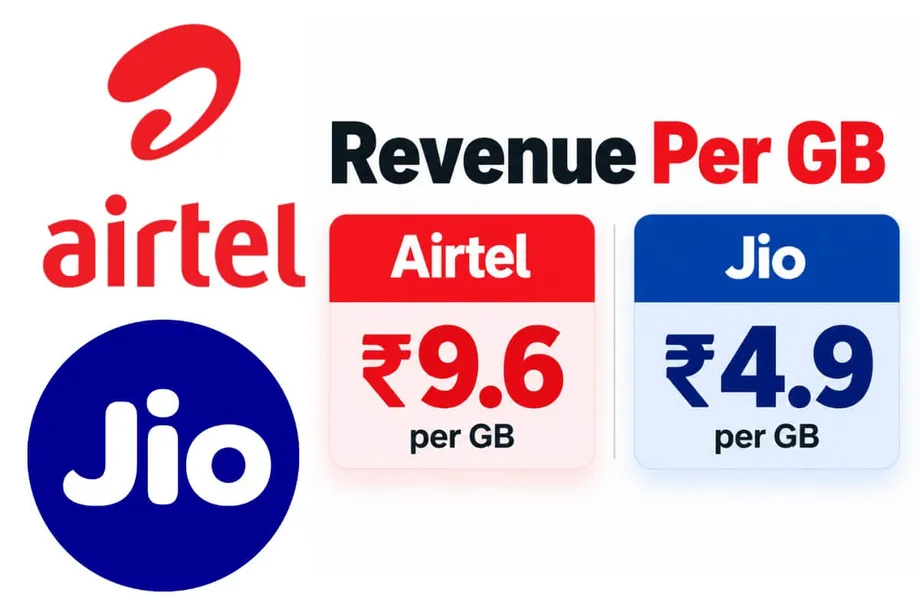
The same analysis estimated revenue per gigabyte at Rs 9.6 for Airtel and Rs 4.9 for Jio. Those calculations include voice and text message revenue, with Airtel covering mobile services and Jio also covering home broadband and fixed wireless access. They measure revenue across those business scopes; customers pay according to their individual plans.
Jio carried about 69 billion GB of quarterly traffic across mobile and home connections, including fixed wireless access. Airtel's disclosed 31 billion GB covered mobile traffic. The different coverage matters because home internet can consume substantial amounts of data.
Faster networks need stronger financial returns
Jio's investment has produced a measurable speed advantage. Opensignal measurements from February 2026 put average download speeds at approximately 107 megabits per second for Jio and 58 Mbps for Airtel. Jio's figure was about 84% higher.
Jio has invested in standalone 5G, a network design that uses a dedicated 5G core, as well as spectrum in the 700 MHz and 3.5 GHz bands. These investments support coverage, capacity and services such as home broadband delivered through a wireless connection.
Airtel, however, generated stronger financial returns from capital spending under the industry analysis's methodology. Between the financial years ending in 2023 and 2026, each Rs 100 of capital expenditure generated about Rs 35 in additional annual EBITDA for Airtel's mobile, home and business operations, compared with Rs 21 for Jio.
EBITDA is earnings before interest, tax, depreciation and amortization. It is commonly used to compare operating performance before financing costs and certain accounting charges. The analysis also estimated operating free cash flow margins of about 36% for Airtel and 29% for Jio in the financial year ending in 2026.
Jio therefore arrives at the market with a strong network and a clear commercial task: convert more of its traffic and infrastructure into cash. Higher tariffs are one option. Selling more home connections and digital services offers another.
What subscribers could face next
Indian consumers have already experienced broad tariff increases. Airtel moved first in November 2021, with Jio following within a week. Jio announced first in July 2024, followed by Airtel the next day.
Those episodes show how decisions by the largest operators can quickly affect prices across the sector. Shah argues that a reduced incentive for Jio to keep tariffs low could give competitors more room to raise their own prices.
Vodafone Idea, which faces a weaker financial position, could gain from that shift. Shah described the possible benefit for the company.
"The biggest beneficiary of this shift could be Vodafone Idea," said Shah.
Households with tight budgets may respond to higher charges by choosing cheaper packages or changing operators. For people who depend on mobile data for payments, schoolwork or running a small business, the practical issue is the cost of staying connected each month.
Jio's monthly data use per customer rose from 28.7 GB in 2024 to 42.3 GB in 2026, an increase of about 47% using those figures. Some estimates put usage at 65 GB by the end of the decade. Customers are consuming more data, giving operators a larger service to support and a larger commercial opportunity.
Growth extends beyond the phone bill
Jio's strategy includes moving customers to 5G, expanding fixed wireless broadband and selling services across entertainment, cloud computing, gaming and finance. Fixed wireless access connects a home through a mobile network rather than a fibre cable running directly to the property.
That can help Jio reach homes where fibre has not been installed. It also gives the company another way to earn from network capacity already built for mobile customers.
Jio's revenue rose from Rs 109,558 crore in the financial year ending in 2024 to Rs 146,885 crore in the year ending in 2026, an increase of about 34%. Net profit grew from Rs 21,423 crore to Rs 30,049 crore over the same period, or about 40%.
EBITDA increased from Rs 54,958 crore to Rs 76,255 crore. In the first quarter of the financial year ending in 2027, Jio recorded revenue of Rs 39,172 crore and net profit of Rs 7,764 crore.
Those figures give investors a business with growing earnings as well as a large audience. The next stage depends on how successfully Jio can increase spending per customer while keeping its services attractive to people accustomed to inexpensive connectivity.
A huge valuation, with different expectations
At Rs 1,119 a share, Jio's estimated market capitalization is Rs 10.30 lakh crore, approximately $108 billion. That would place it among India's largest listed businesses, although its ranking will depend on the trading price and the value of other companies when it debuts.
An equity valuation analysis put Jio at 33.3 times earnings for the financial year ending in 2026 and assigned a fair value range of Rs 1,167 to Rs 1,267 per share. Unofficial grey market indications suggested Rs 1,366, about 22% above the offer price. The actual opening price will be set through exchange trading.
Reliance's long history with individual shareholders adds to the interest. Founder Dhirubhai Ambani helped popularize share ownership among Indian households, building a loyal investor base through public meetings, dividends and major business announcements. Jio's debut offers those investors a direct stake in the group's telecom and digital business.
The transaction is less generous to its bankers than its scale might suggest. Jio is paying about Rs 196 crore to 19 banks, around 0.65% of the issue size, according to figures attributed to company filings. Hyundai Motor India paid about Rs 490 crore for its 2024 offering, while Paytm parent One 97 Communications paid about Rs 320 crore for its 2021 sale.
Competition for prominent deals has compressed banking fees, even as investor demand has surged. Jio's wider test begins after the celebrations: meeting public shareholders' expectations while serving hundreds of millions of people whose digital lives were built around cheap data.
Key Points
- Jio's Rs 30,213 crore IPO was priced at Rs 1,119 per share, with trading scheduled for October 28, 2026.
- Public subscription reached 22.19 times the available shares, led by institutional demand.
- The offer comprises 270 million new shares, with no shares sold by Reliance, Meta or Google.
- About Rs 27,500 crore, or 91% of proceeds, is intended for repayment of subsidiary borrowings.
- Jio has roughly 553 million mobile subscribers and faces pressure to earn more from its network and customers.
- No tariff increase tied to the listing has been announced, but analysts expect stronger incentives to raise revenue per user.