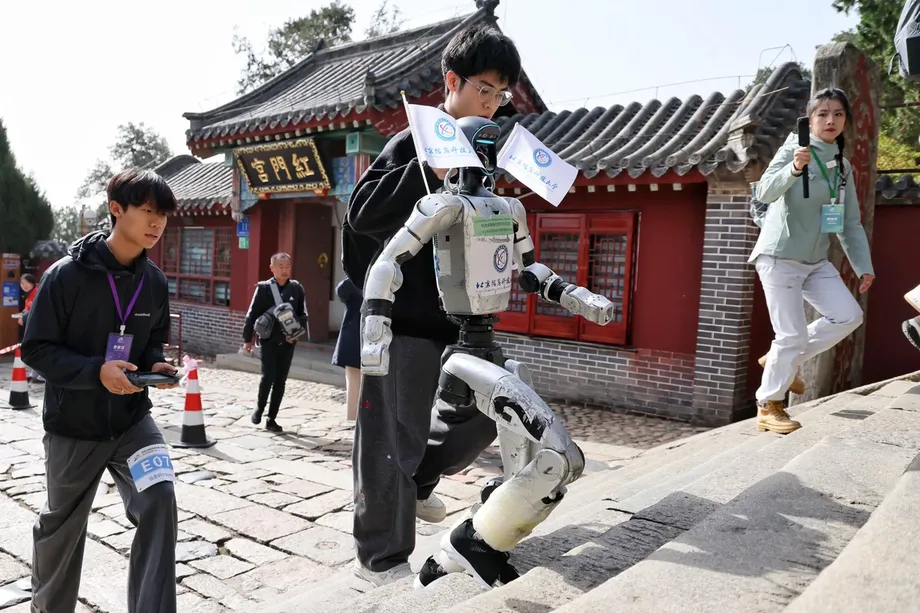
More than 3,100 steps put robots under pressure
A robot walking on four legs climbed a 3.9 kilometre course on China's Mount Tai in 43 minutes and 41 seconds, winning a mountain race that tested whether machines could handle steep stone steps, uneven ground and fragile cargo. Other competitors carried eggs, bottled water and watermelons, making balance as important as speed.
Contents
- More than 3,100 steps put robots under pressure
- Different races measured different abilities
- Why eggs make a demanding cargo
- Stone paths demand more than a steady stride
- Overheating brought one humanoid's climb to an end
- A fast climb on a route used by tourists
- Exoskeletons put people inside the test
- A historic mountain becomes a technology venue
- Key Points
Nearly 90 teams took part in the first CMG World Robot Mount Tai Climbing Competition, which opened on November 2 in Tai'an, in eastern China's Shandong province. Organised by the state broadcaster China Media Group, the event used the popular hiking route from Hongmen to Zhongtianmen, with more than 3,100 steps and over 600 metres of ascent.
The fastest machine on four legs was a Unitree A2 entered by Beijing Lingyi Technology, a Unitree subsidiary. The humanoid winner, entered by the Zhishen Lingyue team, completed its shorter official course in 27 minutes and 26 seconds. A third winner, the Lingsi Intelligent D50, carried a load and finished in 1 hour, 51 minutes and 29 seconds, earning 400 points.
Several machines struggled. One humanoid wearing a bandana collapsed on the cobbled path and needed engineers to intervene. Another fell down stairs and stopped beside a rubbish bin. A Unitree G1 development model entered by the Yongda Zhicheng team withdrew after overheating and was carried down the mountain by staff.
The combination of successful climbs, falls and a withdrawal gave the competition a practical purpose beyond its unusual spectacle: testing how robots perform when the ground, the load and the length of the journey all create problems at once.
Different races measured different abilities
Organisers set four formal events: humanoid speed, speed for robots with legs, load carrying for robots with legs, and assistance using robotic exoskeletons. A further exploration challenge tested movement across varied terrain. Cash prizes were offered in several categories.
The humanoid speed event had a shorter official route than the full mountain course. Its approximately 1.6 kilometre section ran from Hongmen Square to Doumu Palace and included more than 600 steps. Teams completing it could choose to attempt a harder stretch from Doumu Palace to Hutian Pavilion.
The winning humanoid, Zhishen Technology's Yinyi NE01, therefore faced a different task from the winning Unitree A2. Their finishing times belong to separate contests over different distances. For readers following the results, the main outcomes were:
- Robot speed on four legs: Beijing Lingyi Technology's Unitree A2, 43 minutes and 41 seconds.
- Humanoid speed on the official shorter course: Zhishen Lingyue team's Yinyi NE01, 27 minutes and 26 seconds.
- Load carrying: Lingsi Intelligent's D50, 400 points and a time of 1 hour, 51 minutes and 29 seconds.
The load contest also had its own measure of success. A fast climb mattered, but transporting goods required a machine to manage its cargo throughout the journey. The published result gives the winner's points and time, without explaining the full scoring formula.
Why eggs make a demanding cargo
Robots carrying baskets of eggs, mineral water and thermos flasks faced a problem familiar to anyone who has climbed stairs with shopping: the load changes how the body must balance. Watermelons added another bulky item to the competition's transport tasks.
A machine has to keep its combined weight and cargo supported as it lifts each foot. On stairs, that means repeatedly raising the load while adjusting to the next foothold. Sudden movements can destabilise the robot or damage what it is carrying, so a successful climb requires controlled movement as well as enough power.
Chen Xiyun, a marketing manager at Unitree Technology, described the load event as a demanding test of carrying capacity and the ability to adjust the centre of gravity during movement. In simple terms, the robot must keep shifting its balance as its legs and cargo move.
Chen said machines tested in this way could eventually serve in mountain supply delivery, emergency rescue and outdoor inspection. Those uses explain the choice of cargo: getting useful goods up a difficult path is a practical job, with the condition of the delivery mattering alongside the arrival time.
Stone paths demand more than a steady stride
Mount Tai's route mixes stairs, flatter stretches and stone paving. A robot that walks successfully on a smooth laboratory floor must make more frequent adjustments on this kind of terrain, choosing where to place its feet and how quickly to move.
Zhou Tong, deputy general manager of Shandong Youbaote Intelligent Robotics, said the team developed several movement strategies because a single fixed walking pattern was unsuitable for the mountain. The approach combined different strategies with training using large amounts of data from real settings.
Zhou described an effort to let the robot work out suitable movements for climbing, travelling quickly on level ground and even running. The goal was to remain both stable and fast as the route changed.
A gait is simply a pattern of leg movements. People change theirs almost without thinking when they leave a pavement and start climbing steps. A robot needs its control software to make equivalent decisions, while its motors carry out those movements accurately enough to keep it upright.
Overheating brought one humanoid's climb to an end
The Yongda Zhicheng team's Unitree G1 development model stopped competing because of excessive heat. Its operator chose to withdraw for safety, and staff carried the machine down the mountain.
A sustained ascent asks a robot to keep lifting its own weight against gravity. Motors, power electronics and other components produce heat as they work. Managing that heat is part of endurance, alongside battery capacity and the strength of the machine's moving parts.
The G1 withdrawal illustrated a different challenge from the visible falls elsewhere on the course. Staying upright is one requirement; continuing to operate through a long climb is another. Engineers also had to be ready to repair machines or remove them when they could no longer continue.
The competition placed those demands in the same journey. A machine needed sufficient power for the slope, reliable footing for the steps and enough endurance to keep working as the climb continued.
A fast climb on a route used by tourists
The Unitree A2's winning time was less than 44 minutes for the 3.9 kilometre course. Most tourists need at least two hours to complete that route, according to a comparison aired by China's state broadcaster.
Using two hours as the comparison, the robot finished in about 36% of that time, roughly 76 minutes sooner. Its average progress was about 5.4 kilometres per hour over a route that climbed more than 600 metres.
The tourist comparison gives a familiar sense of the pace. The competition results also show why speed was divided into categories: the humanoid had a shorter official route, while the load carrying winner spent nearly two hours completing a task that required transporting goods.
Exoskeletons put people inside the test
The exoskeleton assistance event brought a different kind of machine to the mountain. Rather than sending a robot up the route alone, an exoskeleton supports the person wearing it, using an external structure and mechanical assistance to help movement.
Its inclusion widened the competition from independent robot travel to machines that work directly with people. On a mountain staircase, assistance with repeated upward steps is a different engineering task from making an unattended robot choose its own footholds.
The programme placed both approaches in a real setting used by walkers. Alongside speed and cargo transport, organisers included an exploration challenge, extending the event to how machines move through varied terrain rather than simply how quickly they reach a fixed finish.
A historic mountain becomes a technology venue
Mount Tai is a UNESCO World Heritage site and one of China's most culturally important mountains. Emperors travelled there for ceremonies over many centuries, and the mountain holds a prominent place in Chinese mythology.
The race followed a familiar visitor route linking landmarks including Wanxian Tower and Doumu Palace. Its full course ended at Zhongtianmen, partway up the mountain, while the official humanoid course ended earlier at Doumu Palace.
Tourists stopped to watch and photograph the machines as they climbed. A Tai'an culture and tourism official described the competition as the world's first robot contest held in a real mountain setting, presenting it as a way to connect technology, sport and tourism.
Tai'an's tourism authorities said they planned to explore educational visits and technology experiences connected with the event. For the city, the competition offered another reason to visit an established cultural destination. For robot developers, the same ancient paths provided a demanding place to test modern machines.
Key Points
- Nearly 90 teams joined the competition, which opened on November 2 on Mount Tai in Shandong.
- The full route covered 3.9 kilometres, more than 3,100 steps and over 600 metres of ascent.
- Beijing Lingyi Technology's Unitree A2 won the speed event for robots on four legs in 43 minutes and 41 seconds.
- The winning humanoid finished a shorter official course in 27 minutes and 26 seconds.
- The Lingsi Intelligent D50 won the load carrying event with 400 points.
- A Unitree G1 development model withdrew after overheating, while other competitors suffered falls.
- The events tested speed, balance, carrying capacity, endurance and assistance for people climbing the mountain.