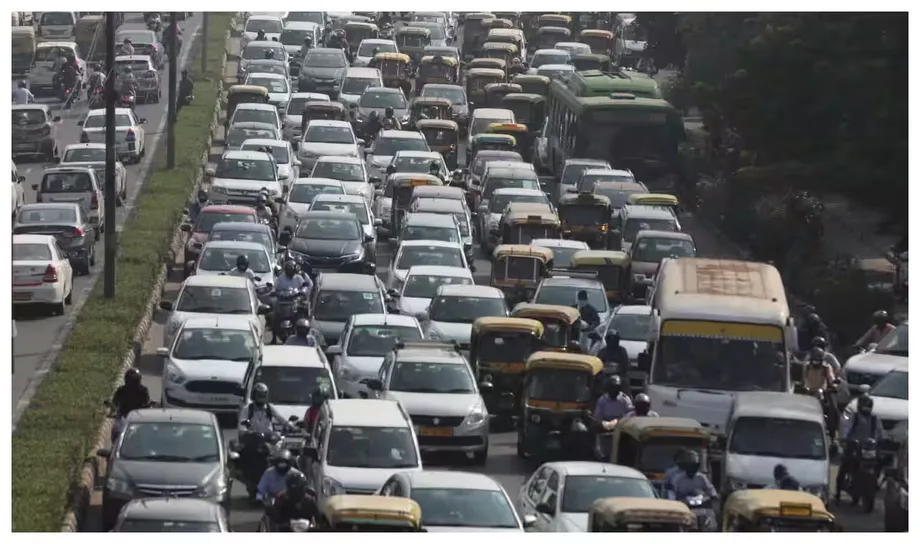
Record shipments meet a busy festive calendar
India's passenger vehicle dispatches crossed 500,000 units in October 2026 as manufacturers prepared dealerships for Dhanteras and Diwali in the first half of November. Maruti Suzuki, Hyundai and Mahindra reported monthly records, while Tata Motors and Kia also posted strong gains, supported by festive demand and cuts in the goods and services tax (GST).
Contents
- Record shipments meet a busy festive calendar
- What the different sales numbers mean
- Maruti supplies most of the retail increase
- Tata edges ahead in domestic volumes
- Mahindra and Hyundai reach new highs
- Kia beats its September record
- Why electric registrations fell as the market grew
- Mahindra and MG gain electric market share
- Mahindra's wider business shows the calendar effect
- Key Points
Maruti dispatched 212,384 passenger vehicles to the domestic market. Tata followed with 73,894, narrowly ahead of Mahindra's record 73,338 domestic sport utility vehicles (SUVs). Hyundai recorded 62,799 domestic sales, while Kia reached a monthly wholesale record of 33,462 vehicles.
Customer registrations also rose sharply. Vahan vehicle registration data put October passenger vehicle registrations at 498,208, up 15.1% from September's 432,802. Electric car registrations moved in the opposite direction, falling 4% to 35,777 as supply constraints affected Tata and registrations declined at Vinfast.
October therefore brought two connected developments: a broad expansion in the car market and a tighter supply situation for some electric models. For buyers, the practical difference was availability. Dealerships were receiving more vehicles before the festivals, but some electric car customers were still waiting for manufacturers and component suppliers to catch up.
What the different sales numbers mean
Manufacturers' dispatches, also called wholesales, count vehicles sent into the dealer network. Retail registrations record vehicles registered for customers. A car can reach a dealership in one month and be registered to its buyer in the next, so the two measures follow different stages of a purchase.
October's dispatch total above 500,000 captured manufacturers preparing for the November festivals. The 498,208 passenger vehicle registrations captured activity further along the sales process. Company totals can also include exports, commercial vehicles or other categories, making domestic passenger vehicle figures the most useful comparison between carmakers.
The calendar helps explain the sequence:
- February 2026: The starting point for Tata's later statement that electric vehicle bookings had tripled.
- September 2026: Passenger vehicle registrations reached 432,802 and electric car registrations reached 37,284.
- October 27, 2026: Tata passenger vehicle chief Shailesh Chandra said electric vehicle supply could take another two to three months to catch up with demand.
- October 2026: Passenger vehicle dispatches exceeded 500,000, while registrations reached 498,208.
- First half of November 2026: Dhanteras and Diwali were expected to bring the main festive buying period.
GST cuts supported demand, alongside the festivals. The October sales figures give no precise measure of how much growth came from the tax changes and how much came from seasonal purchases. November buying will provide the next view of how the vehicles shipped in October move through dealerships.
Maruti supplies most of the retail increase
Maruti Suzuki's total October sales reached a record 276,120 vehicles, up 25% from 220,894 a year earlier. Within that broader total, domestic passenger vehicle dispatches rose to 212,384 from 176,318, an increase of 36,066 vehicles, or about 20.5%.
Growth extended across different kinds of vehicles. Maruti's utility vehicle sales rose to 97,787 from 77,571, while its passenger car category increased to 100,877 from 85,210. Utility vehicles grew by about 26%, compared with about 18% for the passenger car category, showing the stronger pace of expansion in the larger vehicle group.
Maruti's retail performance was especially important to the market's monthly increase. Vahan registrations rose to 211,444 from 172,872 in September, adding 38,572 vehicles. Across the entire passenger vehicle market, registrations increased by 65,406. Maruti therefore accounted for nearly 59% of that additional volume.
Partho Banerjee, Maruti Suzuki's senior executive officer for marketing and sales, said dealership inventory stood at 12 days ahead of Diwali. Inventory expressed in days estimates how long the stock on hand would last at the prevailing sales pace. That gave a more immediate view of dealership supply than the company's dispatch record alone.
Tata edges ahead in domestic volumes
Tata Motors Passenger Vehicles recorded total October sales of 75,426 vehicles, up 23% from 61,295 in October 2025. Domestic sales increased 21% to 73,894 from 61,134, putting Tata second behind Maruti in the monthly passenger vehicle ranking.
Tata's domestic total exceeded Mahindra's by just 556 vehicles. That narrow gap contrasts with Maruti's much larger lead: its 212,384 domestic passenger vehicle dispatches were more than 2.8 times Tata's volume.
International business also increased sharply, reaching 1,532 vehicles from 161 a year earlier. The percentage rise was large because the earlier total was small. Domestic sales still represented almost 98% of Tata's combined passenger vehicle volume, keeping the Indian market central to its performance.
Tata's electric vehicle sales across domestic and international markets reached 16,244, up 75% from 9,286 a year earlier. Electric vehicles accounted for about 21.5% of Tata's October total, compared with about 15.1% in October 2025. The company added 6,958 electric vehicles against an increase of 14,131 vehicles across its passenger vehicle business.
Mahindra and Hyundai reach new highs
Mahindra's domestic SUV dispatches reached a record 73,338, compared with 71,624 in October 2025. Annual growth was 2.4%, while the increase from September's 64,092 vehicles was a stronger 14.4%, or 9,246 additional SUVs.
Mahindra's longer period of growth was also stronger than its October annual comparison. Domestic SUV sales for April through October in the financial year ending March 2027 reached 431,480, up about 17% from 369,194 a year earlier. Including exports, October utility vehicle sales totalled 74,904.
Hyundai's total sales reached 82,299 vehicles, up 17.7% from a year earlier. Domestic sales increased 16.7% to 62,799, while exports rose 21.1% to 19,500. Exports accounted for almost one quarter of Hyundai's total, illustrating why its combined figure was substantially higher than its Indian market volume.
The two companies arrived at their October results through different mixes of business. Mahindra's passenger vehicle performance centred on domestic SUVs, while Hyundai's total included a sizeable export contribution. Both benefited from stronger volumes as the market approached its main festive purchases.
Kia beats its September record
Kia India set a monthly wholesale record for the second consecutive month, dispatching 33,462 vehicles in October. That was 13.22% above October 2025's 29,556 and 4.51% above the previous record of 32,017 set in September 2026.
Kia's January through October wholesales reached 286,470, up 21.31% from 236,138 in the same period of 2025. With two months left in the year, the company had already exceeded its full 2025 total of 280,286 by 6,184 vehicles.
The Seltos contributed more than 13,000 October sales, roughly 39% of Kia's monthly total. The Sonet was another leading contributor. Kia said the Seltos had maintained average monthly sales above 10,000 since the latest model's launch in January 2026.
Atul Sood, Kia India's senior vice president for sales and marketing, attributed the record to festive demand, established models and the response to newer products. Kia also reported record electric vehicle sales, up 31% from September, with the Syros EV and Carens Clavis EV contributing. CNG versions of the Carens and Carens Clavis accounted for close to 10% of October sales, adding another fuel option to the company's sales mix.
Why electric registrations fell as the market grew
Electric car registrations across ten manufacturers declined to 35,777 in October from September's 37,284. Their share of the tracked passenger vehicle market fell to 7.2% from 8.6%, because electric registrations decreased while the wider market expanded.
Tata showed that split within a single manufacturer. Its total passenger vehicle registrations rose 24.3% from September to 73,002, but its electric vehicle registrations fell 7.1% to 14,552 from 15,660. Vinfast registrations declined 22.4% to 2,565 from 3,304.
Together, Tata and Vinfast registered 1,847 fewer electric cars than in September. The entire electric car market fell by a smaller 1,507 vehicles, meaning gains at other manufacturers offset part of their decline.
Tata Motors Passenger Vehicles managing director and chief executive Shailesh Chandra said at an industry event on October 27 that electric vehicle bookings had tripled since February. He said supply could take another two to three months to catch up as component manufacturers expanded capacity.
A Tata Motors Passenger Vehicles spokesperson described demand and the company's response:
There was "growing customer preference for EVs, with demand continuing to exceed supply", and the company was "scaling up supply" to improve availability.
Tata's 75% annual increase in electric vehicle sales and its monthly decline in electric registrations cover different comparisons. The former counts domestic and international company sales against October 2025; the latter tracks Indian registrations against September 2026. Together, they describe a business selling far more electric vehicles than a year earlier while facing difficulty meeting recent demand.
Mahindra and MG gain electric market share
Mahindra's electric car registrations rose 3.4% from September to 8,472, while JSW MG Motor increased 6.5% to 5,877. Their combined share of the tracked electric car market climbed to 40.1% from 36.8%.
Tata remained the largest electric car manufacturer by registrations, with a 40.7% share, down from 42% in September. Its lead over Mahindra narrowed to 6,080 vehicles from 7,468. That brought the two closer even as Tata retained a substantial monthly lead.
October was still the second highest month for electric car registrations in 2026, behind September. Its 35,777 registrations exceeded July's 34,013 and August's 31,987. The market had stepped back from a record month while remaining above those earlier levels.
For January through October, electric car registrations totalled 287,453. Tata led with 117,547, followed by Mahindra at 66,945 and MG at 55,016. Together, those three manufacturers accounted for about 83% of the total, showing how heavily the electric car market depended on their ability to supply vehicles.
Mahindra's wider business shows the calendar effect
Mahindra's total automotive sales, including exports, reached 131,109 vehicles in October, up 9% from a year earlier. Alongside SUVs, domestic light commercial vehicle sales rose 4% to 33,037, and three wheeler sales increased 38% to 17,632.
Vehicles in the category weighing between 2 and 3.5 tonnes drove commercial vehicle growth, rising 5% to 28,654. Sales below 2 tonnes fell 4% to 4,383. Three wheeler sales for April through October reached 99,690, up 50% from 66,340.
Automotive exports rose 77% to 7,102 vehicles, while cumulative exports for April through October increased about 53% to 37,133. The separately reported trucks and buses business sold 2,838 vehicles, up 40%, led by a 62% rise in cargo vehicle sales.
Mahindra's tractor business moved in the opposite direction. Domestic tractor sales fell 13% to 62,626 from 72,071, a decline the company attributed primarily to Diwali moving into November from October the previous year. Domestic tractor sales for April through October were still about 2% higher at 325,498.
For the passenger vehicle market, the next stage is the conversion of festive stock into customer purchases. For Tata's electric vehicle customers, the next stated supply window was the two to three months after October 27. Those schedules put the focus on November registrations and production through the following months.
Key Points
- India's October 2026 passenger vehicle dispatches exceeded 500,000 ahead of Dhanteras and Diwali in November.
- Passenger vehicle registrations rose 15.1% from September to 498,208, with Maruti contributing nearly 59% of the increase.
- Maruti dispatched 212,384 domestic passenger vehicles, followed by Tata at 73,894 and Mahindra at 73,338.
- Hyundai recorded 62,799 domestic sales, while Kia set a monthly wholesale record of 33,462.
- Electric car registrations fell 4% to 35,777 as Tata faced supply constraints and Vinfast registrations declined.
- Mahindra and MG increased their combined electric car market share to 40.1%, while Tata remained the leader.
- Tata expected electric vehicle supply to take another two to three months to catch up with demand after October 27.