Lee seeks to turn the chip boom into broader growth
South Korean President Lee Jae Myung has proposed allocating 21.3 trillion won, about US$16 billion, to artificial intelligence, semiconductors and related projects in 2027, nearly twice the amount set aside for 2026. The investment sits within a record 820.9 trillion won budget that would increase government spending by 12.8 percent.
Contents
- Lee seeks to turn the chip boom into broader growth
- What the 21.3 trillion won would fund
- A national AI model and the infrastructure beneath it
- How public spending connects with corporate investment
- Exports are financing a larger ambition
- What the Future Response Fund would do
- Why debt is at the centre of the argument
- Defence spending would rise alongside civilian AI
- The dates that determine what happens next
- Key Points
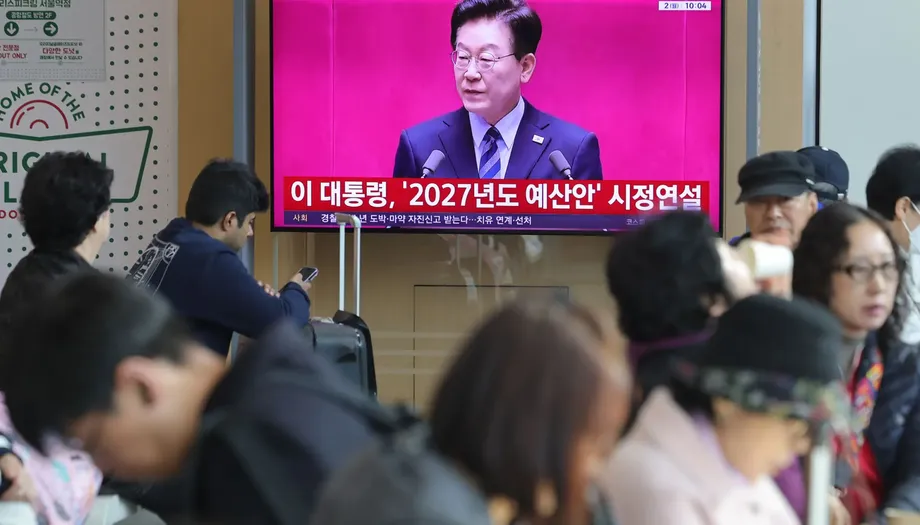
Addressing the National Assembly on November 2, 2026, Lee asked lawmakers to approve a spending plan that uses rising tax revenue from the semiconductor boom to finance new industries, regional development and household support. Parliament faces a December 2 legal deadline to finalize the budget.
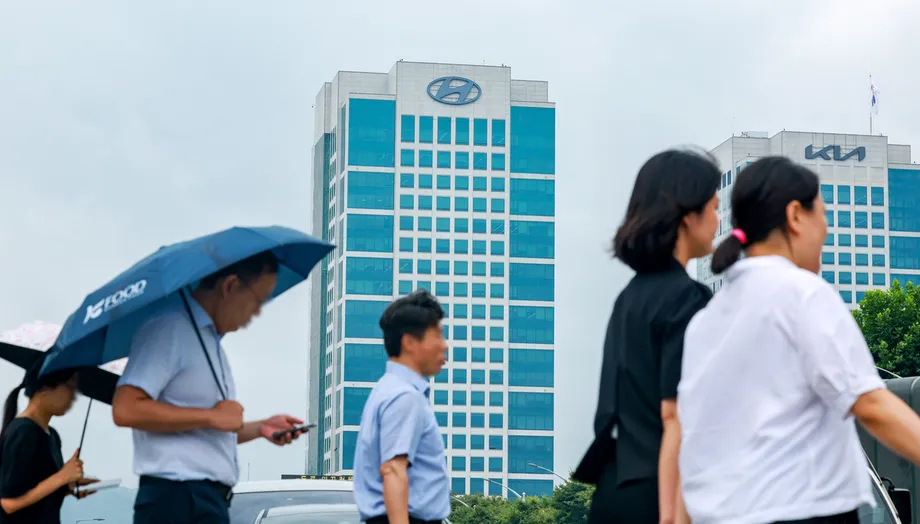
Samsung Electronics and SK hynix are benefiting from intense demand for memory chips used in AI systems. Their success has lifted exports, investment and government revenue, giving Lee room to propose larger spending while forecasting a smaller fiscal deficit.
Lee presented the budget as an attempt to spread those gains beyond a small number of companies, workers and regions. The president described the economic shift he wants:
We must make a great transition from 'growth for the few,' in which opportunities and gains are concentrated among certain regions, classes and a small number of companies, to 'growth for all,'
The central political dispute is how to use the windfall. Lee wants to invest much of it in future growth, while the opposition People Power Party argues that a large share should instead reduce national debt. His Democratic Party holds a parliamentary majority, making passage likely, although the spending details still face committee scrutiny.
What the 21.3 trillion won would fund
The technology package combines broader AI investment with three major projects: semiconductor production, physical AI and AI data centres. The government wants these activities to support one another, connecting the factories that manufacture chips with the computing facilities and machines that use them.
Physical AI means artificial intelligence operating through machines in the real world, including robots. An AI system that answers a question produces information; a robot using AI can interpret its surroundings and carry out a physical task. Lee's plans include robotics research and development centres alongside semiconductor hubs and large computing facilities.
Data centres house the computers, memory and networking equipment needed to train and operate AI systems. Expanding them creates demand for chips, but also requires electricity, cooling and reliable connections between thousands of processors.
The 21.3 trillion won package equals about 2.6 percent of the proposed 820.9 trillion won national budget. Its importance extends beyond that share because the government is pairing public spending with much larger investment plans involving private companies.
Lee also outlined 13.8 trillion won for competitiveness across 10 strategic technology sectors. The speech presented the technology measures as a way to increase economic growth potential, meaning how much the economy can sustainably produce as its skills, equipment and productivity improve.
A national AI model and the infrastructure beneath it
Lee wants South Korea to develop a national AI model capable of competing with the strongest systems internationally. Such a model is often called sovereign AI: technology developed under domestic control, giving a country greater influence over its operation, data practices and continued availability.
The proposed allocation for this effort was described as 4.6 trillion won for a sovereign AI model and as 4.7 trillion won for frontier AI development projects, including a domestic model. The figures refer to descriptions of closely related initiatives; a detailed reconciliation of their scope was not given.
Lee described the domestic model as a national strategic asset and set a goal of reaching the highest international performance levels. Frontier AI refers to systems at the leading edge of current capabilities, rather than a separate type of computer hardware.
The government also proposes 2.1 trillion won for electricity, water supplies and infrastructure serving industrial complexes. Semiconductor plants need stable power around the clock, while chip manufacturing and data centre cooling place substantial demands on water and energy systems.
For communities receiving new facilities, these supporting works are a practical part of the investment. A factory or computing centre needs functioning utilities before it can begin producing chips or operating AI systems.
How public spending connects with corporate investment
Lee's budget builds on a partnership between government and business announced in June 2026. That initiative called for semiconductor hubs across the country, robotics research centres and AI data centres with electricity requirements measured in gigawatts.
A gigawatt is one billion watts, a measure of power rather than computing performance. Using that unit to describe data centres shows the scale of the electricity infrastructure involved.
The June programme carried investment plans approaching US$1.2 trillion. Samsung and SK hynix also announced domestic investment plans exceeding 4,755 trillion won, while Lee is pursuing an 800 trillion won private sector semiconductor development in the southwest. These are broader corporate and development commitments, with different scopes from the government's proposed spending for 2027.
South Korea's expanding AI supply chain already extends beyond the two memory manufacturers. An October agreement for dedicated AI substrate lines involves Samsung Electro-Mechanics and Nvidia investing in production at Sejong and Busan. Substrates provide the electrical connections between a chip and the surrounding computer system.
The regional element matters to Lee's stated goal of sharing growth more widely. Nationwide production hubs and research centres would place more of the activity supporting AI outside a small number of established industrial locations.
Exports are financing a larger ambition
South Korea recorded US$930 billion in exports from January through October, leaving US$70 billion to reach US$1 trillion for the year. Passing that threshold would make it the fourth country to do so, after the United States, China and Germany.
The economy also grew faster than expected in the third quarter, supported by semiconductor exports and investment. Strong demand for advanced memory has raised earnings at Samsung and SK hynix, increasing the tax revenue underpinning Lee's budget proposal.
AI computing requires processors to receive large amounts of information quickly. Memory chips supply that information, making memory capacity and speed central to the performance of AI systems. South Korea's position as a major memory supplier has therefore become a source of both corporate profits and public revenue.
The production response has extended beyond South Korea. Samsung and SK hynix increased investment at Chinese factories as AI demand deepened shortages, while equipment approvals from Washington became an important condition for further upgrades.
Lee's fiscal strategy links the current boom with future investment: collect more revenue from profitable chip companies, then use part of that revenue to build industries and infrastructure intended to support growth over a longer period. That connection also explains the opposition's concern about relying on exceptional semiconductor earnings.
What the Future Response Fund would do
The proposed Future Response Fund is valued at 162.3 trillion won and would draw largely on additional tax revenue generated by the semiconductor boom. Its purposes include supporting growth industries, younger people, regional development and education, while providing a buffer against future revenue shortfalls.
Lee also outlined a first allocation of 45.4 trillion won for 2027. The fund's larger headline size and the amount allocated for its initial year describe different parts of the plan: its proposed financial scale and its opening allocation.
The president presented the fund as a strategic investment platform that could strengthen growth potential and reduce social gaps. Its revenue buffer would address another problem with a chip boom: tax receipts can rise sharply when corporate earnings surge and weaken when industry conditions change.
Kim Jin-wook, an economist at Citi, estimated that the fund's cumulative funding sources could reach 215 trillion won across 2026 and 2027. That is his projection for funding over two years, alongside the government's proposed fund figure.
Housing, employment and financial assistance form another part of Lee's approach. His administration is pursuing initiatives for households with low incomes, including microfinance, which provides access to relatively small loans for people who may struggle to obtain conventional credit.
The uneven distribution of chip wealth has already become a public issue. April's chip bonus and wage disputes highlighted the contrast between exceptional rewards in parts of the semiconductor industry and more modest gains elsewhere in the economy.
Why debt is at the centre of the argument
Lee said the fiscal deficit is projected to fall from 3.9 percent of gross domestic product in 2026 to 0.1 percent in 2027. He also forecast that public debt would decline from 51.6 percent of GDP to 48.3 percent.
A deficit measures the gap between government spending and revenue during a period. The debt ratio compares accumulated borrowing with the size of the economy. Lee's forecasts amount to a reduction of 3.8 percentage points in the deficit ratio and 3.3 percentage points in the debt ratio.
Before his speech, Lee met National Assembly Speaker Cho Jeong-sik and leaders from the ruling and opposition parties. He said the budget would allow public finances to operate with almost no new bond issuance, reflecting his expectation of stronger revenue.
The president also cited restructuring 107.2 trillion won in expenditures and converting 1.9 trillion won in tax benefits into direct financial support. These changes form part of how his administration presents the financing and distribution of the larger budget.
People Power Party policy chief Lim Lee-ja argued that around 100 trillion won should instead go toward debt repayment, citing uncertainty about how long the semiconductor boom will last. Lim gave the proposed fund a hostile label:
Future Erosion Fund
Democratic Party spokesperson Park Sung-joon defended investment in AI, young people and regional development, rejecting the call to redirect the money toward debt repayment. Lee acknowledged that the opposition's preference had merit, but argued that investment could produce greater benefits by supporting sustained growth.
Citi economist Kim said South Korea could eventually receive an upgrade from Fitch's AA- credit rating toward AA. He linked that possibility to stronger growth potential and fiscal sustainability. His assessment concerns a possible future rating decision.
Defence spending would rise alongside civilian AI
The government proposes increasing defence spending by 8.2 percent to 73.3 trillion won in 2027. Lee connected the increase with acquiring capabilities needed for South Korea to take over wartime operational control of its forces from the United States.
Wartime operational control concerns who directs military operations during a conflict. Lee cited submarines powered by nuclear reactors and KF-21 fighter jets among the capabilities his government wants to secure.
The president also outlined a larger role for AI, robots and drones in systems combining personnel with equipment operating without people aboard. Lee described the military transformation he seeks:
rapidly transform our military into a smart, elite force by establishing integrated manned and unmanned systems based on AI, robots and drones
South Korea announced an agreement with Washington in 2025 to build submarines powered by nuclear reactors. North Korea opposed that programme and has recently said that a precision guided torpedo system and an intermediate range hypersonic missile used AI technology.
The defence proposal places AI within both industrial and security policy. Civilian spending would support computing, factories and robotics, while military spending would seek to apply related technologies to equipment and command systems.
The dates that determine what happens next
The National Assembly must now examine the proposal and decide its final allocations. The Special Committee on Budget and Accounts is scheduled to begin comprehensive policy questioning on November 4, followed by standing committee reviews and detailed examination by a budget subcommittee.
The main dates trace the plan from industrial commitments to the parliamentary decision:
- June 2026: Lee announced the partnership for nationwide semiconductor hubs, robotics research centres and large AI data centres.
- September 2026: The government submitted its 820.9 trillion won budget proposal and announced the Future Response Fund plan.
- November 2, 2026: Lee presented his budget policy speech and requested support from ruling and opposition lawmakers.
- November 4, 2026: Parliamentary budget deliberations are scheduled to begin with the Special Committee on Budget and Accounts.
- December 2, 2026: The National Assembly faces its legal deadline to finalize the 2027 budget.
Lee's parliamentary majority gives the proposal a strong route to approval. The immediate contest is over how much of the semiconductor windfall should finance new investment, how much should support households and how much should reduce debt. Those decisions will shape the final spending plan for 2027.
Key Points
- South Korea proposes a record 820.9 trillion won budget for 2027, up 12.8 percent.
- AI, semiconductors, physical AI and data centres would receive 21.3 trillion won, nearly twice the 2026 amount.
- The proposed Future Response Fund would channel semiconductor tax revenue into growth, regional development, education and support for younger people.
- The opposition wants around 100 trillion won directed toward debt repayment instead.
- Defence spending would rise 8.2 percent to 73.3 trillion won.
- Parliament faces a December 2 deadline to finalize the budget.