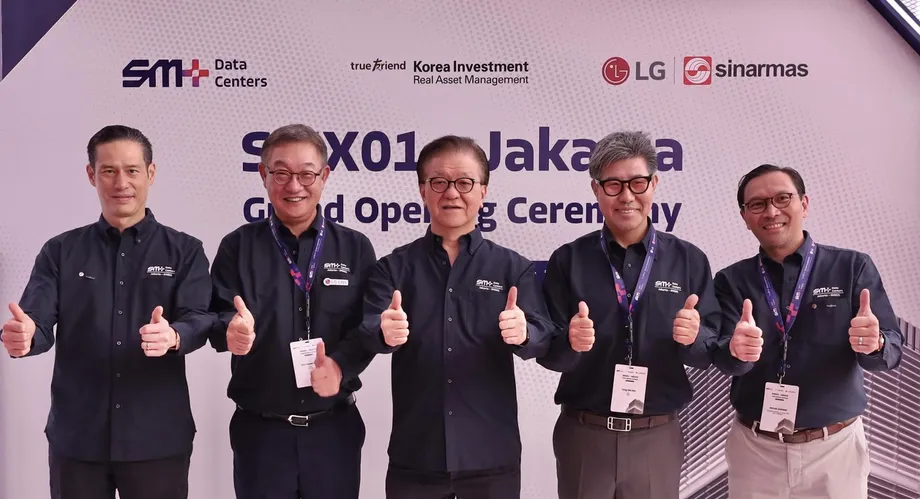
Jakarta facility opens with all capacity booked
LG CNS has completed a 30 megawatt artificial intelligence data center in Jakarta, Indonesia, with customers secured for its entire capacity before construction finished. The South Korean technology company is already designing a further phase that could bring the site's total incoming power capacity to 400 megawatts.
Contents
- Jakarta facility opens with all capacity booked
- What the 30 megawatt capacity means
- Power systems built for dense GPU racks
- Air cooling comes first, liquid cooling follows
- The proposed expansion is more than thirteen times larger
- Three LG businesses supply one project
- Five markets feature in the expansion plan
- Beyond buildings to GPU subscriptions
- Key Points
The company announced the completion on November 2, 2026. It described the project as the first time a South Korean company had directly built an AI data center overseas for an overseas customer. KMG, a joint venture between Indonesia's Sinar Mas Group and Korea Investment Real Asset Management, commissioned the facility last year.
The center is designed for demanding computing tasks using next generation graphics processing units, or GPUs. These processors perform many calculations at once, making them useful for training and running AI systems. Putting many GPUs together requires large amounts of electricity and equipment to carry away the heat they produce.
LG CNS, the information technology affiliate of LG Group, supplied the project's design, construction and operating expertise. LG Electronics provided air conditioning systems, while LG Energy Solution supplied batteries. The group calls this combined approach its One LG solution.
The completed facility gives LG CNS a project it can point to as it seeks more business across Asia and the Pacific. Its target markets include Malaysia, Thailand, Vietnam, the Philippines and Japan. The next steps in Jakarta involve a much larger power supply and the addition of liquid cooling in later construction phases.
What the 30 megawatt capacity means
A megawatt is a measure of power, equal to 1,000 kilowatts. Data center capacity is commonly described through electricity because the power available helps determine how much computing equipment a facility can support, alongside its cooling and other infrastructure.
LG CNS describes the completed Jakarta center as a hyperscale AI facility. In plain language, it is a large data center designed to accommodate substantial computing resources. Its equipment is intended to support high performance computing with GPUs, rather than simply provide space for ordinary business servers.
The company said all of the facility's capacity had customers before construction was complete. That gives the project a commercial milestone alongside its engineering achievement: its initial capacity was already committed when the building work finished.
For businesses using the center, the service brings together the physical requirements of AI computing in one location: space for servers, a substantial power supply, cooling and backup infrastructure. Those requirements grow more demanding as customers install more powerful equipment in a limited area.
Power systems built for dense GPU racks
LG CNS said the power system can supply more than 300 kilowatts to a single rack, roughly 60 times the requirement of a typical data center rack. A rack is the frame that holds servers and associated equipment, usually stacked vertically.
The comparison shows how concentrated AI computing can become. Using the company's approximate ratio, 300 kilowatts is 60 times 5 kilowatts. A rack filled with powerful GPU servers can therefore require electricity on a very different scale from a conventional rack.
Supporting that concentration calls for more than bringing a large power connection into the building. Electricity must also reach the equipment reliably through the facility's internal systems. LG CNS designed the Jakarta infrastructure for racks containing multiple GPUs and the heavy electrical demand that comes with them.
The power infrastructure includes duplicate systems so backup power can support operations if the main supply is interrupted. LG CNS says this arrangement is intended to maintain service around the clock throughout the year. LG Energy Solution's batteries form part of the project's integrated energy infrastructure.
Air cooling comes first, liquid cooling follows
The first completed phase uses air cooling. Air conditioning equipment circulates cooled air to remove heat from the servers and help keep operating temperatures under control. LG Electronics supplied the project's air conditioning systems.
LG CNS has designed the facility around a cooling architecture that allows air and liquid technologies to be used across its development. Liquid cooling is planned for subsequent phases, when it will help manage heat from densely installed GPU equipment.
Liquid cooling carries heat away using fluid near, or in direct contact with cooling components attached to, hot equipment. It offers a way to remove concentrated heat from powerful processors. The planned addition is particularly relevant to racks containing many GPUs, where a large amount of heat is generated in a small space.
The sequence matters for understanding what has been delivered. Jakarta's completed first phase relies on air cooling, while the later construction program includes liquid cooling. The larger project is being developed in stages, with changes to cooling accompanying its planned growth.
The proposed expansion is more than thirteen times larger
LG CNS is carrying out design work for the next construction phase. Once the wider development is completed, the company expects total power receiving capacity to reach 400 megawatts, potentially making the site one of Indonesia's largest AI data center facilities.
Compared with the completed 30 megawatt phase, the proposed total is about 13.3 times as large. The difference is 370 megawatts. That comparison describes the scale of the power ambition, with the 400 megawatt figure referring to total incoming power capacity after expansion.
The company has not given a completion date for the expansion, named the tenants or disclosed the project's cost. For now, the concrete milestones are the completion and booking of the initial facility, followed by design work for further construction.
The project's sequence is:
- 2025: KMG commissioned the Jakarta data center project.
- November 2, 2026: LG CNS announced completion of the 30 megawatt facility, with its full capacity already booked.
- At the completion announcement: Design work was under way for further construction targeting 400 megawatts of total incoming power capacity.
- Later phases: LG CNS plans to add liquid cooling to support equipment with greater heat output.
Three LG businesses supply one project
LG CNS brought together its data center design, build and operate capabilities, often shortened to DBO, for the Jakarta project. The term covers the work needed to plan a facility, construct it and support its operation.
LG Electronics and LG Energy Solution supplied separate parts of the infrastructure through the One LG approach. Air conditioning manages the heat produced by computing equipment, while batteries support the energy systems. LG CNS combined these capabilities within the wider power and cooling design.
The Jakarta project gives this group strategy a completed overseas example. Rather than selling only construction work or individual pieces of equipment, the participating companies supplied connected parts of an AI facility.
For LG CNS, that is central to its expansion plans. The company aims to carry capabilities developed in South Korea into projects for customers abroad, using Jakarta as a reference for both its engineering work and its ability to coordinate equipment from other LG businesses.
Five markets feature in the expansion plan
Malaysia, Thailand, Vietnam, the Philippines and Japan are the markets LG CNS has named for further AI data center expansion. The Jakarta facility gives the company an operating project in Southeast Asia as it pursues those opportunities.
LG CNS chief executive Hyun Shin-kyoon said the Indonesian project demonstrated the company's ability to serve overseas customers with expertise developed in South Korea:
Completing the AI data center in Indonesia is a meaningful achievement, demonstrating our ability to bring the expertise we have developed in Korea to overseas customers and strengthening our competitiveness in the global market,
Hyun also described the region as a focus for the company's next stage of growth:
Building on this achievement, we will expand our AI data center and AI factory businesses in global markets, particularly across the Asia-Pacific region, where demand for AI computing is surging.
The strategy connects a completed customer project with a broader sales effort. Jakarta provides an example of the company's work on dense GPU infrastructure, backup power and cooling, all elements that feature in its plans for further AI facilities.
Beyond buildings to GPU subscriptions
LG CNS is also widening the types of data center services it provides. Its domestic portfolio includes colocation, DBO services, prefabricated modular data centers, GPU subscriptions and liquid cooling infrastructure.
Colocation means customers place their computing equipment in a shared data center that supplies services such as power and cooling. Prefabricated modular facilities use sections prepared in advance to support faster deployment. Both models address how customers obtain the physical space and infrastructure for computing.
GPU as a Service, or GPUaaS, addresses access to the processors themselves. Customers subscribe to GPU computing resources rather than purchasing all of the hardware upfront. LG CNS plans to broaden this part of its business alongside its physical infrastructure work.
The company's proposed AI factory business would bring infrastructure together with AI platforms and services. In this context, a factory refers to a coordinated computing environment for developing and running AI, rather than a plant manufacturing physical goods. The Jakarta completion supports LG CNS's ambition to supply more of that environment, from the building and its power systems to the computing services customers use.
Key Points
- LG CNS completed a 30 megawatt AI data center in Jakarta for KMG, a venture between Sinar Mas Group and Korea Investment Real Asset Management.
- The company said customers had booked the facility's entire capacity before construction finished.
- The power system supports more than 300 kilowatts per rack, approximately 60 times a typical rack's requirement.
- The completed phase uses air cooling. Liquid cooling is planned for later phases.
- Further construction is being designed to raise total incoming power capacity to 400 megawatts.
- LG CNS is targeting Malaysia, Thailand, Vietnam, the Philippines and Japan while developing GPU subscription and AI factory services.