A warning about banks, borrowers and public trust
Nearly one-third of Bangladesh's bank loans were classified as defaulted as of June, Bangladesh Institute of Bank Management director general Ejazul Islam told a banking conference where National Professor Mahbub Ullah warned that many banks were approaching collapse.
Contents
- A warning about banks, borrowers and public trust
- What nearly one-third in default means
- Why some banks lack cash while others have a surplus
- How confidence became central to the crisis
- Government borrowing squeezes private businesses
- Political influence and the cost of weak oversight
- Policy enforcement and a proposed role for AI
- Why Mahbub says recovery needs political change
- Key Points
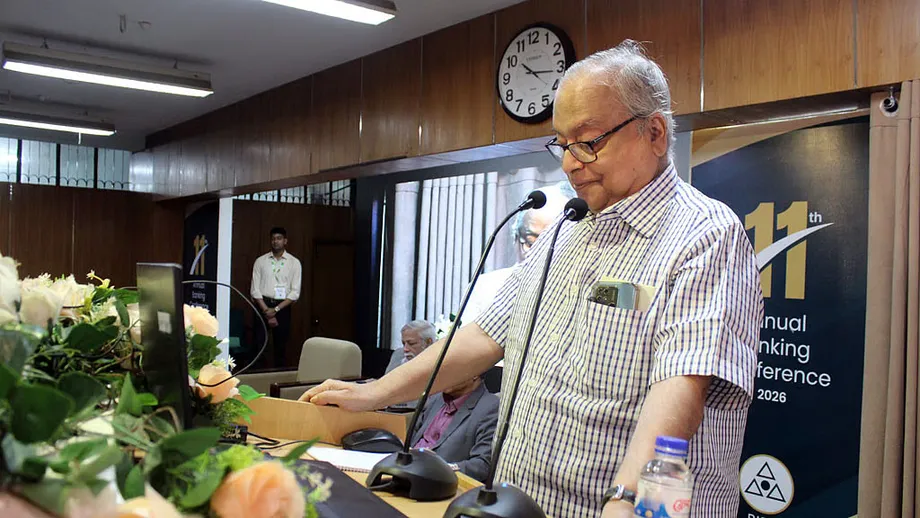
Speaking on Thursday at BIBM in Dhaka's Mirpur, Mahbub described the banking sector as "very weak" and "fragile". He said authorities were keeping troubled institutions alive through various measures while public confidence had suffered from widespread irregularities.
The discussion took place during the first session on the second and final day of the Annual Banking Conference, following a keynote presentation by Barkat-E-Khuda, a former economics professor at Dhaka University. Speakers described a sector facing several connected problems: unpaid loans, shortages of accessible cash at some banks, weak oversight and increasing dependence on lending to the government.
Mahbub's warning went beyond bank management. He argued that the damage reflected failures in governance and economic management, with powerful business interests benefiting from political protection. Repairing banks, he said, would require changes in both economic policy and political accountability.
What nearly one-third in default means
Ejazul's figure puts the scale of the loan problem in simple terms: nearly one out of every three taka lent by banks had been classified as defaulted by June. A defaulted loan is credit that a borrower has failed to repay according to the required schedule and applicable classification rules.
Banks depend on borrowers returning money so they can meet their own obligations and lend again. When repayments stop, banks lose expected income and may eventually have to absorb losses. That puts pressure on their finances and limits the money available for other borrowers.
Ejazul also identified inadequate capital and provisioning, money laundering, weak governance and limited productivity as factors weakening the sector. Capital is the financial cushion that absorbs losses. Provisions are amounts banks set aside against possible losses on loans. When either is insufficient, a bank has less protection against borrowers failing to pay.
The discussion provided a June snapshot of loan quality and a later assessment at Thursday's conference:
- As of June, nearly one-third of total bank loans were classified as defaulted, according to Ejazul.
- On Thursday, the final day of the conference, speakers examined those loan problems alongside uneven liquidity, regulatory failures and pressure on private borrowing.
No calendar date for the conference or year for the June figures was specified, and speakers gave no timetable for restoring the sector's health.
Why some banks lack cash while others have a surplus
Barkat-E-Khuda described opposing pressures within the banking system. Some weak banks, including some operating under Shariah principles, faced acute liquidity shortages, while the sector taken together held substantial surplus liquidity.
Liquidity means money a bank can readily use to pay depositors or meet other immediate obligations. A bank may have loans and other assets on its books but still struggle to find enough accessible cash when payments fall due.
Bangladesh's problem therefore includes where money is held, as well as how much exists across the banking system. Cash available at one institution does not automatically become available to another institution that needs it. For customers, the condition of their own bank matters directly.
Ejazul also described sufficient surplus liquidity across the sector despite shortages at individual banks. He called for rebuilding confidence and directing funds toward effective investment. Together, the two assessments point to a banking system in which cash and financial weakness are distributed unevenly.
How confidence became central to the crisis
Mahbub identified lost public confidence as a central problem after widespread irregularities. He argued that most banks would have ceased to exist if ordinary market forces had been allowed to operate, and questioned how successful official efforts to sustain them would be.
Depositors place money in banks expecting to retrieve it when needed. Banks, in turn, use much of that money to make loans. Confidence helps that arrangement function because customers do not usually seek all their deposits at once. Anxiety about a bank's condition can place further pressure on its available cash.
Mahbub nevertheless said four or five banks were functioning well and could provide lessons. His assessment pointed to differences in institutional performance within a troubled sector, with some banks offering examples worth examining.
The conference discussion connected confidence to practical decisions: how banks choose borrowers, whether repayments are enforced, how losses are recognised and whether regulators act when problems appear. Customers and businesses depend on those decisions even when they have no role in making them.
Government borrowing squeezes private businesses
Mahbub warned that the government's reliance on bank borrowing to finance its budget deficit was reducing the credit available to private businesses. A budget deficit occurs when government spending exceeds revenue, requiring borrowing or other financing to cover the gap.
He said banks had become "totally oriented towards the government". His concern was that lending to the state was drawing attention and resources away from private borrowers, while creating a growing repayment burden for the government itself.
This pressure is often called crowding out. In plain language, the government takes up lending capacity that businesses might otherwise use to buy equipment, purchase materials or expand production. Mahbub also warned that repaying the government's loans and interest would be a serious challenge.
Bangladesh's weak tax to GDP ratio compounded the problem, he said. That ratio compares tax collections with the size of the economy. When tax revenue is low relative to economic activity, the government has fewer resources of its own to meet spending commitments.
Mahbub linked that failure to collect domestic revenue directly to the borrowing pressure. He said it should serve as a warning to the government.
Political influence and the cost of weak oversight
Barkat-E-Khuda attributed rising default loans to political influence, weak governance, lenient policies and slow growth in private credit. His diagnosis connected the quality of lending decisions with the rules and incentives surrounding banks.
Mahbub described a nexus between bankers, unscrupulous businesspeople and bad politicians. He argued that this relationship would be difficult to break and alleged that the state had enabled a small group of wealthy, influential business figures to extract benefits.
Mahbub, speaking as National Professor, used the idea of privatisation to describe his view that rulers had treated public power as private property.
"We speak about privatisation of industry, privatisation of banks, but could you ever imagine that the state itself could be privatised? Unfortunately, our state has been privatised," he said.
Mahmud Osman Imam, chairman of Dhaka University's finance department, focused on the responsibility of regulators. Discussing risk management, he questioned how large amounts of money could have been looted from Shariah banks without authorities detecting or preventing it.
His intervention placed supervision at the centre of the debate: whether regulators knew about misconduct, when they knew and why action failed to stop money leaving the banks. For depositors, those are concrete questions about who was responsible for protecting institutions holding their savings.
Policy enforcement and a proposed role for AI
Pubali Bank managing director Mohammad Ali said implementing policy was urgent. He questioned whether rules should be created only after irregularities occur or put in place before problems develop.
Mohammad Ali also suggested using artificial intelligence to check compliance. Compliance means following the rules that govern banking, including requirements intended to control risk and prevent misconduct.
His proposal addressed the monitoring side of the problem: checking whether institutions are doing what regulations require. The conference discussion supplied no details about a particular AI system, its cost or how it would be introduced.
Enforcement was the common thread connecting his remarks with the concerns raised by other speakers. Rules require institutions capable of checking behaviour and acting on violations. Mahbub's allegations of political protection and Mahmud Osman Imam's questions about regulatory inaction both addressed weaknesses in that process.
Why Mahbub says recovery needs political change
Mahbub argued that banking was one part of a wider crisis affecting administration, trade, education and health. In his view, technical repairs to banks needed to proceed alongside changes in how power is exercised.
He described repeated uprisings roughly every 10 to 15 years, tracing the pattern to the Pakistan era. Despite public sacrifice, he said, meaningful social and cultural change had failed to follow, leaving frustration to accumulate. He argued that uprisings needed dedicated leaders, an ideological framework and a clear programme for national renewal.
Mahbub called for democracy and accountability to function and urged authorities not to renew protection for powerful business figures on the assumption that the economy could not operate without them. His proposed response combined financial correction with political responsibility.
The National Professor also cautioned against expecting an immediate recovery.
"We cannot expect a solution overnight," he said.
For depositors and businesses, the conference identified practical priorities: banks able to meet payment obligations, credible action on unpaid loans, oversight that catches misconduct and lending that reaches productive activity. Mahbub's argument was that lasting progress on those tasks depends on holding powerful decision makers accountable.
Key Points
- BIBM director general Ejazul Islam said nearly one-third of bank loans were classified as defaulted as of June.
- Mahbub Ullah warned that many banks were near collapse and linked their weakness to lost confidence and failures in governance.
- Some weak and Shariah banks faced acute cash shortages despite surplus liquidity across the sector.
- Speakers identified political influence, weak supervision and poor enforcement as central problems.
- Mahbub warned that government borrowing was squeezing private credit and called for economic and political corrections together.