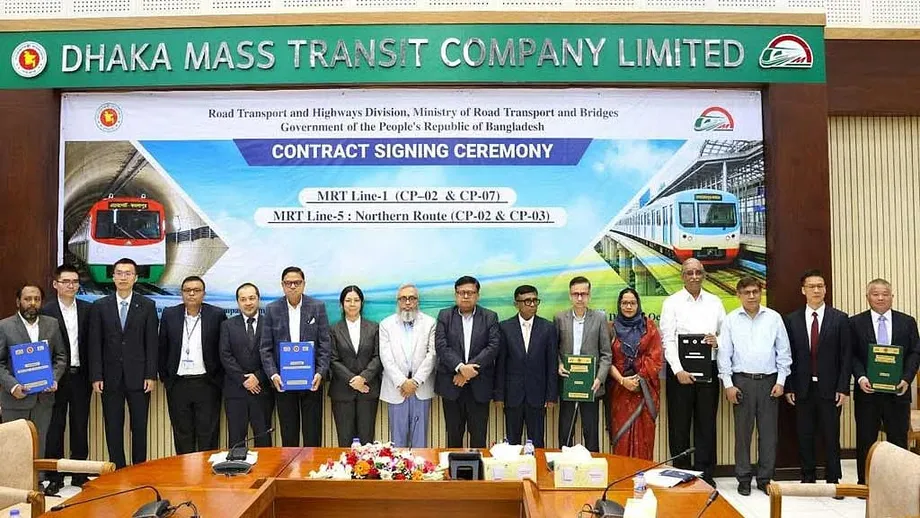
Four contracts move two metro lines into major construction
Dhaka's metro expansion has reached a new construction milestone with contracts for eight elevated stations, 11.507 kilometres of elevated railway and depot buildings for MRT Line 1 and MRT Line 5's Northern Route. The agreements were signed on October 27, 2026, at Metro Rail Bhaban in Diabari, Uttara.
Contents
- Four contracts move two metro lines into major construction
- What will be built on Line 1?
- Five stations for the Northern Route
- Depots provide the railway's working base
- Tracks, power and signalling have separate contracts
- How the schedule moved towards 2033
- Costs have more than doubled
- Safety and disruption become immediate concerns
- What the expansion changes for commuters
- Key Points
The four packages, awarded to three joint ventures, divide the work between structures that passengers will use and facilities needed to store, maintain and manage trains. Dhaka Mass Transit Company Limited (DMTCL) is implementing both projects with joint financing from the Bangladesh government and the Japan International Cooperation Agency (JICA).
The two lines have a combined estimated cost of about Tk 203,000 crore, or Tk 2.03 trillion: approximately Tk 114,000 crore for Line 1 and Tk 89,000 crore for Line 5. Those figures cover the projects as a whole. The announcement did not disclose the individual prices of the four contracts or a date for passenger services to begin. Construction of both lines is expected to finish by 2033.
For commuters, the planned network would extend metro access towards the airport, Kamalapur, Purbachal, Hemayetpur and Vatara. Before those journeys become possible, contractors must build railway structures, complete maintenance facilities and connect them with power, signalling and other operating equipment.
The signing follows years of slow procurement on Line 1. By January 2025, contractors had been appointed for only one of its 12 packages. The new agreements bring major station and elevated structure works into the construction programme, alongside separate contracts for the systems that will make trains run.
What will be built on Line 1?
Line 1's CP-07 package covers a 5.007 kilometre viaduct from the point where the railway rises from underground to the beginning of the Balu River section. A viaduct is a raised structure that carries the railway above roads, land or waterways.
Three elevated stations, Joar Sahara, Boalia and Mastul, are included. The contract went to the CREC-MIL-MBEC joint venture, identified in the detailed contract breakdown as China Railway Engineering Corporation, Max Infrastructure Limited and China Major Bridge Engineering Group Company.
Line 1 includes two routes: an airport route linking Hazrat Shahjalal International Airport with Kamalapur, and a Purbachal route running from Natun Bazar towards Purbachal Terminal. The elevated package therefore forms part of a railway that combines tunnels with structures above ground.
The earlier design put Line 1's length at 31.24 kilometres, including 19.87 kilometres underground and 11.36 kilometres elevated. Its airport to Kamalapur section was planned underground, while the Purbachal branch was planned above ground. The new 5.007 kilometre package covers roughly 44 percent of that earlier planned elevated length.
Line 1's station count needs clarification: the current project description lists 21, while the earlier design and the description of the new systems contracts list 19. No explanation for the change was given. The three stations covered by CP-07 are specifically named in the construction announcement.
Five stations for the Northern Route
Line 5's Northern Route will receive 6.50 kilometres of elevated railway under package CP-03. The work covers two stretches, Hemayetpur to Amin Bazar and Natun Bazar to Vatara, rather than one continuous elevated section.
The five stations are Hemayetpur, Baliapur, Bilamalia, Amin Bazar and Vatara. CREC-MIL-MBEC, the same joint venture building Line 1's elevated package, will carry out this work.
The Northern Route is described as approximately 20 kilometres long, with 14 stations between Hemayetpur and Vatara. Its new elevated package accounts for nearly one third of that approximate route length and five of the planned stations.
Together, the two elevated packages total 11.507 kilometres, with three stations on Line 1 and five on Line 5. These named sections set out the geographical reach of the new railway construction contracts.
Depots provide the railway's working base
Line 1's CP-02 package will provide 49 structures at its depot, including workshops, stabling sheds and an operations management centre. SINOHYDRO-SEBCL, a joint venture involving China's Sinohydro and its partner, received the contract.
The depot is at Pitalganj in Rupganj, Narayanganj, serving the Purbachal side of the project. Land preparation there began before the buildings covered by the new agreement. By December 2024, that earlier land development work had reached 87 percent completion.
A stabling shed is where trains are parked when they are out of service. Workshops provide space for inspection and repairs, while an operations centre supports the management of railway activity. These facilities allow a fleet to return to service each day and receive maintenance between journeys.
Line 5's depot package, also numbered CP-02 within its own project, covers administrative buildings, operations and depot control centres, stabling yards, warehouses and workshop sheds at Hemayetpur.
That contract went to CPC-HANIL. The detailed contract breakdown identifies the partners as Bangladesh's Concord Pragatee Consortium Limited and South Korea's Hanil Engineering and Construction Company Limited.
Tracks, power and signalling have separate contracts
Larsen & Toubro (L&T) has also secured two design and construction packages for Line 1's operating systems. These contracts address the equipment needed to turn completed tunnels, viaducts and stations into a functioning railway.
Under CP09, L&T and Japan's Sumitomo Corporation will design, procure, install, test and commission track works, power supply and distribution equipment, traction substations, overhead catenary systems and associated electrical facilities.
Traction substations supply electricity in the form needed to power trains. An overhead catenary is the wire system above the tracks from which trains collect electricity. Both must work with the tracks and other equipment across the route.
CP10 covers signalling, telecommunications and platform screen doors. Signals control train movements, telecommunications connect railway staff and equipment, and platform screen doors form a barrier between waiting passengers and the tracks.
L&T, which previously delivered the integrated railway systems package for Dhaka's operating Line 6, described its CP10 responsibilities in a company statement:
Under CP10, L&T will execute the signalling, telecommunication and platform screen doors for the entire network,
The division of contracts creates a practical coordination task. Civil contractors must deliver structures that fit the track and electrical designs, while systems teams must install and test equipment across those structures before passenger operations can begin.
How the schedule moved towards 2033
Line 1 was approved in October 2019 with a completion deadline of December 2026. By January 2025, officials were already anticipating an extension of three or four years because major construction contracts had yet to be awarded.
The project's sequence shows how much time passed between approval, depot preparation and the latest agreements:
- October 2019: Line 1 received project approval.
- October 2022: A contract was signed to develop land for the Pitalganj depot.
- February 2023: Physical works were formally inaugurated.
- March 2023: Depot land development began under package 1.
- December 2024: Depot land development reached 87 percent, while total project progress stood at 6 percent.
- January 2025: Only one of Line 1's 12 packages had a contractor appointed.
- October 27, 2026: Four depot and elevated infrastructure contracts were signed across Lines 1 and 5.
- 2033: Both projects are now expected to complete construction.
Project officials attributed the earlier delays to COVID-19 restrictions and JICA's approval procedures. The pandemic affected detailed design, land acquisition and related work. Project Director Abul Kashem Bhuiyan also explained that JICA concurrence was required at each stage of bidding.
Land and utility work added further tasks. By early 2025, authorities had acquired 93 of the 115 acres required for Line 1, and utility relocation had started near five stations under an arrangement with the Bangladesh Army.
Procurement schedules also matter because construction takes years after a contract is signed. Bidding documents discussed in January 2025 allowed five years for underground works and three and a half years for elevated works. Completing different packages in step will be central to meeting the revised timetable.
Costs have more than doubled
Line 1's earlier approved cost was Tk 52,561 crore. Its current estimate of approximately Tk 114,000 crore is more than twice that amount. The first revision describes an increase of 117.64 percent.
For Line 5's Northern Route, the approved revision describes a 117.87 percent increase, taking its estimated cost to approximately Tk 89,000 crore. In simple terms, an increase of about 118 percent means adding roughly Tk 118 to every Tk 100 in the earlier budget.
Exchange rates were already a concern in January 2025. Project Director Abul Kashem said the US dollar had risen from around Tk 85 when Line 1 was approved to more than Tk 120. Using those figures, a dollar cost over 41 percent more taka.
That change matters for imported equipment and payments linked to foreign currencies. The same dollar bill requires more local currency when the taka weakens. The budget revisions also come after years of delay, although the announcement did not provide a detailed allocation of the increases by cause.
Safety and disruption become immediate concerns
Road Transport and Highways Division Secretary Mohammad Ziaul Haque told the signing ceremony that reducing congestion and travel time remained a government priority. He called for construction quality, safety and completion within the stipulated deadlines.
Haque also directed agencies and contractors to limit public inconvenience and environmental impacts, particularly for communities near construction sites. He called for closer coordination among implementing authorities, engineers and contractors to avoid delays.
Residents and businesses along the named sections will experience the construction period before receiving the transport service. The secretary's instructions connect the deadline with that daily burden: prolonged work would also prolong disruption around project areas.
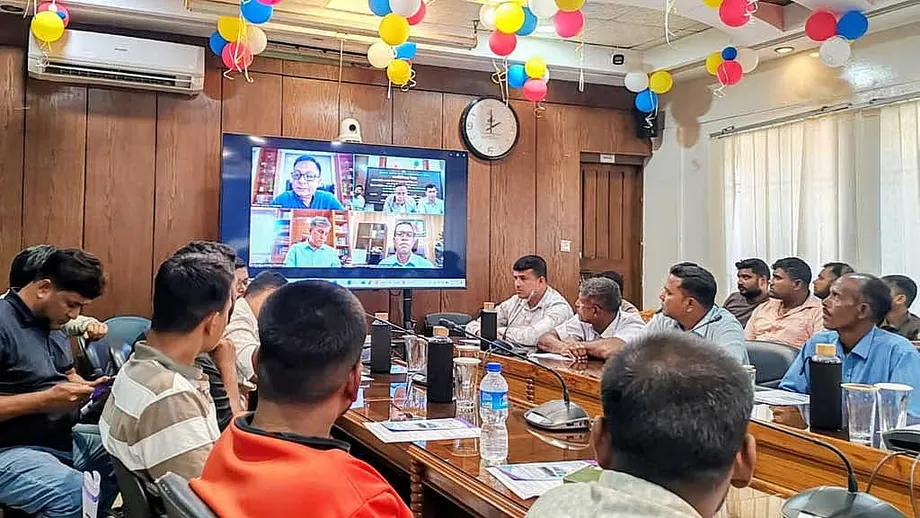
DMTCL Managing Director Md Shawgatul Alam delivered the welcome address, while Planning Commission member Kabir Ahmed attended as a special guest. Representatives of the Japanese embassy, JICA, consultants and contractors were also present.
What the expansion changes for commuters
Line 1's earlier design projected capacity for 800,000 passenger journeys a day. Its airport, Kamalapur and Purbachal routes would bring a large railway connection to areas that currently depend heavily on road travel.
Line 5's Northern Route would add a corridor from Hemayetpur towards Vatara. The newly contracted stations show where part of that access will be provided, while the depot and systems contracts address the facilities needed to sustain regular service.
Dhaka's wider transport programme is also changing. The government recently approved replacing the BRT corridor between Dhaka and Gazipur with a highway carrying three lanes in each direction, after about Tk 28.11 billion had been spent. That decision affects the corridor between Gazipur's Shibbari and Dhaka airport, while the new metro contracts advance separate rail routes.
The immediate achievement is a defined set of construction commitments: eight stations, two elevated railway packages and depot facilities for two lines. Delivering the promised journeys will require those works to finish alongside tunnels, operating systems, testing and the remaining project packages.
Key Points
- Four contracts signed on October 27, 2026, cover 11.507 kilometres of elevated railway, eight stations and depot facilities.
- Line 1 receives three elevated stations, a 5.007 kilometre viaduct and 49 depot structures.
- Line 5's Northern Route receives five elevated stations, 6.50 kilometres of elevated railway and depot buildings.
- Separate L&T contracts cover Line 1's track, electrical systems, signalling, telecommunications and platform screen doors.
- The two projects have a combined estimated cost of about Tk 203,000 crore, with construction expected to finish by 2033.
- Officials have called for safety, quality, timely completion and reduced disruption to nearby communities.