Ankara agreements target trade, customs and social rights
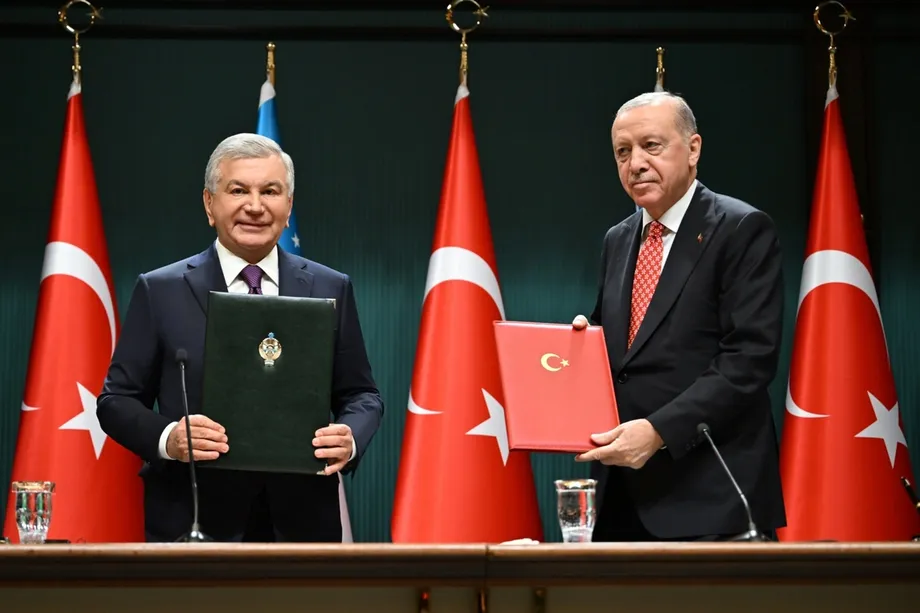
Uzbekistan and Türkiye signed five bilateral documents in Ankara on October 29, 2026, establishing a High-Level Business Support Council and setting out changes to preferential trade, customs information exchange and social security cooperation. The package brings together measures affecting companies selling goods, transport operators moving cargo and citizens seeking protection of their social rights.
Contents
- Ankara agreements target trade, customs and social rights
- What the business council will do
- More goods to receive preferential treatment
- Customs authorities will receive cargo data earlier
- Two documents address social security
- A $5 billion trade goal builds on existing projects
- Priority sectors extend beyond trade procedures
- The visit fits a wider Turkic diplomatic calendar
- Implementation will determine the practical benefits
- Key Points
Uzbek President Shavkat Mirziyoyev and Turkish President Recep Tayyip Erdoğan personally signed the agreement creating the council after talks at the Presidential Complex. Turkish Trade Minister Ömer Bolat said Vice President Cevdet Yılmaz would lead the Turkish side of the new body.
The economic ambition is substantial. Bolat put bilateral trade in 2025 at $3.1 billion, against the presidents' target of $5 billion. Reaching that level would require another $1.9 billion in annual trade, an increase of about 61% from the 2025 figure.
The other four documents expand the goods covered by preferential trading arrangements, update a customs information protocol signed on March 29, 2022, and establish a social security agreement alongside an administrative agreement for its implementation. Ministers signed those documents in the presence of both presidents.
What the business council will do
The High-Level Business Support Council is intended to support trade, investment and business relations between the two countries. Its creation gives those objectives a dedicated body at a senior political level, with Yılmaz's planned leadership of the Turkish side placing the work under the vice presidency.
Mirziyoyev and Erdoğan also called for thorough preparation of the next meeting of the Intergovernmental Joint Commission and an expanded portfolio of prospective projects. The council and commission therefore feature in the same push to turn closer diplomatic relations into practical economic activity.
The announcements left the council's membership beyond the Turkish leadership, its meeting schedule and its procedures for taking up business concerns unspecified. The timing of the next commission meeting was also not given. Those details will help companies understand how to engage with the new structure.
More goods to receive preferential treatment
Bolat and Uzbekistan's Minister of Investment, Industry and Trade, Laziz Kudratov, signed the protocol expanding the list of goods covered by the Preferential Trade Agreement. The measure is designed to give more products favourable access to the two countries' markets.
A preferential trade agreement gives specified goods better trading terms than would otherwise apply, commonly through lower customs duties. For an exporter, a lower duty can reduce the cost of reaching a foreign buyer. For an importer, it can affect the price paid to bring a product into the country.
The Turkish Trade Ministry said the new conditions would take effect after both countries complete their domestic approval procedures. Businesses will therefore need to follow that approval process before applying the expanded terms to shipments.
The additional product list, applicable duty rates and start date were not disclosed in the announcement. Those are the practical details that will determine which producers and buyers benefit, and by how much. The agreement establishes the expansion, while the product coverage will define its commercial reach.
Customs authorities will receive cargo data earlier
Bolat and Uzbek Foreign Minister Bakhtiyor Saidov signed the additional protocol updating the March 29, 2022 arrangement on advance information exchange about goods and vehicles crossing state borders. The amendment provides a framework for customs authorities to receive that information electronically before the relevant movements.
The Turkish Trade Ministry said the aim was to accelerate customs clearance, reduce waiting at border gates and improve coordination between customs authorities. It also described the agreement as supporting faster and safer bilateral and transit trade through closer alignment of procedures.
Advance data exchange means customs officials can receive information about a load and its vehicle before they arrive for processing. That gives authorities time to prepare checks and compare records earlier in the journey. For transport operators, the intended benefit is less time spent waiting for paperwork to be processed.
The customs amendment and the preferential trade protocol address different parts of a shipment's cost. Preferential treatment concerns the terms under which eligible goods enter a market; advance information concerns how authorities process their movement. Together, the measures seek to make selling and delivering goods between the countries more efficient.
Two documents address social security
Turkish Labour and Social Security Minister Vedat Işıkhan and Saidov signed the intergovernmental agreement on social security. They also signed a separate administrative agreement governing its practical implementation, accounting for two of the five documents concluded in Ankara.
Uzbekistan described the agreements as measures to protect the social rights of citizens of both countries. Social security agreements generally concern how national systems work together when a person's working life or circumstances involve more than one country. The precise rights depend on the provisions negotiated by the governments.
The published announcement did not detail the benefits covered, eligibility rules, treatment of contribution periods or application procedures. Citizens seeking information about pensions or other payments will need those specific rules to understand how the agreement applies to them.
The administrative agreement matters because a promise of cooperation also requires a way to carry it out. Such arrangements set out how the responsible institutions apply the main agreement. In this package, social protection sits alongside commercial measures, extending the talks beyond the needs of exporters and investors.
A $5 billion trade goal builds on existing projects
Bolat's figures show the scale of the relationship the presidents want to expand. Bilateral trade reached $3.1 billion in 2025, while Turkish contractors had completed 333 projects in Uzbekistan with a combined value of more than $9.5 billion.
The trade figure measures goods exchanged during one year. The construction figure covers the combined value of completed projects. Each describes a different part of the economic relationship: recurring purchases and sales on one side, and accumulated contracting activity on the other.
Mirziyoyev and Erdoğan noted growth in mutual trade and investment, the number of joint companies and flight connections. Their discussion linked further commercial expansion with a larger pipeline of prospective projects and continued work through government institutions.
The $5 billion objective gives the new measures a numerical benchmark. Moving from $3.1 billion to that target would mean annual trade reaching about 1.6 times its 2025 level. The leaders did not specify a deadline for achieving it.
Priority sectors extend beyond trade procedures
Erdoğan identified trade, investment, mining, transport and the defence industry as priority areas for further cooperation. The five signed documents concentrate on business support, preferential trade, customs procedures and social security, while the talks covered a wider economic and political agenda.
Transport connects several parts of that agenda. The leaders discussed expanding air services, while the customs amendment addresses information about cargo and vehicles. More connections concern the ability to move people and goods; earlier customs data concerns how efficiently authorities handle those movements.
Mirziyoyev and Erdoğan also discussed strengthening political and diplomatic ties, as well as cultural and humanitarian relations. They exchanged views on regional and international developments and upcoming events, placing the economic agreements within what both governments describe as a comprehensive strategic partnership.
The visit fits a wider Turkic diplomatic calendar
Mirziyoyev travelled to Ankara with his wife on a working visit at Erdoğan's invitation, in connection with the 13th Summit of the Organization of Turkic States. He also congratulated Türkiye on Republic Day during the visit.
The summit's theme was a Turkic century marked by unity in language, thought and action. Its agenda concerned stronger cooperation among participating countries in priority areas. Erdoğan expressed support for further initiatives through the organisation and for the summit advancing cooperation among Turkic states.
Erdoğan also invited Mirziyoyev to the leaders' summit of the COP31 United Nations Climate Change Conference, scheduled for November 11–12 in Antalya. That invitation places another planned presidential gathering shortly after the Ankara talks.
The dates connecting the agreements and the diplomatic calendar are:
- March 29, 2022: The countries signed the original protocol on advance information exchange about goods and vehicles.
- 2025: Bilateral trade reached $3.1 billion, according to Bolat.
- October 29, 2026: The presidents met in Ankara and five bilateral documents were signed.
- November 11–12, 2026: The COP31 leaders' summit is scheduled in Antalya, with Mirziyoyev invited to attend.
Implementation will determine the practical benefits
Companies have several concrete developments to follow: completion of domestic approval procedures for the trade protocol, publication of the expanded product coverage and arrangements for using the business council. Customs authorities will also need to put the electronic information exchange framework into practice.
For citizens, the central issue is publication and application of the social security rules. The two signed agreements create a basis for cooperation, while their detailed provisions will explain who can claim which rights and how the responsible institutions will process applications.
The package combines three distinct objectives: better market access, more efficient cargo processing and protection of social rights. Its practical reach will depend on how the responsible ministries and institutions carry out each part, alongside the presidents' broader effort to raise trade to $5 billion.
Key Points
- Uzbekistan and Türkiye signed five bilateral documents in Ankara on October 29, 2026.
- Mirziyoyev and Erdoğan established a High-Level Business Support Council. Turkish Vice President Cevdet Yılmaz will lead the Turkish side, according to Bolat.
- The expanded preferential trade terms will take effect after domestic approval procedures in both countries.
- A customs protocol provides for advance electronic exchange of information about goods and vehicles.
- Two agreements address social security cooperation and its administration.
- The presidents seek $5 billion in bilateral trade, compared with $3.1 billion in 2025.