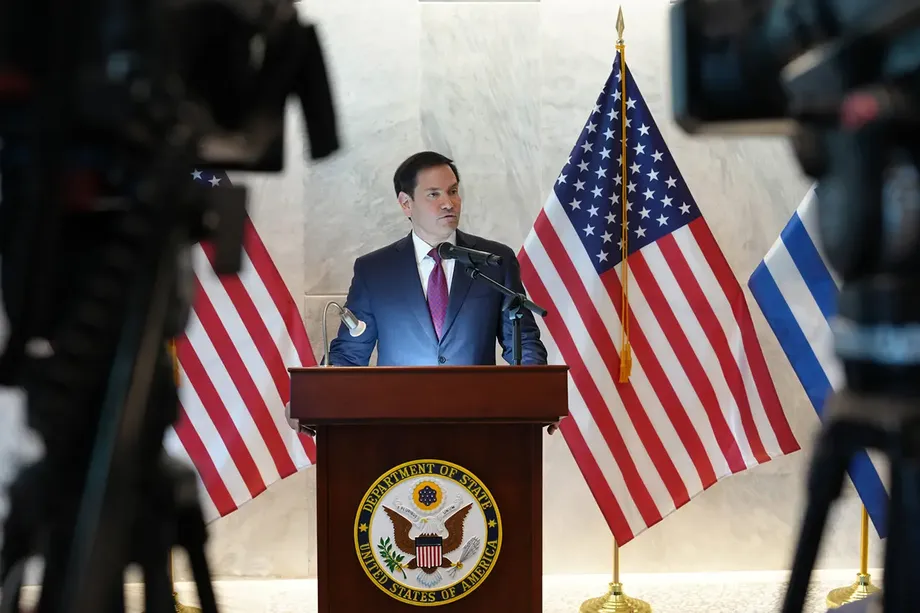
Samarkand visit puts business at the centre of diplomacy
US Secretary of State Marco Rubio will lead more than 200 American business leaders to Samarkand during an October 17–22, 2026, trip to Uzbekistan and India, bringing a large commercial delegation to talks with all five Central Asian countries. The US State Department announced the itinerary on October 13, naming Mumbai and Jamnagar as his next stops after Uzbekistan.
Contents
- Samarkand visit puts business at the centre of diplomacy
- What the C5+1 meeting will cover
- A larger delegation follows months of preparation
- Minerals and a business council give Uzbekistan a starting point
- Technology cooperation is also taking shape
- How the trip fits into the diplomatic calendar
- Why Mumbai and Jamnagar matter
- Trade disputes complicate the India agenda
- Cooperation continues beyond energy
- Key Points
The State Department announcement, dated October 13, 2026, states:
Secretary of State Marco Rubio will travel to Samarkand, Uzbekistan; Mumbai, India; and Jamnagar, India from October 17-22.
The Samarkand visit will combine a C5+1 foreign ministers' meeting with separate talks involving senior officials from Uzbekistan, Kazakhstan, Kyrgyzstan, Tajikistan and Turkmenistan. Critical minerals, energy security and stronger economic connections across Central Asia form the backdrop to a visit intended to expand trade and investment.
The State Department describes the delegation as more than 200 business leaders. Some descriptions of the visit give the figure as more than 200 companies, but the announced headcount is for people, and the number of distinct firms has not been specified.
Rubio will be making his first visit to Uzbekistan, and to Central Asia, as secretary of state. He previously said he intended to visit all five countries in the region during 2026. The announced itinerary includes only Uzbekistan, where officials from the other four countries will meet him.
India will receive Rubio for his second official visit this year. Energy cooperation is a central subject there, alongside investment, trade and regional and global developments. The choice of Jamnagar, home to Reliance Industries' huge oil refining complex, gives the Indian leg a concrete industrial focus.
What the C5+1 meeting will cover
C5+1 brings the five Central Asian states together with the United States. Launched in 2015, the format began with a meeting of foreign ministers attended by then US Secretary of State John Kerry. It gives the six governments a regular setting for discussing shared regional concerns.
Samarkand will host both collective discussions and bilateral meetings, meaning talks between the United States and each Central Asian government separately. The group meeting can address common priorities, while the individual meetings allow officials to discuss matters specific to their countries.
The State Department outlined the purpose of Rubio's participation in its announcement:
In Uzbekistan, Secretary Rubio will participate in the C5+1 Ministerial to highlight how strategic cooperation through this diplomatic platform promotes a more peaceful and prosperous future for the United States and the countries of Central Asia.
Economic connectivity, energy security and shared regional challenges were identified as priorities when the visit was being prepared. Economic connectivity means making it easier for goods, investment and services to move between countries. Energy security concerns whether countries can obtain reliable supplies at manageable prices.
President Donald Trump hosted the leaders of all five Central Asian countries at the White House in November 2025. Rubio's forthcoming ministerial meeting follows that gathering, moving discussions back to the level of foreign ministers while adding a substantial business presence.
A larger delegation follows months of preparation
Sergio Gor, the US special envoy for South and Central Asia, discussed the planned Uzbekistan visit in late September. At that stage, he spoke of a delegation representing more than 100 companies. The October announcement instead describes more than 200 business leaders.
The two figures show how the public description developed, although they count different things: companies in September and individuals in October. The practical importance lies in the scale of participation and the opportunity for American executives to meet officials from across Central Asia in one place.
The State Department described its commercial ambitions in direct terms:
On this historic visit, Secretary Rubio will lead a U.S. commercial delegation comprised of over 200 business leaders, ushering in a new era of strengthened commercial cooperation for the United States and Central Asia.
Washington's stated aim is to strengthen commercial cooperation. The business delegation gives companies an opportunity to discuss investment and trade alongside government talks. The announcement does not identify individual participating firms or attach a total investment value to the visit.
Uzbekistan is the host, but the commercial message is regional. Rubio's meetings with officials from all five countries create an opening for discussions that extend beyond the US relationship with Tashkent.
Minerals and a business council give Uzbekistan a starting point
Uzbek Foreign Minister Bakhtiyor Saidov met Rubio in Washington in February 2026. The two sides signed a memorandum on cooperation in extracting and processing critical minerals and rare earth elements, placing those resources among the specific areas of bilateral cooperation.
Critical minerals are materials that governments consider important for industry and supply security. Rare earth elements are a group of metals used in products such as powerful magnets and electronics. Extraction brings resources out of the ground; processing turns them into materials that manufacturers can use.
The February memorandum covers both stages. Its scope therefore reaches beyond mining to the industrial work needed to prepare minerals for use. That makes it relevant to discussions involving companies with expertise in production, processing equipment and investment.
The American Uzbek Business and Investment Council began operating in Washington in April. Presidents Shavkat Mirziyoyev and Donald Trump had agreed to establish it at the November 2025 C5+1 summit.
The council provides another channel for business cooperation before the Samarkand delegation arrives. Together, the council and the minerals memorandum give the visit a foundation built during the preceding months, rather than leaving commercial discussions to begin with a broad declaration of interest.
Technology cooperation is also taking shape
Astana hosted the C5+1 SI Conference on September 29, bringing together government representatives, technology companies and specialists from Central Asia and the United States. Its agenda covered artificial intelligence, digital infrastructure, cybersecurity and technology investment.
Those subjects broaden the economic relationship beyond natural resources. Digital infrastructure includes the networks and computing systems used to run online services. Cybersecurity concerns protecting those systems and the information they hold.
The Astana conference and the minerals agreement point to two different areas of cooperation: the physical materials needed by industry and the technology used to operate modern businesses and public services. Both are relevant to the wider push for investment across the region.
Samarkand's announced agenda remains centred on strategic and commercial cooperation. The September conference shows that governments and businesses have also been discussing specific technology priorities ahead of the ministerial gathering.
How the trip fits into the diplomatic calendar
Rubio's itinerary follows a sequence of political meetings, economic agreements and business events. The main dates show how preparations have accumulated:
- 2015: C5+1 begins at the foreign minister level, with John Kerry participating.
- November 2025: Trump hosts Central Asian leaders in Washington; the US and Uzbek presidents agree to establish a business and investment council.
- February 2026: Saidov and Rubio meet in Washington and sign a memorandum on critical minerals and rare earth elements.
- April 2026: The American Uzbek Business and Investment Council begins operating in Washington.
- May 23–26, 2026: Rubio makes his previous official visit to India.
- September 29, 2026: Astana hosts the C5+1 SI Conference on technology cooperation.
- October 13, 2026: The State Department announces Rubio's forthcoming itinerary.
- October 17–22, 2026: Rubio is scheduled to travel to Samarkand, followed by Mumbai and Jamnagar.
The October 17–22 window covers both countries. Samarkand comes first, followed by the two Indian cities. Separate arrival dates for each stop were not given.
Rubio's previous India visit included the Quad Foreign Ministers' meeting in New Delhi, hosted by External Affairs Minister S. Jaishankar. The Quad brings together India, the United States, Japan and Australia. His return shifts attention toward bilateral government talks and business engagements.
Why Mumbai and Jamnagar matter
Rubio will meet senior Indian officials to discuss the strategic partnership, regional and global developments, and opportunities for expanded energy cooperation. Business meetings are also planned to promote investment and economic cooperation.
The State Department described the government discussions as follows:
He will meet with senior government officials to strengthen the U.S.-India strategic partnership, exchange views on regional and global dynamics, and discuss prospects for enhanced energy cooperation.
The announcement also states:
Secretary Rubio will also meet with business leaders to promote opportunities for commercial investment and economic cooperation.
Jamnagar, in Gujarat, is home to Reliance Industries' refinery complex, described as the world's largest refining facility at a single location. Its capacity is 1.4 million barrels of crude oil per day. A refinery processes crude oil into fuels and other products.
That capacity explains why Jamnagar is a relevant setting for energy discussions. Rubio's itinerary places him in a city with a major industrial role in turning oil into usable products, alongside Mumbai's business engagements.
Trump announced in March a proposed refinery in Brownsville, Texas, involving investment from Reliance Industries. He put the proposed project's cost at $300 billion and described it as the first new US refinery in 50 years. The project remains a proposal in the account of his announcement, with no construction schedule given.
The Jamnagar complex and the Brownsville proposal create a concrete connection between the countries' energy industries. Rubio's talks will take place against that commercial backdrop, as officials discuss how to expand cooperation.
Trade disputes complicate the India agenda
US and Indian officials said earlier in October that negotiations on a bilateral trade agreement had stalled again. Those talks concern the terms under which the two countries exchange goods and services, making their progress relevant to the business meetings planned during Rubio's visit.
New Delhi has also raised concerns about US legislative measures allowing tariffs of up to 100 percent on countries purchasing Russian energy. Trump signed the Lindsey O. Graham Sanctioning Russia and Iran Act of 2026 into law on September 18, 2026. The law directs tariffs of up to 100 percent on the five largest importers of Russian oil or natural gas, with an exception for countries importing less than 15 percent of Russia's natural gas exports that have taken significant steps to reduce those imports.
An analysis by CSIS explains that Section 113 authorizes tariffs of up to 100 percent on major Russian oil and gas purchasers and countries facilitating sanctions evasion, while Section 115 gives the president broad authority to waive tariffs if deemed in the national interest. Enactment of the law therefore does not mean that a 100 percent tariff has automatically been imposed on India.
A tariff is a tax charged on imports. A tariff rate of 100 percent would mean a tax equal to the declared value of the affected goods, making them much more expensive to bring into the country. Washington's stated purpose is to pressure Moscow over its war against Ukraine.
India briefly reduced Russian energy purchases in early 2026, then increased them again, particularly after supply disruptions associated with the US and Israeli war against Iran. Energy discussions will therefore take place alongside disagreements over where India buys its oil.
Relations have also been strained by Trump's repeated claims that he mediated a ceasefire between India and Pakistan, and by the deaths of three Indian sailors in a US military strike on a ship near Oman. Those disputes add political pressure to a visit focused on strategic and economic cooperation.
Protests over the removal of 130 million names from Indian electoral rolls form another part of the domestic setting for Rubio's arrival. Washington had not commented on those demonstrations when the trip was announced.
Cooperation continues beyond energy
US Ambassador to India Sergio Gor has described expanding cooperation in defence, information technology and health services. He said more than 500 soldiers took part in a recent military exercise and that American F-35 fighter jets participated in Rajasthan for the first time.
Gor also pointed to US imports of generic medicines from India and investment by companies from each country in the other's market. Generic medicines contain the same active ingredients as the original branded versions and are generally sold after the relevant patent protections expire.
The ambassador expressed hope that a conversation between Prime Minister Narendra Modi and Trump in the week before the announcement would create more opportunities for cooperation. His comments show that official efforts to expand practical ties are continuing alongside the trade and political disputes.
Rubio's two destinations share a commercial thread, but their immediate priorities differ. Uzbekistan offers a regional diplomatic meeting backed by a large American delegation, a minerals memorandum and a new business council. India offers talks centred on energy and investment within an established relationship facing several active disagreements.
Key Points
- Rubio is scheduled to visit Samarkand, Mumbai and Jamnagar from October 17 to 22, 2026.
- More than 200 US business leaders will accompany him to Uzbekistan.
- Samarkand will host a C5+1 ministerial meeting and bilateral talks with officials from all five Central Asian countries.
- US and Uzbek cooperation already includes a February minerals memorandum and a business council that began operating in April.
- India discussions will cover energy, investment, strategic ties, and regional and global developments.
- Jamnagar houses Reliance's refining complex, with capacity to process 1.4 million barrels of crude oil daily.
- Stalled trade talks, Russian energy purchases and political disputes complicate the India visit.
- Trump signed the Russian energy tariff measures into law on September 18, 2026; tariffs can reach 100 percent, subject to an exception for qualifying natural gas importers and presidential national-interest waivers.