Ten companies set out plans to channel capital into projects
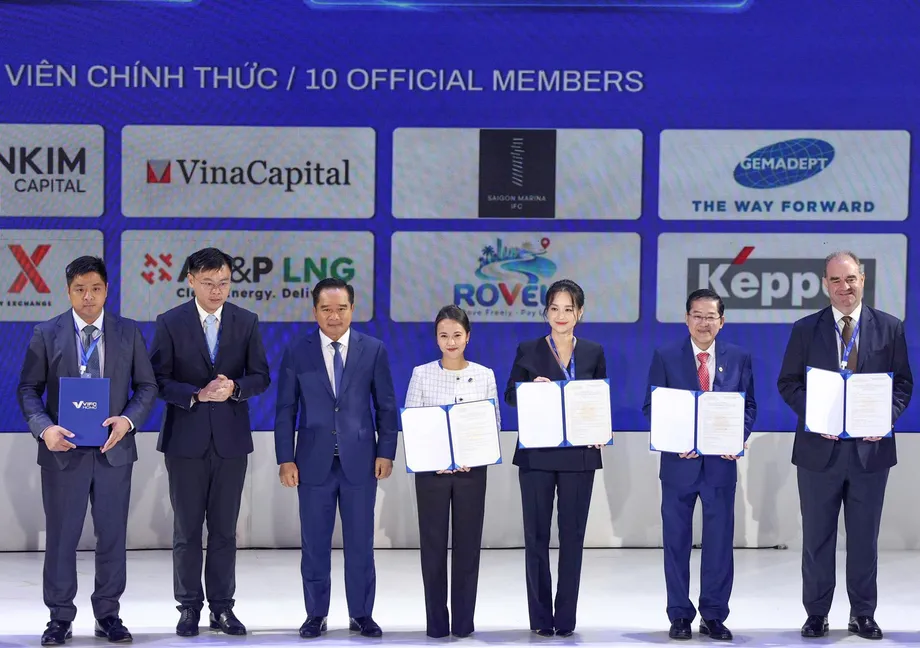
Ho Chi Minh City's international financial centre recognised its first 10 members on October 28, 2026, bringing together companies with $33.63 million in registered charter capital and committed contributions and plans to mobilise and invest about $2.7 billion by 2027. The centre expects cumulative investment commitments to reach $3 billion by 2030.
Contents
- Ten companies set out plans to channel capital into projects
- Who are the first members?
- How the investment figures fit together
- Infrastructure, education and energy lead the plans
- Keppel seeks partners for up to $1 billion
- Gemadept connects maritime services with finance
- November rules will open the next stage
- A wider investment programme surrounds the centre
- How the October announcement fits into 2026
- Key Points
The certificates were presented during the Autumn Economic Forum 2026 in the presence of Prime Minister Le Minh Hung. The companies outlined projects ranging from financial infrastructure and university facilities to renewable energy, maritime services, payment systems and commodity trading.
Saigon Marina IFC announced the largest individual infrastructure fundraising commitment, at $816 million. EQuest Capital plans to raise up to $325 million for education infrastructure, while Son Kim Capital IFC aims to mobilise $275 million for infrastructure within the Vietnam International Financial Centre in Ho Chi Minh City, known as VIFC-HCMC.
Deputy Prime Minister Nguyen Van Thang and Nguyen Thanh Nghi, head of the Party Central Committee's Commission for Policies and Strategies, also attended. City leaders involved in the recognition included People's Committee Chairman Nguyen Van Duoc and Vice Chairman Truong Minh Huy Vu, who chairs the centre's executive authority.
The next scheduled step is November 2026, when VIFC-HCMC expects to issue procedures and regulations for admitting investment funds. Banks, securities companies and other businesses requiring specific financial licences will be considered in later stages as the relevant rules are introduced.
Who are the first members?
The inaugural group consists of holding companies, businesses whose main role is to own and manage stakes or capital contributions in other companies. They can coordinate investment across several projects rather than carry out every activity themselves.
- EQuest Capital.
- Son Kim Capital IFC.
- VinaCapital International Partners.
- Saigon Marina IFC.
- Gemadept Holdings Maritime Investment and Development.
- Rovela Pay One Member.
- REE Energy Finance.
- Vietnam IFC Commodity Exchange JSC.
- AG&P Holding Vietnam.
- Keppel Asset Management (Vietnam).
The companies provide an initial base for assembling infrastructure, investment vehicles and services. Activities such as banking, securities trading and fund management will still require the relevant specialist licences or approvals, alongside membership of the centre.
How the investment figures fit together
The $33.63 million figure covers registered charter capital and contributions the companies have committed to make. Charter capital is the capital owners register or promise to contribute to their own businesses. The much larger $2.7 billion target covers money the members plan to raise and invest in projects, including capital from outside investors.
VIFC-HCMC's projected increase from $2.7 billion by 2027 to $3 billion by 2030 amounts to $300 million, or about 11%. Several company plans extend beyond 2027, and some involve potential investment platforms rather than fixed funding commitments.
Keppel's proposed platforms, for example, could raise up to $1 billion, mainly from outside investors, depending on market conditions, suitable opportunities and partner participation. The centre has also described that potential fundraising as additional to the other members' plans. A detailed reconciliation showing how every company target fits into the $2.7 billion and $3 billion totals has not been published.
AG&P Holding Vietnam's LNG, power and data centre plan was presented at about $425 million in the membership announcement. A longer programme for 2027 to 2030 was also described at $750 million to $1 billion. LNG, or liquefied natural gas, is gas cooled into liquid so it can be transported by ship and later used for electricity or other purposes.
Rovela Pay's $60 million projection measures a different activity: the value of payments expected to pass through its platform between 2026 and 2030. Transaction value measures money moving through a service, while fundraising measures money secured for investment.
Infrastructure, education and energy lead the plans
Saigon Marina IFC plans to mobilise $816 million for the financial centre's technology and physical infrastructure. Its commitment addresses the practical foundations needed to bring companies, financial services and investment activity together.
EQuest Capital's plan to raise up to $325 million is linked to a cooperation agreement with Standard Chartered Bank's New York branch. The money would support education infrastructure in Vietnam, particularly a university and innovation area in southwestern Ho Chi Minh City.
Son Kim Capital IFC plans to raise $275 million through a privately managed corporate investment structure described as CIF. The proposed structure would pool capital for infrastructure investment within VIFC-HCMC.
VinaCapital International Partners plans to mobilise $200 million for a proposed Iconic VIFC tower with 99 storeys and a project producing electricity from gas. The power project's location was described as Long An in the investment details and as Tay Ninh Province in another description of the announcement.
REE Energy Finance aims to raise $200 million for renewable energy projects. Together with AG&P's plans, the commitments place electricity supply and energy infrastructure among the centre's early investment priorities, alongside buildings and financial services.
Keppel seeks partners for up to $1 billion
Keppel joined through its real estate division and Keppel Asset Management (Vietnam). It is exploring platforms through which international partners could invest together in Vietnamese opportunities, with potential fundraising of up to $1 billion, mainly from third parties.
Keppel's description focuses on real estate opportunities in Vietnam. The centre's announcement describes a broader range covering infrastructure, property, commerce and services within VIFC-HCMC. The company's fundraising plans remain subject to market conditions, investment opportunities and participation by partners.
Joseph Low, Keppel's chief representative in Vietnam and president of its Vietnam real estate business, said membership reflected the group's commitment to the country:
This reflects our longstanding commitment to Vietnam and our confidence in the country's long-term growth potential.
Keppel has operated in Vietnam for about four decades and has 30 licensed projects with registered investment capital exceeding S$5 billion. Its activities include commercial buildings, housing, shopping centres and integrated urban developments in Hanoi and Ho Chi Minh City.
The company also has experience raising money specifically for Vietnam. Its first Vietnam focused real estate fund secured US$400 million at its initial close in 2020, against a US$600 million target. In July 2025, it outlined plans for a Vietnam retail fund, whose launch status has not been disclosed.
Gemadept connects maritime services with finance
Gemadept Holdings Maritime Investment and Development, or GMI, committed $100 million to maritime data systems and services covering management advice, coordination, valuation and the leasing of ships and maritime equipment.
GMI director Tran Thi Thuy Lien said the centre's greatest value for shipping would be connecting the movement of goods with the financing needed to support it. Maritime businesses need substantial capital over long periods, including money for equipment, operations and service expansion as well as port infrastructure.
Lien proposed attracting banks providing trade finance, maritime insurers, investment funds, equipment leasing and financing companies, and technology and data businesses. Trade finance helps companies pay for goods moving between buyers and sellers, while leasing lets operators use expensive equipment without buying it outright at the start.
Standardised shipping data and transparent asset valuations would help financiers assess vessels and equipment, according to Lien. More suitable financing and leasing options could then reduce the initial cash businesses need and support the development of maritime services within Vietnam.
Vietnam IFC Commodity Exchange JSC adds another planned service, with an investment commitment of about $57.7 million to establish a commodity exchange inside the centre. Rovela Pay, meanwhile, intends to develop payment solutions for international tourists.
November rules will open the next stage
VIFC-HCMC is preparing a proposed framework with three levels of licensing for asset management companies. Truong Minh Huy Vu has said the approach draws on practices in Singapore, Dubai and Hong Kong and would match regulatory requirements to the activities, scale and complexity of each business.
- The first level would cover investment advice and portfolio management, helping clients decide how to invest and managing their holdings.
- The second would cover management of private investment funds and funds for professional investors.
- The third would cover management of public investment funds, which can gather money from a wider group of investors.
The centre expects to finalise and issue fund admission procedures and regulations in November 2026. Applications from banks, securities firms and other regulated financial businesses will follow a staged process once their corresponding rules are in place.
Vietnam established the international financial centre under National Assembly Resolution 222/2025/QH15, with operations in Ho Chi Minh City and Da Nang. The framework includes access to international financing, foreign currency transactions, tax incentives for eligible projects and international dispute resolution mechanisms.
The centres are also intended to use international accounting and financial regulation standards. Banking requirements include capital adequacy, meaning sufficient financial resources to absorb losses, and liquidity, meaning access to money needed to meet payments when they fall due.
A wider investment programme surrounds the centre
Ho Chi Minh City announced 12 projects receiving investment policy approval or investment registration certificates at the same forum on October 28. Their stated combined investment exceeded VND337.22 trillion, approximately US$13.58 billion, spanning ports, logistics, urban development, manufacturing and technology.
The largest port project is Can Gio International Transshipment Port, with planned investment of VND128.8 trillion across 571 hectares. Vietnam Maritime Corporation, Saigon Port and Terminal Investment Limited Holding are developing it, with at least two berths scheduled for completion by 2030.
Can Gio's expected capacity is 4.8 million TEUs by 2030 and 16.9 million by 2047. A TEU represents the capacity of a standard shipping container measuring 20 feet in length. The later target is about 3.5 times the 2030 level.
Other port plans include the VND16.8 trillion Gemadept–Terminal Link Cai Mep project, designed to handle 25.6 million tonnes of cargo annually, and the VND1.7 trillion My Xuan 6 Port, scheduled to begin operations in the fourth quarter of 2028.
Singapore's Tokgistic plans a US$987.4 million Swift Logistics project, with operations expected to start in late 2026. The first phase of Vinh Lap Industrial Park covers 497.19 hectares and has registered investment exceeding VND9.7 trillion.
The International University Urban Area in Xuan Thoi Son commune has had its investment raised from VND59 trillion to VND173.1 trillion. The 880 hectare development combines education with housing, commerce, healthcare, sports, parks and information technology facilities. Lotte Properties HCMC is also developing a VND60 trillion complex in Thu Thiem with financial, commercial, service and residential facilities.
Manufacturing and technology projects announced at the forum include investments by GL Cables, Xinyi Glass Vietnam, Chang Yue Technology, II-VI Vietnam and Ito Automation Technologies Vietnam. Their plans cover cables, specialised glass, metal processing, semiconductor cooling materials, automation equipment, robots and sensors.
How the October announcement fits into 2026
The financial centre began its initial operational phase in February 2026. By July, VIFC-HCMC had reported about $20 billion in investment commitments from domestic and foreign partners, without a deployment timetable. October's announcement gave named members and specific project plans their own milestones.
- February 2026: The international financial centre entered its initial operational phase.
- July 2026: VIFC-HCMC reported about $20 billion in investment commitments from partners.
- September 2026: Ho Chi Minh City ranked 67th in the Global Financial Centres Index.
- October 28, 2026: The centre recognised its first 10 holding company members.
- November 2026: Fund admission procedures and regulations are expected to be issued.
- 2027 and 2030: The announced member investment targets reach about $2.7 billion and $3 billion respectively.
Ho Chi Minh City scored 692 points in the 40th Global Financial Centres Index, compiled by Z/Yen Partners and the China Development Institute. Its rise of 17 places and 27 points puts the preceding position at 84th, with 665 points.
The municipal Department of Finance estimated total social investment at VND510.2 trillion in the first nine months of 2026, up 10.2% from a year earlier. Registered foreign investment reached $17.8 billion, including new projects, additional capital and investment through contributions or share purchases.
The city licensed 1,592 new foreign investment projects worth more than $9.7 billion and approved 37 domestic projects worth about VND209.9 trillion. Against that investment demand, the centre's immediate task is concrete: establish workable rules and services that connect investors with projects needing capital.
Key Points
- VIFC-HCMC recognised its first 10 holding company members on October 28, 2026.
- The members plan to mobilise and invest about $2.7 billion by 2027, with cumulative commitments expected to reach $3 billion by 2030.
- Saigon Marina IFC plans $816 million in fundraising, EQuest up to $325 million and Son Kim Capital IFC $275 million.
- Keppel is exploring platforms that could raise up to $1 billion, subject to market conditions, opportunities and partner participation.
- AG&P's plans include a figure of about $425 million and a longer programme described at $750 million to $1 billion for 2027 to 2030.
- Investment fund admission rules are expected in November 2026, with other financial licences to follow in stages.
- The city also announced 12 projects with stated combined investment of about $13.58 billion at the forum.