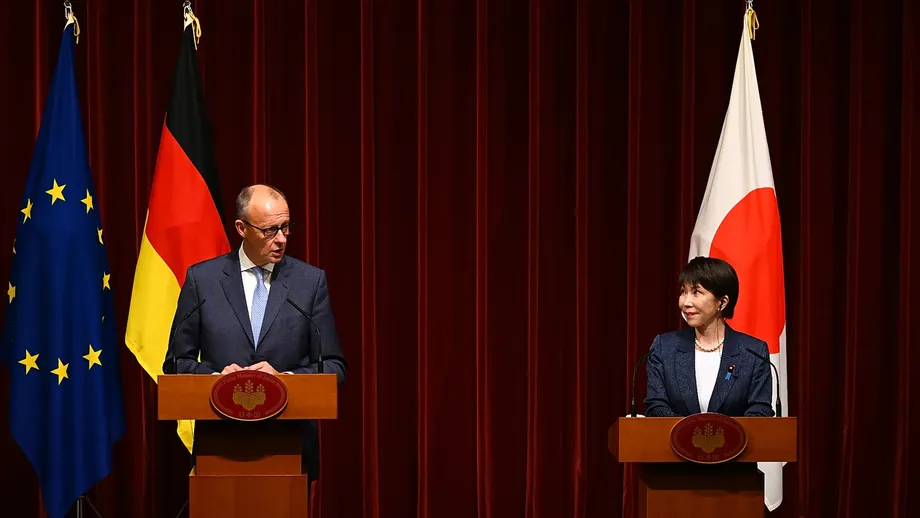
Tokyo Talks Connect Trade, Technology and Defense
Japan and Germany agreed on October 28, 2026, to strengthen supplies of critical minerals, establish a high-level dialogue on artificial intelligence and explore closer military cooperation, bringing industrial policy and national security into a broader partnership.
Contents
- Tokyo Talks Connect Trade, Technology and Defense
- Critical Minerals Become a Shared Priority
- Economic Security Without Naming Particular Countries
- AI Talks and 33 Business Agreements
- Military Cooperation Moves Toward a Framework
- Merz Signals Interest in the Fighter Program
- Ukraine and Taiwan Shape the Security Message
- Industrial Support Remains a Sensitive Issue
- Key Points
Japanese Prime Minister Sanae Takaichi and German Chancellor Friedrich Merz met at the prime minister's office in Tokyo as both governments faced concerns about dependence on China and a worsening security environment. China's export restrictions and military activity, Russia's invasion of Ukraine and uncertainty over international trade formed the backdrop to their discussions.
The visit also brought a substantial business delegation. About 30 corporate executives accompanied Merz, and public and private organizations and companies signed 33 memorandums of understanding covering advanced technologies, including AI and nuclear fusion.
Merz expressed interest in cooperation on fighter aircraft development, potentially connecting Germany with the Global Combat Air Programme, or GCAP, led by Japan, Britain and Italy. The program aims to develop a next-generation fighter jet by 2035.
The meeting was Merz's first visit to Japan since taking office in May 2025. It formed part of an Asian tour that also included Singapore and South Korea, as Germany sought stronger commercial relationships beyond its heavy exposure to the United States and China.
Critical Minerals Become a Shared Priority
Japan and Germany agreed to strengthen supply chains for strategic goods in response to concerns about Chinese export controls affecting critical minerals and semiconductors. For manufacturers in both countries, reliable access to these materials is closely connected to the ability to keep factories operating.
Rare earths are a particular concern. These elements are used in products ranging from electric vehicles and semiconductor equipment to defense systems, and China dominates their global supply. Restrictions can therefore affect several industries at once.
A supply chain is the series of businesses and processes that takes a material from extraction through processing and manufacturing to a finished product. Strengthening it can mean finding additional suppliers or making access less vulnerable to decisions in a single country. The leaders agreed on the goal of greater resilience, without announcing specific supply volumes or procurement contracts.
Japan and Germany, described as the world's fourth- and third-largest economies respectively, both have major manufacturing interests at stake. Their shared concern is practical: a shortage of a small but essential input can interrupt production of a much more valuable machine, vehicle or electronic device.
Economic Security Without Naming Particular Countries
The leaders adopted declarations on economic security and advanced technology cooperation. Takaichi also said three joint statements were to be issued following the talks, setting out a wider package of cooperation.
The declarations did not directly name China or the United States. Their focus on economic coercion nevertheless addressed a central concern for both governments: the use of trade, supply restrictions or other economic measures to pressure another country.
Germany's effort to reduce trade dependence on Washington and Beijing gives the partnership a commercial purpose alongside its security goals. Japan offers another major industrial economy with which German businesses can deepen ties, while Tokyo gains a European partner facing similar supply concerns.
Takaichi, explaining the agreement after the meeting, described the two countries as partners with complementary strengths:
We agreed to further strengthen our strategic cooperation across a wide range of fields.
The Japanese prime minister also set out the principles she said underlay that cooperation:
Japan and Germany share strengths that complement each other and are important like-minded partners in upholding a free, open and fair international economic order based on the rule of law.
Both leaders described the other's country as a "premium partner," language that placed the relationship beyond a single trade deal or defense project.
AI Talks and 33 Business Agreements
The planned high-level AI dialogue will give the two governments a dedicated channel for discussing artificial intelligence. AI systems perform tasks such as recognizing patterns, generating text or helping people make decisions, making the technology relevant across industry and government.
The leaders announced the dialogue's creation, but gave no date for its first meeting. Its detailed agenda and the responsibilities of the participating institutions were also left open.
Private sector cooperation extends beyond AI to hydrogen and nuclear fusion. Hydrogen can carry energy for use in industrial processes, while nuclear fusion seeks to release energy by joining light atomic nuclei. Fusion remains a technology under development, making research and engineering cooperation central to work in the field.
The 33 memorandums connect the diplomatic meeting with organizations and companies that would carry out individual projects. A memorandum of understanding generally records shared intentions and a framework for cooperation; the work that follows depends on the terms of each agreement.
The business delegation's size also shows how closely the visit linked government policy with industrial interests. Mineral supplies, advanced computing and new energy technologies all matter to the future products and production methods of Japanese and German companies.
Military Cooperation Moves Toward a Framework
Takaichi and Merz agreed to examine opportunities and frameworks for cooperation between their armed forces and to promote collaboration between complementary defense industries. The military discussions therefore covered both how forces might work together and how companies might develop or supply equipment.
Japan's planned revision of its three principal security policy documents later in 2026 gives that cooperation a domestic policy setting. Large-scale deployment of unmanned systems was expected to be a central part of the revisions, increasing the relevance of industrial cooperation involving drones.
An August 3, 2026, Ministry of Defense evaluation was prepared to inform revision of the Three Strategic Documents. It states that Japan will transform its defense capabilities through those revisions and identifies fielding large numbers of diverse unmanned systems and introducing strike unmanned aerial vehicles, or UAVs, as future defense measures.
Unmanned systems operate without a person aboard, although people may control or supervise them remotely. Their development brings together aircraft design, sensors, communications and software, fields that overlap with the wider technology agenda discussed in Tokyo.
In its March 2026 document on defense capability transformation, Japan's Ministry of Defense describes unmanned capabilities as important and calls for focused consideration of unmanning and automation. It sets out an allocation of ¥100.1 billion in the FY2026 budget for introducing unmanned assets, with the aim of establishing Synchronized, Hybrid, Integrated and Enhanced Littoral Defense, or SHIELD, using unmanned assets in FY2027.
The August evaluation also describes the limits of Japan's existing capabilities. Its unmanned systems are primarily short-range and used for intelligence, surveillance and reconnaissance, and acquisition of strike UAVs designed to operate alongside stand-off missiles has not begun. Even after SHIELD is completed, the inventory is expected to remain limited to several thousand platforms. Efforts to establish mass-production capacity for unmanned assets, including dual-use assets, are still at an early stage.
Takaichi said security in the Euro-Atlantic and Indo-Pacific regions was inseparable. Her position linked Russia's war in Europe with Japan's concerns about military pressure in Asia: developments in either region affect the security calculations of partners in the other.
The discussions reflected Japan's continuing effort to strengthen defense relationships with European countries as well as Germany's growing attention to the Indo-Pacific. The proposed framework would give that political alignment a more organized channel for military cooperation.
Merz Signals Interest in the Fighter Program
Merz said Germany was willing to cooperate with Japan on fighter aircraft development, signaling interest in GCAP. Japan, Britain and Italy are already pursuing the project with a target of developing a next-generation fighter by 2035.
Germany's participation was not agreed at the Tokyo meeting. Takaichi did not mention GCAP during the joint press event, leaving Merz's comments as an expression of interest rather than an announcement of an expanded partnership.
The difference matters for the next stage of discussions. General defense industrial cooperation can cover many types of equipment, while joining a fighter program would require decisions about development responsibilities, technology, financing and production.
The 2035 target gives the aircraft discussion a much longer horizon than the immediate work of creating an AI dialogue or improving access to minerals. Any German role would have to fit a program already being developed by three governments.
Ukraine and Taiwan Shape the Security Message
Russia's full-scale invasion of Ukraine, which began in 2022, was a central part of the leaders' discussion of the international security environment. Both governments also addressed China's increasingly assertive actions in the Indo-Pacific.
Merz voiced concern about rising tensions in the Taiwan Strait and called on the parties involved to act prudently. He said the United Nations Charter's prohibition on the use of force applied, placing his comments within the international rules governing relations between states.
The Taiwan Strait separates Taiwan from mainland China. By raising it in Tokyo alongside Ukraine, Merz connected Germany's European security concerns with a potential source of conflict in East Asia.
Merz also said Japan and Germany shared interests and values and could work together to prevent major powers from acting without restraint. The message supported the broader agreement to protect trade relationships and security cooperation through common rules.
Industrial Support Remains a Sensitive Issue
Takaichi said the leaders had affirmed the importance of considering each country's interests when introducing industrial support measures. Her remarks appeared directed at an EU proposal, promoted by Germany and France, to favor cars made in Europe, with Japan excluded from the proposed preferential treatment.
The issue exposes a practical tension within the partnership. Both countries want more secure industries and dependable trading partners, yet policies designed to support domestic or regional production can put manufacturers from friendly countries at a disadvantage.
For Japanese vehicle companies, the concern is access to the benefits offered under European industrial policy. For the two governments, the task is to reconcile that concern with their stated support for a free, open and fair international economic order.
Merz invited Takaichi to visit Berlin the following year. The sequence of announced steps stretches from immediate diplomatic agreements to projects with much longer development schedules:
- 2022: Russia began its full-scale invasion of Ukraine, a continuing focus of Japanese and German security discussions.
- May 2025: Merz took office as German chancellor.
- October 28, 2026: Takaichi and Merz met in Tokyo and announced broader economic, technology and defense cooperation.
- Later in 2026: Japan planned to update its three principal security policy documents, with unmanned systems a central priority.
- 2027: Merz invited Takaichi to visit Berlin.
- 2035: GCAP aims to develop its next-generation fighter aircraft.
The immediate work centers on turning the Tokyo commitments into government talks, military arrangements and business projects. The car policy dispute shows that a closer partnership will also require negotiations over where the interests of the two manufacturing economies diverge.
Key Points
- Japan and Germany agreed to strengthen critical mineral supply chains and establish a high-level AI dialogue.
- About 30 business executives accompanied Merz, and organizations and companies signed 33 memorandums covering advanced technologies.
- The leaders will explore a framework for cooperation between their armed forces and closer defense industrial ties.
- Merz expressed interest in fighter aircraft cooperation, but Germany's participation in GCAP was not agreed.
- Ukraine, the Taiwan Strait and concerns about economic pressure shaped the talks.
- European support for locally made cars remains a sensitive issue for Japan.