Extreme heat can halt lessons at school and at home
The Philippine Department of Education (DepEd) has set out a four level response to El Niño that suspends classroom lessons at a heat index of 33°C to 41°C and stops both physical classes and academic activities at home at 42°C or above. Schools must monitor classroom temperature and humidity at 8 a.m., noon and 2 p.m., giving school heads a local basis for decisions.
Contents
- Extreme heat can halt lessons at school and at home
- What the four heat levels mean
- Who decides whether classes stop?
- Learning continues with fewer demands
- Water shortages can close classrooms too
- Families cannot be charged for cooling requirements
- Solar power and classroom construction face longer schedules
- Food costs add pressure to school preparations
- Preparations extend into 2027
- Key Points
DepEd Memorandum No. 64, series of 2026, released on October 26, replaces a blanket national response to extreme heat with decisions coordinated with schools division offices or local government units (LGUs). The rules take effect immediately and remain in force until the Philippine Atmospheric, Geophysical and Astronomical Services Administration (PAGASA) announces the end of the 2026–2027 El Niño episode.
Education Secretary Sonny Angara described the preparations as a way to protect children and staff while preserving classroom time:
"We cannot afford to wait until extreme heat hits before we act. Our plan this year is proactive, deliberate and organized," he said.
The thresholds are described in the detailed guidelines as heat index readings, although Angara's announcement also referred to ambient temperature reaching 42°C. Air temperature measures how hot the air is; the heat index combines temperature with humidity to describe how hot conditions feel to the body. Humid air makes it harder for sweat to evaporate and cool a person.
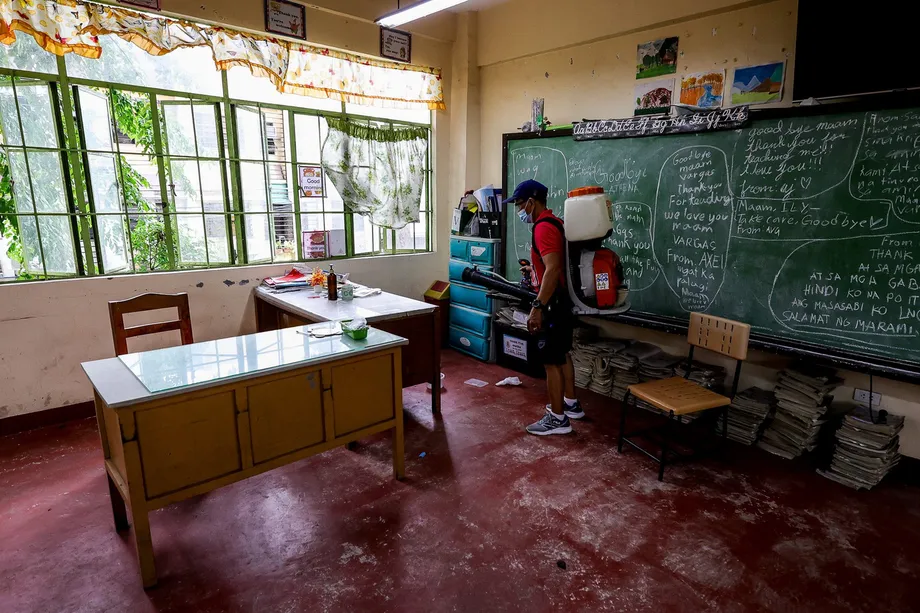
DepEd requires calibrated thermometers with hygrometers in classrooms. A hygrometer measures humidity, while calibration checks that an instrument gives reliable readings. Measuring both conditions inside classrooms allows schools to respond to the spaces children actually occupy.
What the four heat levels mean
DepEd calls its system the 4H framework: Hayo, Hinay, Hinga and Hinto. Each level sets a different balance between attending school, learning at home and stopping academic work for safety.
- Level 1, Hayo: Below 27°C, regular classes may continue with scheduled drinking breaks. Outdoor activities can move to early morning or shaded areas.
- Level 2, Hinay: At 27°C to 32°C, school heads may shorten classroom hours or use a mixture of classroom lessons and structured activities at home.
- Level 3, Hinga: At 33°C to 41°C, physical classes are suspended. Learners move to lighter tasks at home and health check-ins. Loss of water supply can also trigger this level.
- Level 4, Hinto: At 42°C or above, both classroom lessons and academic activities at home are suspended. Schools focus on safety checks and referrals for psychosocial support.
The difference between the two highest levels matters for families. At Level 3, children may still receive short learning activities. At Level 4, the academic pause also covers online lessons and other schoolwork at home, allowing children and staff to concentrate on safety.
Schools using modified hours at Level 2 may schedule a morning shift from 6 a.m. to 10 a.m. or an afternoon shift from 2 p.m. to 6 p.m. School heads must assess local conditions when choosing arrangements, including what classroom measurements show during the day.
Who decides whether classes stop?
School heads and LGUs have discretion to suspend or resume classes according to actual local weather conditions. Angara said school officials should notify the relevant LGU as part of the coordination process.
Education Undersecretary Malcolm Garma said proposed suspensions must be properly assessed and vetted by the schools division office or coordinated with the LGU. The daily readings give those decisions a factual basis, while allowing responses to vary between communities.
Angara explained the purpose of that flexibility:
"Every community experiences weather conditions differently. Through our 4H framework and daily classroom-level monitoring, we are empowering our school heads with the flexibility to adjust hours or shift to modular learning only when local conditions genuinely require it," Angara said.
A school experiencing dangerous classroom heat or a water interruption can therefore change its arrangements without waiting for a nationwide suspension. Nearby schools may operate differently if their measured conditions and water supplies allow it.
Learning continues with fewer demands
DepEd plans to prepare learning modules, activity sheets and other materials before the hottest months. At Level 3, schools may use learning packets, short activities and broadcast resources, alongside checks on learners' health.
The department has directed schools to prioritize essential skills in reading, mathematics and other key subjects over rigid completion of the curriculum. For a child whose classes are repeatedly interrupted, this means concentrating on the skills needed to keep learning, with reduced academic demands during dangerous conditions.
Schools are also expected to include practical lessons on heat safety, water conservation and climate adaptation in their activities. Student environmental organizations can take part in that work, connecting lessons with decisions children encounter at school and at home.
At Level 4, schools shift their attention to safety and support rather than assigning replacement academic work. Psychosocial referrals provide a route to help for learners who need emotional or mental health support during disruption.
Water shortages can close classrooms too
DepEd's framework treats water supply as a school safety issue alongside heat. Under Level 3, a loss of water can suspend physical classes even when the heat index has not reached 33°C. Drinking water, sanitation and the ability to respond to dehydration all depend on a reliable supply.
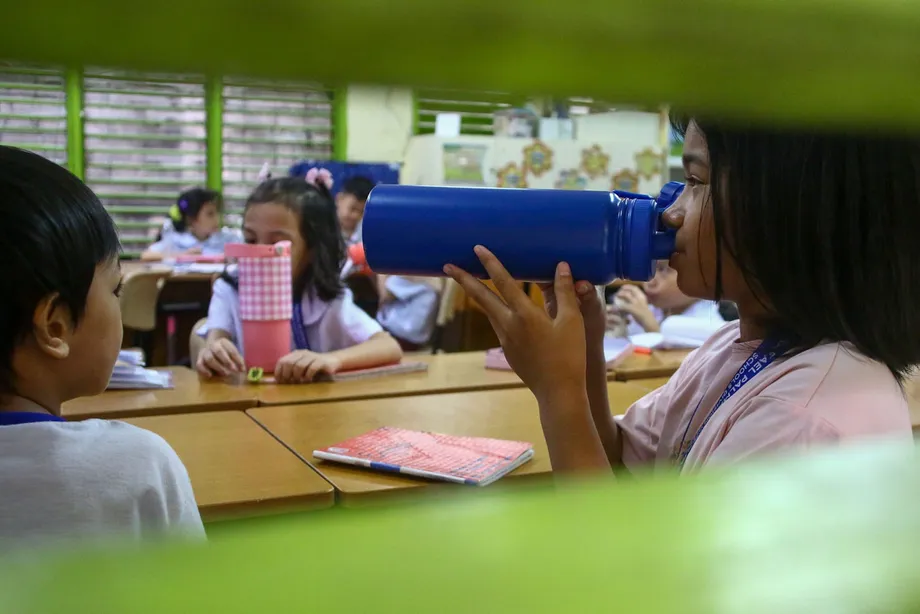
Schools have been instructed to make safe drinking stations and water dispensers accessible, repair leaks promptly and coordinate with local water providers on possible rationing. School clinics are expected to prepare for dehydration and heat stroke, with help from LGUs and the Department of Health for emergency response.
DepEd met with Maynilad on October 27 to obtain water conservation advice and educational materials. Angara said the materials were being translated from English for distribution nationwide. The department also coordinated with the Metropolitan Waterworks and Sewerage System over possible service interruptions.
Angara said water supplies were adequate at the time, while warning that a prolonged dry spell could put them under pressure. Social Welfare Secretary Rex Gatchalian had also raised the possibility of placing community water depots in public schools. The proposed equipment would collect rainwater and use filtration systems to provide drinking water.
Families cannot be charged for cooling requirements
DepEd prohibits schools from requiring parents to buy cooling equipment, internet connectivity or specialized clothing as a condition for alternative learning arrangements. The rule is especially relevant when a household is managing both disrupted school schedules and additional costs during hot weather.
Schools may allow learners and teachers to wear physical education uniforms or other comfortable clothing. They must also assess ventilation, drinking water reliability, electricity resilience and fire risks as part of their preparations.
Public schools can use maintenance and other operating funds to purchase electric fans. They may seek support through local school boards and the special education fund, or through disaster preparedness and response allocations.
Garma said existing classrooms would need measures to reduce heat, while buildings under construction and future classrooms could incorporate higher or insulated ceilings and better airflow. Those design choices address the heat inside a room, rather than relying entirely on changes to the school timetable.
Solar power and classroom construction face longer schedules
DepEd is targeting 2027 for the use of solar power in public schools and is working with the National Electrification Administration. A collaboration signed in February covers solar photovoltaic systems, which convert sunlight into electricity, for schools in geographically isolated and disadvantaged areas.
Angara said crowded schools, hotter locations and places with expensive electricity should receive priority. Garma said the department was also exploring solar power as a way to reduce electricity costs and potentially support air conditioning. No completion date was given for nationwide installation.
The department's classroom construction allocations through LGU partnerships cover 439 local governments, 1,955 schools and 8,777 classrooms. Provincial LGUs account for 4,043 classrooms, city LGUs for 3,123 and municipal LGUs for 1,611. The provincial allocation is about 46% of the total.
DepEd has acknowledged concerns from the Second Congressional Commission on Education about gaps in initial 2026 allocations for areas with severe classroom shortages. Some schools also lack space for new buildings because unsafe structures must first be demolished. The department is pursuing several construction arrangements, including partnerships with LGUs and private organizations, alongside learning continuity spaces.
Food costs add pressure to school preparations
DepEd has instructed schools and division offices to prepare contingency menus for the school feeding program, work with LGUs and cooperatives to source food locally, and maintain stocks of foods that can be stored safely for longer periods.
El Niño can reduce rainfall and increase the risk of drought, damaging crops and tightening food supplies. Research firm BMI identified food inflation driven by drought as the main economic risk from the episode. Its historical estimate puts local food inflation 1.8 to 2.5 percentage points higher within a year of an extreme drought.
BMI said the Philippines imports around one third of its rice, making it particularly exposed to higher prices. It also noted that rice stocks in Thailand, Vietnam and the Philippines had fallen below 2023 levels, although ample global rice supplies could limit the risk of a repeat of the price surge in 2023 and 2024.
September food inflation reached 6.8%, compared with 4.6% in August, an increase of 2.2 percentage points. Higher vegetable prices were the main driver. Inflation across all consumer goods and services reached 7.2% in September, while the January to September average of 5.4% exceeded the government's target range of 2% to 4%.
For school feeding programs, rising food prices mean menus and purchasing plans may need to change to keep meals available. Families could face the same price pressure while also arranging supervision and learning at home during classroom suspensions.
Preparations extend into 2027
PAGASA's October 21 update said the strong to very strong El Niño affecting the tropical Pacific was expected to peak before the end of 2026. The weather agency said it could persist through the first quarter of 2027, with effects potentially continuing through the first half of that year.
DepEd's response therefore spans several months. The forecast peak, the possible end of the episode and the duration of its effects fall at different points in that schedule:
- October 21, 2026: PAGASA issued its update projecting an El Niño peak before the end of the year.
- October 26, 2026: DepEd released Memorandum No. 64 setting out its school preparations and four level response.
- October 27, 2026: DepEd met with Maynilad on water conservation advice and school materials.
- First quarter of 2027: PAGASA said El Niño could persist through this period.
- First half of 2027: Effects of the episode could continue, according to PAGASA.
The memorandum remains in force until PAGASA officially announces that the episode has ended. School decisions during that period will depend on classroom readings, water availability and coordination with education and local government officials.
Key Points
- Physical classes stop at a heat index of 33°C to 41°C, with lighter learning activities at home.
- At 42°C or above, both classroom lessons and academic activities at home are suspended.
- Schools must measure classroom temperature and humidity at 8 a.m., noon and 2 p.m.
- Loss of water supply can also trigger suspension of physical classes.
- Parents cannot be required to buy cooling equipment, connectivity or specialized attire for alternative learning.
- The rules remain in force until PAGASA announces the end of the 2026–2027 El Niño episode.