Thousands of inquiries, just 12 reported tracing outcomes
Sri Lanka's Office on Missing Persons reported completing 5,791 inquiries by 31 December 2023. In the same annual report, its tracing unit said investigations with police assistance had revealed information about the fate of 12 people: six living in Sri Lanka, four legally abroad, one abroad without legal status and one classified as no longer missing.
Contents
- Thousands of inquiries, just 12 reported tracing outcomes
- A search shared across communities
- What the office was created to do
- A public list with a major geographic gap
- What the database numbers mean
- Inquiry totals rise, while records need clearer accounting
- Financial help and the search for truth
- Protection and participation remain central
- The practical limits facing the search
- Key Points
Those figures describe different parts of an institution carrying a much larger responsibility. Its database contained 21,374 physical complaints, with 14,988 records classified as active after other entries were grouped as military personnel missing in action, duplicates or cases outside its mandate. Families across the country are still seeking the central answer: what happened to the person who disappeared?
The office's 2023 annual report documents thousands of interviews, recommendations for financial assistance and help obtaining legal documents. It also records limited staffing, difficulties bringing together testimony from earlier commissions and problems building public trust.
For relatives who have already testified before state officials, the challenge is painfully concrete. Evidence given years ago must be found, preserved and connected to an investigation, rather than leaving families to recount their losses repeatedly. The office's own records show why counting inquiries, delivering support and tracing a missing person must each be understood separately.
A search shared across communities
Tens of thousands of people disappeared during the Janatha Vimukthi Peramuna insurrections of 1971 and 1987 to 1989, and during the civil war between the Sri Lankan state and the Liberation Tigers of Tamil Eelam, which ended in 2009. Sinhalese families in the South, Tamil families concentrated in the North and East, and Muslim families have all suffered.
A retired Muslim civil servant who investigated disappearances of mainly Sinhalese people during the 1980s has recalled testimony about bodies displayed on stakes, survivors hiding beneath corpses and people spared when ammunition ran out. Now physically frail and living abroad, he remains haunted by the grief and fear of the women who testified.
The International Truth and Justice Project, an organisation based outside Sri Lanka, has worked to preserve his memories and recover records from earlier presidential commissions. That work has involved finding reports that were never digitised, scanning them and comparing thousands of names. A Tamil researcher has carried out much of this painstaking work on disappearances of Sinhalese people.
Sri Lanka marks its Day of Commemoration for the Disappeared on 27 October, rooted in the violence surrounding the JVP insurrections and state counterinsurgency operations. The search for answers stretches across those periods and communities. In 2015, the United Nations Working Group on Enforced or Involuntary Disappearances recorded its second largest outstanding caseload in Sri Lanka, behind only Iraq.
What the office was created to do
An enforced disappearance occurs when state officials, or people acting with state authorisation, support or acceptance, take someone away and then conceal their fate or whereabouts, or refuse to acknowledge holding them. The person is placed beyond the protection of the law. The state's obligations include investigating, establishing what happened, bringing those responsible to justice and providing redress.
The OMP has a broader remit covering disappearances connected to conflict, political unrest and civil disturbances, as well as members of the armed forces or police identified as missing in action. Its responsibilities include tracing people, protecting relatives and witnesses, bringing records together and recommending assistance.
The campaign for the institution stretched over decades. Accounts of that campaign place its establishment in 2017; the office's annual reports date its formal institution and operation to 2018, under legislation passed in 2016. The key stages were:
- 2016: Parliament passed the Office on Missing Persons Act, No. 14 of 2016.
- 2018: The OMP became operational as a permanent institution.
- February 2020: The office began asking families to verify records while checking internally for duplicates.
- 26 November 2020: It released its list of missing persons to its offices.
- February 2022: It temporarily halted complaint intake to concentrate on existing cases.
- 31 December 2023: It reported 5,791 completed inquiries in its first phase.
A public list with a major geographic gap
The OMP's published complaints list explains how its records were assembled. They came from direct complaints, records collected through District Secretariats and forwarded by the former Ministry of National Integration and Reconciliation, and armed forces lists of personnel missing in action.
The publication notice identifies an important omission: Batticaloa, the district with the largest number of complaints, was excluded and was to be released later. The notice gives no release date for those records. Readers therefore need that geographic limit when considering the list's reach.
For civilian entries, the list records an OMP reference number, the person's name in English and Sinhala or Tamil, the disappearance date and the district where the person last lived. Military entries include additional details such as service number, rank and the place where the person went missing.
The office says the list includes some cases requiring clarification about whether they fall within its mandate. It also says information from earlier state bodies, commissions and other organisations should be consolidated into the database. That task connects the public list directly to the older testimony that families expected the state to retain.
What the database numbers mean
The OMP recorded 21,374 direct complaints in March 2022 and again reported 21,374 physical complaints at the end of 2023. Within that total, it grouped 6,386 entries as military personnel missing in action, duplicates or cases outside its mandate, leaving 14,988 active records.
Those 6,386 entries combine three different categories. Military personnel missing in action are expressly covered by the OMP Act, while duplicate records and complaints outside the mandate require different handling. The report gives no breakdown showing how many entries belong to each group.
The office divided its inquiry work by period, putting cases after 2000 first, followed by cases from 1980 to 2000 and then those before 1980. Its legal mandate extends to missing people regardless of when they disappeared, but this order places the first inquiry phase around the later conflict period.
The 2023 report says matching earlier commission reports with testimonial records consumes substantial working time. It estimates that a trained social worker can process at most 15 files a day. For families affected by the earlier insurrections, that unfinished task concerns evidence that may already be several decades old.
Inquiry totals rise, while records need clearer accounting
The OMP's 2022 annual report recorded 2,647 cumulative inquiries by the end of that year, including 2,110 completed during 2022. Its 2023 report put the cumulative total at 5,791 and said 2,832 inquiries took place during 2023.
The published figures leave an accounting gap: adding 2,832 to the previous cumulative total of 2,647 gives 5,479, rather than 5,791. The 2023 report also gives two different figures for inquiries remaining in Phase 1, 1,221 in one passage and 1,150 in another. It does not explain these differences.
Inquiry panels usually comprise three professionals. They gather information from relatives about the missing person and the circumstances of the disappearance, and request an additional witness, who is interviewed separately. Panels then recommend measures that can include legal documents, financial support, housing or further investigation.
The tracing unit reported that 931 complaints had been recommended for further investigation by the end of 2023, with action taken on 338. Reports concerning 50 missing people had been forwarded to the Criminal Investigation Department. Alongside the 12 people whose circumstances it said it had clarified, the unit recorded four files held because court proceedings were continuing.
Financial help and the search for truth
The 2023 report listed recommendations for family revival payments for 2,252 families, support for legal instruments for 1,565, tracing or further investigation for 587, and family support for 257. These are recommendations recorded by inquiry panels; families receive payments and documents through the relevant authorities.
A Certificate of Absence provides official recognition that a person is missing and can help relatives manage administrative affairs while the person's fate remains unresolved. The report also records referrals for Certificates of Death. Financial support addresses another immediate consequence: a disappearance can remove the family's main income earner while relatives spend money searching.
Amnesty International's November 2020 statement said a monthly living allowance of LKR 6,000 had reached only a limited number of families before the government then in office stopped payments. It called for funding to resume and extend that assistance.
David Griffiths, then director of the Office of Amnesty International's Secretary General, described the financial damage facing relatives:
A disappearance of the main income earner can often mean financial ruin for a family.
The earlier monthly allowance and the later recommendations for revival payments belong to different reporting periods. The 2023 figures concern proposed assistance, while the 2020 statement describes an allowance that had already begun and then stopped.
Protection and participation remain central
Families and lawyers pursuing disappearance cases have faced threats. Amnesty International said in 2020 that human rights lawyer Kumaravadivel Guruparan had been forced from his position at the University of Jaffna after military pressure on university authorities. He represented families of 24 Tamil youths taken into military custody in 1996.
Lawyer Achala Senevirathna, representing relatives of 11 youths allegedly disappeared by Sri Lankan Navy officers in 2008 and 2009, received threats including rape and murder threats. Amnesty said at the time that authorities had taken no action despite her complaints.
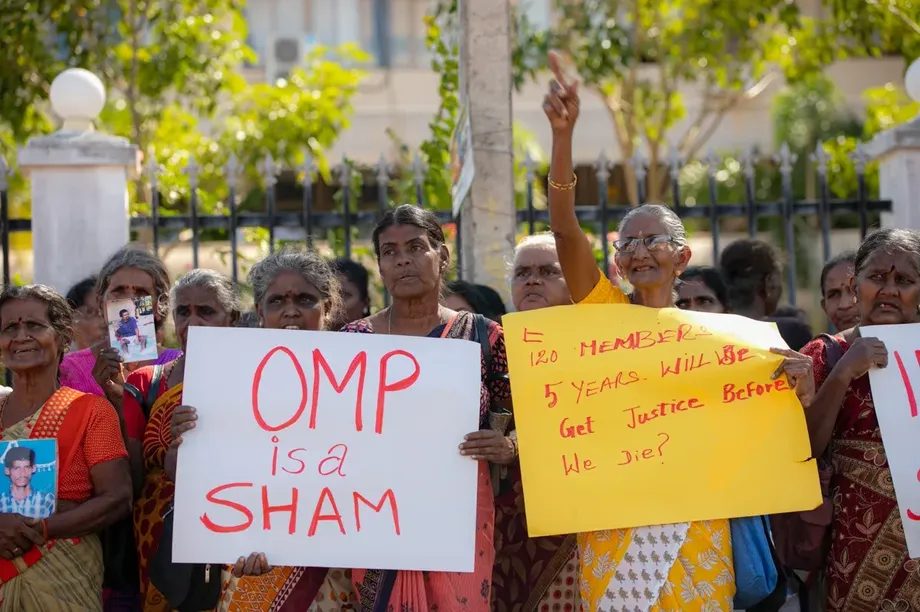
The OMP's annual reports describe protests at some inquiry venues that it said sought to prevent complainants from participating. It attributed these protests to misunderstandings about compensation and demands for international justice or involvement. The office also identified building public trust as a major challenge.
Participation matters in investigations involving human remains as well as interviews. In a case before the Vavuniya High Court, the OMP supported families' right to take part and have lawyers represent them in magisterial inquiries into remains. It said relatives could provide crucial information for investigators.
The practical limits facing the search
The OMP reported five regional offices against a planned network of 12, including an office in Kilinochchi. Its 2022 staffing account listed an approved cadre of 255 posts, but only 24 permanent staff and four contract staff. The following year's report continued to describe shortages affecting investigations and family support.
The office also said a 2017 amendment removing section 11(a) of its founding Act created difficulties for its independence, particularly its ability to enter agreements with people or organisations needed to carry out its mandate. Leadership changes and recruitment problems added to those constraints.
Complaint intake was halted in February 2022 so staff could concentrate on existing cases. The 2023 report repeats that history without specifying a general reopening date. Its plans to clear the remaining first phase inquiries in the following year were targets stated at that time.
For families, progress involves several concrete needs at once: access to the office, protection while giving evidence, help surviving without a relative's income, and an investigation that uses both new information and testimony already recorded. The OMP's reports document administrative work on each of these fronts, alongside a much smaller number of reported tracing outcomes.
Key Points
- The OMP reported 5,791 completed inquiries by the end of 2023 and 14,988 active database records.
- Its tracing unit reported information about the fate of 12 people and action on 338 complaints recommended for further investigation.
- The published complaints list initially excluded Batticaloa, identified as the district with the largest number of complaints.
- The office prioritised cases after 2000 while older commission records still required consolidation.
- Recommendations included financial assistance and legal documents, with referrals to other authorities for delivery.
- Staff shortages, threats to people pursuing cases, problems with public trust and inconsistent published totals complicate the search for answers.