Six employees win findings on five constitutional rights
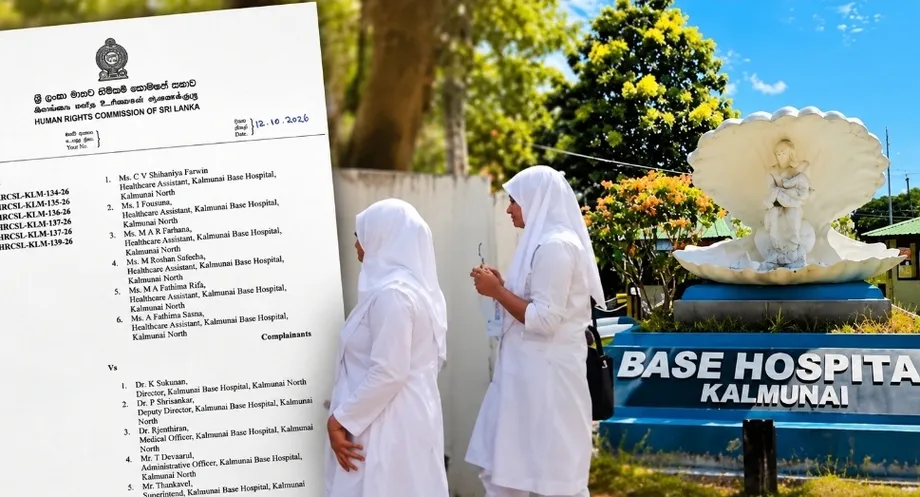
Sri Lanka's Human Rights Commission has found that Kalmunai North Base Hospital violated five constitutional protections when it restricted the religious clothing of six Muslim women employed as healthcare assistants. Its October 12 decision calls for the women to be offered a return to the hospital and for national rules allowing religious attire alongside government uniforms.
Contents
- Six employees win findings on five constitutional rights
- How the dispute developed
- Why the uniform defence failed
- What the constitutional findings mean
- Harassment and transfers require separate action
- What the hospital has been asked to do
- A national circular, with identification protected
- Earlier restrictions show why clarity matters
- What remains unresolved
- Key Points
The dispute involved six complainants among 36 newly appointed healthcare assistants at the government hospital in Ampara district, in Eastern Province. Nine of the recruits were Muslim women. Three removed their additional clothing after instructions from hospital officials; six refused. The commission found that even the three who complied were transferred without justification.
The women said they were told to remove headscarves, long sleeves and trousers worn alongside their prescribed uniforms, and warned that they could not sign the attendance register unless they complied. They described being made to choose between changing their clothing, accepting transfers and resigning.
The commission rejected the hospital's reliance on public administration circulars from 1989 and 2022, finding that neither expressly prohibited the disputed religious clothing. It also found no evidence that the attire threatened a legitimate objective, and noted that another government hospital in the same district permitted similar dress.
The decision goes beyond a disagreement about uniforms. It addresses access to employment, alleged harassment, transfers without disciplinary inquiries and the discriminatory effect of rules applied to a particular group of women. The commission described the treatment as discrimination based on race, religion and sex, even though it found no evidence of explicit discriminatory intent.
Implementation is not yet established. Reports also differ on the deadline for progress updates: most give November 11, 2026, while another gives November 19, 2026.
How the dispute developed
The women received their appointments from the Ministry of Health. Accounts of the commission's findings place their first day at the hospital on August 6, 2026, and describe instructions issued during orientation. An earlier account places an instruction to remove hijabs before a shift on August 10. Those dates may refer to separate encounters, but that distinction has not been confirmed.
Attorney Mubarack Azzam, who advised the women, said five complaints were filed with the commission on August 13. That figure differs from the six complainants identified in the October findings. The earlier account also described nine women as having complained, while the decision distinguishes nine Muslim recruits from the six women whose rights violations it examined.
The reported sequence is:
- August 6, 2026: The newly appointed assistants reported for duty, according to accounts of the commission's findings.
- August 10: An earlier account dates an instruction to remove hijabs before a shift to this day.
- August 13: Azzam said five complaints had been filed and preparations were underway for a fundamental rights petition.
- October 12: The commission issued findings that the hospital had violated the rights of six women.
- November 2026: Progress reports were requested, with reports differing between November 11 and November 19.
Azzam's reference to a fundamental rights petition concerned a separate route to the Supreme Court for challenging violations by public authorities. Preparations for such a petition do not establish that one was filed or that the court has decided the dispute.
Why the uniform defence failed
Hospital representatives told the commission's Kalmunai Regional Office that they were applying public administration circulars and responding to complaints from other staff. Hospital chairman Chandrasekaram Rajan separately cited a uniform guideline issued in 2000.
Rajan defended that guideline as a common standard for health workers, saying it:
applies equally to all without distinction based on caste, ethnicity, religion, or language.
The commission reached a different conclusion about the restrictions imposed at Kalmunai. It found that the relevant 1989 and 2022 circulars did not prohibit religious head coverings or additional modest clothing. It described the hospital's interpretation as arbitrary, unreasonable and discriminatory.
The references to a 2000 guideline and the two circulars are distinct. The accounts do not explain how the 2000 guideline related to the documents examined in the decision, so it cannot be assumed that all three contained the same requirements.
The nearby hospital's acceptance of similar attire also mattered. It showed that religious clothing and an official uniform were being worn together elsewhere in the district, rather than being treated as inherently incompatible. The commission found no evidence that the Kalmunai employees' clothing endangered a legitimate objective.
What the constitutional findings mean
The commission identified violations of Articles 10, 12(1), 12(2), 14(1)(e) and 14(1)(g) of Sri Lanka's Constitution. Together, these provisions protect religious belief, equality, freedom from discrimination, religious practice and lawful employment.
Article 10 protects freedom of thought, conscience and religion. Article 14(1)(e) protects the manifestation of religion or belief, meaning its expression through practice and observance. In this case, the clothing dispute concerned the women's ability to express their religious beliefs while performing their jobs.
Article 12(1) guarantees equality before the law and equal protection of the law, while Article 12(2) protects against discrimination. Article 14(1)(g) concerns the freedom to engage in a lawful occupation. The findings therefore address both religious dress and the consequences for the women's employment.
The commission's description of intersectional discrimination means that the treatment affected the women through overlapping aspects of their identity, here race, religion and sex. Its finding did not depend on proof that administrators openly expressed a discriminatory motive. The effect of the restrictions was discriminatory, it concluded.
This is a human rights commission decision with recommendations to public authorities, not a reported Supreme Court judgment. The distinction matters when assessing what has been decided and what still requires administrative action.
Harassment and transfers require separate action
The complainants alleged verbal harassment and intimidation. They said hospital officials offered transfers, mutual transfers with other employees or resignation as alternatives to complying with the dress instructions. The commission found that transferring them without a disciplinary inquiry violated their constitutional protections.
The findings also identify conduct after the women sought help. The hospital issued a letter threatening disciplinary action after they approached the commission, and allowed other employees to protest against them on hospital premises during working hours.
Those events broaden the case beyond an initial instruction about clothing. They concern how employees were treated when they challenged that instruction and whether the workplace remained accessible to them while their complaints were being considered.
The three Muslim recruits who removed their additional clothing were also transferred without justification, according to the commission. Compliance therefore did not guarantee that they could remain at their original workplace.
The commission recommended a full and impartial inquiry into the harassment allegations. That recommendation should not be confused with a completed investigation assigning responsibility to particular staff members. No outcome of such an inquiry has been reported.
What the hospital has been asked to do
The commission made four recommendations to hospital director Dr K. Sukunan. They combine clarification of the dress rules, investigation of alleged mistreatment and an opportunity for the complainants to return.
- Issue written instructions to administrative staff clarifying that employees may wear head coverings, long sleeves and trousers alongside their prescribed uniforms.
- Conduct a full and impartial inquiry into allegations of harassment by hospital staff.
- Offer the six complainants, in writing, the option of returning to work at Kalmunai North Base Hospital.
- Allow any complainant who returns to wear the religious attire at issue.
The proposed return is an option for the women, not an instruction requiring them to resume work at the hospital. A written offer would also provide a record of the terms on which they could return.
The reports do not establish whether the offers have been made, whether any of the women wishes to return, or whether the hospital has issued the written clarification. Copies of the decision were sent to the Minister of Health and the Secretary to the Ministry of Public Administration.
A national circular, with identification protected
The commission also asked the Ministry of Public Administration to issue a new circular permitting government employees to wear religious attire alongside their basic uniforms, provided they remain clearly identifiable. Several accounts describe the proposal as modelled on Public Administration Circular No. 13/2019, dated June 26, 2019.
A circular is an administrative instruction that tells government institutions how to apply a policy. A national instruction could reduce the room for different hospitals or departments to interpret dress requirements in conflicting ways, as happened between Kalmunai and the other hospital cited by the commission.
The identification condition is central to the recommendation. A hijab covers the hair and neck, while a face veil covers the face. The commission's proposal allows religious attire while retaining a requirement that officials can be identified. It should not be read as permission for every form of covering regardless of identification needs.
Rights activists had already petitioned President Anura Kumara Dissanayake for a national policy on hijab use in public services and public places. Their request used the words:
establish one clear, nationally applicable policy
Ravi Alwis of the Rights Defenders Group in Kalutara likewise called for a national policy to prevent recurring disputes. The commission's recommendation now gives the Ministry of Public Administration a specific administrative measure to consider, but no new circular or confirmed adoption date has been reported.
Earlier restrictions show why clarity matters
The Sisterhood Initiative's analysis of gendered Islamophobia, published in December 2024, describes earlier restrictions affecting Muslim women in public employment and education. This is a civil society account, rather than a government ruling.
It says a 2019 circular restricted the hijab, niqab and abaya in public service, and was later cancelled following advocacy by Muslim women's rights activists and the Human Rights Commission. That history supports the need to distinguish a withdrawn restriction from the uniform rules now being applied.
The analysis also describes temporary face veil restrictions after the 2019 Easter Sunday attacks, continuing notices prohibiting face veils after the ban was lifted, and later proposals to restore a ban. It names former Public Security Minister Sarath Weerasekera in connection with a proposed cabinet measure.
Dress disputes have also affected education. The December 2024 analysis describes 70 Muslim girls in Trincomalee being denied Advanced Level examination results over concerns about identity verification linked to their hijabs. A separate report says the commission ruled on June 26 that withholding results from about 70 girls violated their rights. The relationship between those accounts, including whether they describe the same proceedings, is not established.
The Sisterhood Initiative also describes pressures within the Muslim community, including Akurana Mosque officials' advice in 2023 against abayas, face veils and mosque visits during Ramadan because of a potential security threat. Its wider discussion covers stalled marriage law reform and harassment of activists Bisliya Bhutto and Juwairiya Mohideen. Those are separate issues, but they illustrate why decisions affecting Muslim women cannot be reduced to a single dispute between religious communities.
What remains unresolved
The commission warned that arbitrary restrictions on religious clothing could create hostile workplaces, increase tensions between communities and undermine national reconciliation. The Kalmunai findings address a concrete example: women appointed to government jobs faced restrictions that the commission found were not prescribed by law.
The practical outcome depends on several distinct actions. The hospital must respond to the recommended written dress clarification, return offers and harassment inquiry. The ministry must respond to the proposal for a national circular. None of those steps should be treated as completed merely because the findings have been issued.
The reporting deadline also needs clarification. November 11, 2026, appears in several accounts, including the report focused on the national circular recommendation. A more detailed account of the hospital findings gives November 19, 2026. Without confirmation of the operative date, the discrepancy should remain explicit.
The decision establishes the commission's position on the women's rights and on the hospital's interpretation of uniform rules. Whether that position produces restored employment choices and consistent rules across government workplaces depends on the responses from the hospital and ministry.
Key Points
- The Human Rights Commission found that Kalmunai North Base Hospital violated five constitutional protections of six Muslim healthcare assistants.
- Nine of 36 new assistants were Muslim women. Three complied with the dress instructions, but were also transferred without justification.
- The commission found that the cited 1989 and 2022 circulars did not prohibit the disputed religious clothing.
- It recommended written dress clarification, an impartial harassment inquiry and written offers allowing the complainants to return.
- A proposed national circular would permit religious attire alongside uniforms while keeping employees clearly identifiable.
- Implementation has not been confirmed. Reports differ on whether progress updates are due November 11 or November 19, 2026.