A $137 lead in an economy one eighth the size
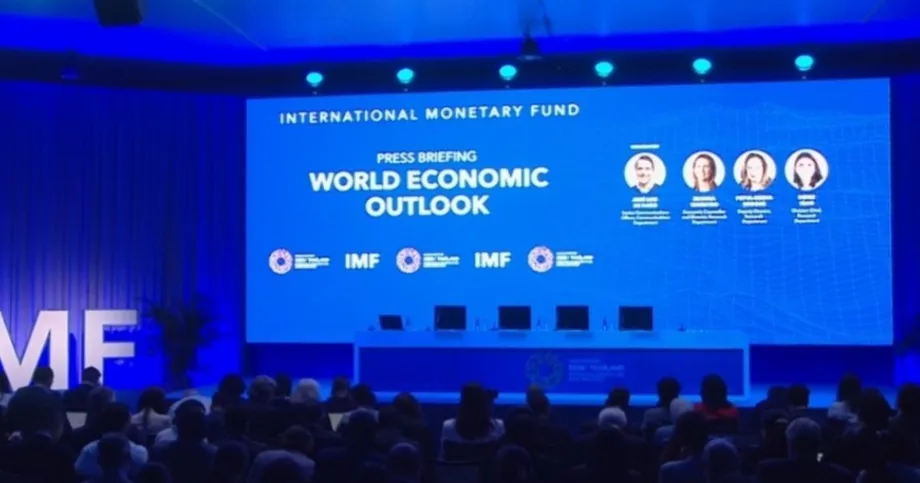
Bangladesh is projected to produce $2,886 in economic output per person in 2026, compared with $2,749 in India, according to figures attributed to the International Monetary Fund's October World Economic Outlook. The $137 difference would put Bangladesh about 5% ahead on a closely watched measure of economic progress.
Contents
- A $137 lead in an economy one eighth the size
- What GDP per person actually measures
- Why exchange rates can change the ranking
- India leads after adjusting for local prices
- Garment factories helped Bangladesh gain ground
- Inflation and growth tell a harder household story
- Energy dependence exposes factories and families
- The projected lead changes again before 2031
- Jobs and regional comparisons complete the picture
- Key Points
India would still have a much larger economy: $4.15 trillion against Bangladesh's $506.4 billion, or roughly 8.2 times as much output. India also leads when the comparison accounts for local prices, with projected output per person of $12,998 in purchasing power terms, against $10,884 in Bangladesh.
The forecast comes with an important qualification about its timing. Figures attributed to the IMF's April 14 outlook put Bangladesh at $2,911 and India at $2,812 in 2026, with India moving ahead in 2027. The October figures instead place that reversal in 2029. The size and duration of Bangladesh's projected lead therefore depend on the forecast edition being used.
For Bangladesh's roughly 175 million people, the more immediate pressures are expensive essentials, slower growth and access to decent work. Its garment factories, money sent home by workers abroad and greater participation by women in employment have supported economic progress over two decades. Energy imports and disrupted shipping routes now put those gains under strain.
What GDP per person actually measures
Gross domestic product, or GDP, measures the value of goods and services produced within a country. Dividing that total by the population gives GDP per person, also called per capita GDP. A country with a smaller economy can rank higher if it has far fewer people sharing that output.
Bangladesh's projected $2,886 is an average measure of production. Household earnings depend on wages, employment, business income and transfers, while living conditions also depend on prices and access to services. A factory owner, a garment worker and an unemployed graduate can have very different circumstances within the same national average.
Exports contribute to GDP through production inside the country. Clothing made in Bangladesh counts even when its buyer lives overseas. Money sent home by Bangladeshis working abroad is generally recorded as a transfer from outside the economy; it supports household spending and supplies foreign currency, rather than being added directly to domestic production.
Bangladesh's Bureau of Statistics put final GDP per person for fiscal 2024/25 at $2,625. That completed national estimate and the IMF's projections refer to different periods and stages of calculation. Forecasts estimate what may happen; final statistics incorporate information collected after the period has ended.
Why exchange rates can change the ranking
The taka and the rupee matter because the headline comparison converts national output into US dollars. Economists call this nominal GDP: output valued at current prices and translated at prevailing exchange rates.
A weaker currency reduces the dollar value of production measured in that currency. Factories can make more goods and businesses can provide more services while their combined output grows more slowly in dollars. Conversely, a steadier currency can support a country's position in an international ranking.
Zahid Hossain, a former World Bank lead economist, identified exchange rate movements as a reason the comparison changes. Bangladesh's taka depreciation also helps explain why India regained the lead in 2025 after Bangladesh had been ahead in the historical series cited for 2018 through 2024, including the widely discussed crossover in 2020.
Earlier figures also place Bangladesh ahead between 1989 and 2002. The countries have exchanged positions across different economic periods, making the projected 2026 change part of a longer history. The useful question for households is how production, jobs and purchasing power move together.
India leads after adjusting for local prices
Purchasing power parity, usually shortened to PPP, adjusts for differences in what goods and services cost. It expresses output in a common unit called an international dollar, allowing a comparison that accounts for local price levels rather than relying only on currency markets.
India's projected $12,998 per person in 2026 is $2,114 above Bangladesh's $10,884. That gives India an advantage of about 19.4% after the price adjustment, reversing the order in the nominal dollar comparison. PPP figures describe average output adjusted for prices; an individual family's spending power still depends on its own income.
The April forecast figures also show India ahead on PPP. They put 2025 output per person at $11,789 for India and $10,271 for Bangladesh, a gap of about 15%. That forecast projects $18,485 for India and $14,857 for Bangladesh by 2031, an Indian advantage of roughly 24%.
The October fiscal series projects a wider PPP gap, around 45% by 2031. Both forecast paths point toward India retaining its purchasing power lead, although they describe different speeds of change. Currency movements, inflation and revisions to expected production can all alter these comparisons.
Garment factories helped Bangladesh gain ground
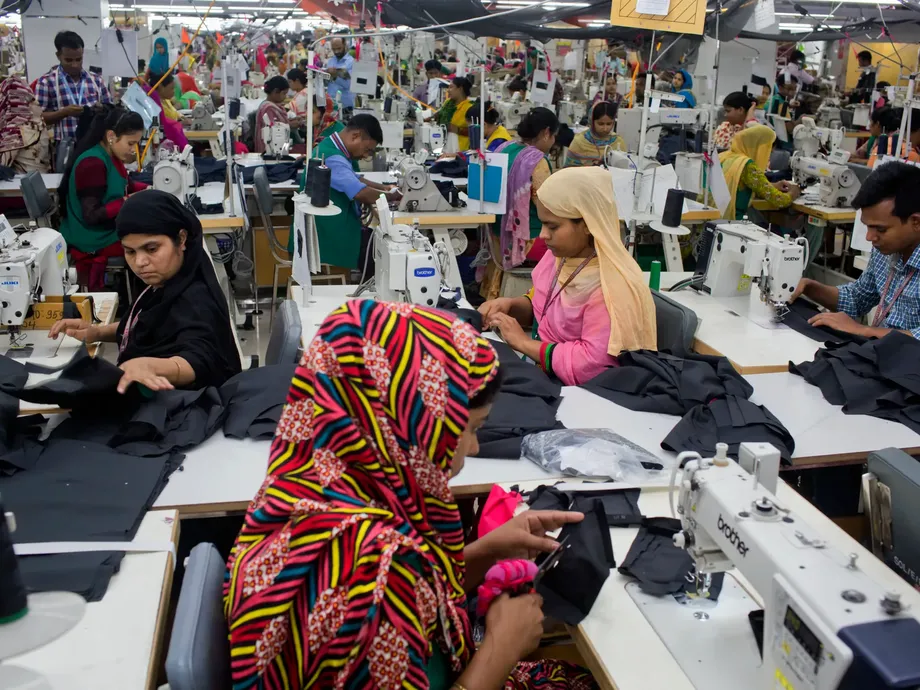
Bangladesh's garment industry, valued at about $38 billion, has been central to its growth. Ready made clothing accounts for more than 80% of export earnings, connecting domestic factories and workers to customers around the world.
Indian economist Santosh Mehrotra described Bangladesh's longer economic advance as a combination of annual growth around 6% and declining population growth. When production expands faster than the number of people, average output per person rises. More women entering paid employment and remittances supporting household spending have also contributed to Bangladesh's progress.
Mehrotra pointed to manufacturing's growing contribution to Bangladesh's economy and praised its use of export markets:
"That's a positive side of export-oriented manufacturing growth that Bangladesh is getting right," he said.
Manufacturing's share of Bangladesh's gross value added rose from 16.6% in 2014 to 22% in 2025, an increase of 5.4 percentage points. Gross value added measures what producers contribute after subtracting the goods and services they use in production, helping avoid counting the same inputs repeatedly.
World Bank figures cited by Mehrotra put India's manufacturing value added at 15.1% of GDP in 2014 and 13.5% in 2024, a decline of 1.6 percentage points. The figures use different ending years and slightly different measures of the economy, but show manufacturing taking a larger share in Bangladesh while its share fell in India.
Inflation and growth tell a harder household story
Bangladesh faces greater price pressure in the headline 2026 comparison. Average consumer inflation is projected at 8.7%, against 5% in India, a difference of 3.7 percentage points. Higher inflation means households need more money to keep buying the same basket of goods and services.
India's economic growth is projected at about 7%, compared with 3.6% for Bangladesh in that comparison. Real growth removes the effect of price increases, making it a measure of changes in the volume of production. India's stronger pace gives businesses a larger expanding market, while Bangladesh's slowdown makes new jobs and investment more difficult to generate.
Bangladesh's fiscal outlook is weaker still. The IMF's Bangladesh growth downgrade puts expansion at 3.2% and inflation at 10.9% for fiscal 2026/27. Those fiscal projections cover a different reporting period from the headline 2026 comparison. They show the pressure facing the country as it moves into the next financial year.
India's growth forecast upgrade puts expansion at 7% in both financial years ending March 2027 and March 2028. Strong domestic demand, services and investment support that outlook, although expensive oil and rupee weakness also affect Indian households and businesses.
Selim Raihan, executive director of the South Asian Network on Economic Modeling, has pointed to weak growth, stagnant investment and inflation as Bangladesh's pressing problems. For workers and employers, higher production per person becomes more useful when it arrives with better earnings, reliable energy and enough investment to create jobs.
Energy dependence exposes factories and families
Bangladesh imports around 95% of the oil and liquefied natural gas it needs, with a large share arriving from the Middle East. Liquefied natural gas, or LNG, is gas cooled into liquid so that ships can transport it.
The war involving Iran, the United States and Israel has disrupted maritime traffic around the Strait of Hormuz and unsettled energy supplies. Bangladesh must manage the cost and availability of imported fuel while facing disruption to goods moving through the Red Sea and the Middle East.
Garment manufacturers face pressure at both ends of production. Energy problems can raise costs or interrupt factory operations, while shipping disruption can delay deliveries to overseas buyers. With clothing providing more than four fifths of export earnings, trouble in that industry reaches far beyond individual factories.
India has a broader mix of economic activity, including agriculture, manufacturing, technology and business services, supported by a large domestic market. Its exposure to imported energy still matters, but it has more sources of demand and production alongside exports.
The projected lead changes again before 2031
The October forecast path gives Bangladesh a temporary nominal advantage before faster growth lifts India ahead. The projected sequence is:
- 2026: Bangladesh reaches $2,886 per person, compared with India's $2,749.
- 2027: Bangladesh rises to $3,219, against $3,036 in India, a lead of $183.
- 2028: Bangladesh retains a narrow lead.
- 2029: India moves ahead at $3,661, compared with Bangladesh's $3,334.
- 2031: The fiscal forecast series puts India at $4,389 and Bangladesh at $3,680, a difference of $709.
India's total economy is projected to reach $6.74 trillion by fiscal 2031, against Bangladesh's $674.4 billion. Those figures would make India's economy about 10 times as large, compared with roughly eight times in the current comparison. The fiscal series puts India's starting output at $4.06 trillion, alongside the $4.15 trillion figure used in the headline 2026 comparison.
Bangladesh's growth in that fiscal series falls to 2.21% in fiscal 2028 before recovering to 2.97% by fiscal 2031. Its projected $674.4 billion economy in 2031 would still leave substantial expansion needed to reach the country's ambition of $1 trillion by 2034.
India's scale is also reflected in the projected move ahead of Japan in 2027. Total economic size matters for the breadth of a country's market and production base, while output per person answers a different question about how much production there is relative to its population.
Jobs and regional comparisons complete the picture
Bangladesh and India remain below several smaller South Asian economies in nominal output per person. Fiscal 2026 projections put the Maldives at $19,507, Sri Lanka at $5,062 and Bhutan at $4,933. Pakistan is projected at $1,836 and Nepal at $1,540.
Bangladesh's ability to turn economic progress into suitable employment is another pressing concern. The IMF's findings on the educated youth jobs crisis put unemployment among highly educated young people at nearly 29%. Almost half of highly educated workers hold jobs below their qualifications.
The IMF also projects Bangladesh's population aged 15 to 64 to grow by around 10% to 12% between 2025 and 2035. That creates an opportunity to expand production, alongside a need for manufacturing and services to generate enough productive work.
Both countries face unequal access to the gains from growth, with wealth increasingly concentrated among richer households. Employment, wages, prices and the distribution of income determine how national economic progress reaches families. Bangladesh's projected lead in dollar output per person sits alongside those practical tests.
Key Points
- October forecast figures put Bangladesh's 2026 GDP per person at $2,886, against India's $2,749.
- India leads in purchasing power terms by about 19.4% and has an economy roughly eight times larger.
- The April forecast places India's return to the nominal lead in 2027; the October path puts it in 2029.
- Bangladesh's manufacturing gains face pressure from inflation, slower growth, imported energy and shipping disruption.
- Jobs, household earnings and local prices determine how economic progress translates into daily living conditions.