A stronger forecast, with pressure on household budgets
The International Monetary Fund's October 2026 World Economic Outlook projects India's economy will grow by 7% in both 2026-27 and 2027-28, following growth of 7.8% in the April-June quarter. The upgrade comes with a less comfortable forecast for household budgets: consumer inflation is projected at 5% in 2026-27, while the IMF assumes crude oil will average $95.74 a barrel in 2026, about 41% more than in 2025.
Contents
- A stronger forecast, with pressure on household budgets
- What is driving India's upgrade?
- Other forecasters also expect growth near 7%
- Oil and shipping are central to the forecast
- Inflation could weaken the domestic cushion
- Why rupee weakness changes the dollar picture
- Global growth is becoming more concentrated
- Artificial intelligence supports demand and creates risk
- Governments have less room to absorb another shock
- Key Points
India's forecast for 2026-27 is 0.6 percentage points higher than the IMF's July estimate of 6.4%. Its projection for 2027-28 rises by 0.3 percentage points from 6.7%. Strong domestic demand, services activity and investment have helped the economy withstand disruption from the conflict in West Asia.
The dates matter. India's FY27 means the financial year from April 2026 to March 2027, while FY28 runs from April 2027 to March 2028. The IMF's global forecasts use calendar years. India's projected 7% expansion sits alongside world growth of 3.1% in 2026 and 3.4% in 2027.
The stronger outlook also comes as a weaker rupee reduces the dollar value of India's economy. India can produce more goods and services while moving more slowly toward a target measured in US dollars. That helps explain why an improved growth forecast can arrive alongside lower estimates of its international economic size.
The central challenge is maintaining spending and investment while expensive energy, shipping disruption and inflation take money away from households and businesses. The IMF's forecast assumes that some of those external pressures gradually ease during 2027.
What is driving India's upgrade?
India's April-June expansion was supported by strong investment and manufacturing activity, which offset weakness in mining and services aimed directly at consumers. The performance gave forecasters a stronger starting point for estimating growth across the financial year.
Gross domestic product, or GDP, measures the value of goods and services produced in an economy. Real GDP growth removes the effect of price increases, helping show whether the country is producing more rather than simply charging more for the same output.
The IMF identifies resilient domestic demand and robust services activity as immediate supports. Domestic demand means spending inside India by households, businesses and government. A large home market gives companies customers even when trade conditions abroad become difficult.
The IMF also points to India's population trends, an expanding domestic market and continued structural reforms as supports for growth potential. These longer lasting factors help explain why its forecast remains strong beyond the latest quarter. Investment associated with artificial intelligence is another contributor cited in the outlook.
The projected 7% rate nevertheless represents a slowdown from the 7.8% growth recorded for FY26. The latest upgrade means the IMF expects better performance than it previously forecast, while still anticipating slower annual growth than in the preceding financial year.
Other forecasters also expect growth near 7%
The Reserve Bank of India has raised its FY27 growth forecast to 7.1%, slightly above the IMF's estimate. The World Bank also expects 7.1%, up from 6.6%, citing strong domestic demand and exports despite difficult international conditions. It projects 7.2% for 2027-28.
The Organisation for Economic Co-operation and Development raised its 2026-27 forecast to 7.1% from 6.3%. S&P Global Ratings and the Asian Development Bank expect 7%, while Fitch Ratings projects 6.9%.
Moody's Ratings increased its FY27 forecast to 7% from 6%, pointing to India's resilience during the Middle East conflict while warning that risks persist. Together, these estimates put the current growth outlook in a narrow range of 6.9% to 7.1%.
The IMF's revisions occurred across successive forecasting rounds. Its April estimate for FY27 was 6.5%, followed by 6.4% in July and 7% in October. The October increase is therefore 0.5 percentage points compared with April and 0.6 percentage points compared with July.
Oil and shipping are central to the forecast
The IMF assumes average crude prices of $95.74 a barrel in 2026 and $87.39 in 2027. The calculation covers Brent, Dubai Fateh and West Texas Intermediate, three widely used oil benchmarks. The projected decline is about 9%, providing some relief after the sharp increase in 2026.
India relies heavily on imported crude oil. Higher prices increase the amount it pays abroad and raise costs for transport and businesses that use energy. Households can then face higher prices while having less money left for other purchases, weakening the domestic demand that currently supports growth.
The Strait of Hormuz, a major route for Gulf energy shipments, is a crucial part of the IMF's assumptions. The fund expects reopening in March 2027 and conditions broadly returning to their state before the war by October 2027, including recovery in shipping, insurance and payment arrangements. Those dates are forecasting assumptions; the actual restoration timetable is unsettled.
Gulf crude exports averaged 88% of their level before the conflict in September, leaving a gap of 12%. Global oil reserves are being drawn down by about 2.7 million barrels a day. Using stored oil helps cushion disrupted supplies, but leaves less protection against another interruption.
Attacks involving MT Petro Dolphin at Sohar Anchorage and M/T Valthera in Hormuz illustrate the continuing danger to shipping. Two Indian seafarers were reported missing after the attack on MT Petro Dolphin. Disruption can affect freight charges and insurance costs as well as the price of the oil itself.
The forecast's main dates are:
- April-June 2026: India's economy grew 7.8%, strengthening the outlook for FY27.
- July 2026: The IMF projected Indian growth of 6.4% in FY27 and 6.7% in FY28.
- October 2026: Both forecasts rose to 7%.
- March 2027: The IMF assumes the Strait of Hormuz reopens.
- October 2027: The IMF assumes conditions broadly return to their state before the war.
Inflation could weaken the domestic cushion
India's consumer inflation is projected at 5% in FY27 before easing to 4.4% in FY28. Inflation measures how quickly prices rise. Even if wages increase, families can buy less when food, fuel and other essentials become more expensive faster than their income grows.
The IMF projects India's FY27 current account deficit at 1.5% of GDP. The current account records trade in goods and services alongside income flows and transfers across borders. A deficit means payments abroad exceed receipts, creating a need for financing from outside the country.
Expensive oil can increase that deficit by raising the import bill. Pressure on the rupee can then make imported goods cost more in Indian currency, adding another route through which international disruption reaches domestic prices.
Below normal monsoon rainfall is another risk because it could reduce agricultural output and rural spending. A prolonged conflict could also disrupt supply chains and raise business costs. These pressures would reach different parts of the economy at once, from farms and transport companies to household shopping budgets.
Why rupee weakness changes the dollar picture
India's real growth and its economic size in dollars measure different things. Real growth tracks changes in production after removing inflation. GDP at current dollar prices also reflects domestic price changes and the exchange rate used to convert rupees into dollars.
The projections put real growth at 7.8% in FY26 and 7% in FY27, while growth at current dollar prices is estimated at 4% and 3.9%, respectively. When the rupee loses value against the dollar, the same output measured in rupees converts into fewer dollars.
Between the IMF's April and October projections, India's estimated GDP at current dollar prices was reduced by $93 billion for FY27. Estimates for FY28 through FY32 were lowered by between $43 billion and $57 billion a year.
The projections place India behind the United Kingdom in sixth position in FY26 and FY27, after three years in fifth place. They put India ahead of the UK and Japan in FY28, reaching fourth place, and ahead of Germany in FY32, reaching third. Those are projected rankings that depend on economic performance and exchange rates.
The same calculations put India about $4 billion short of $5 trillion in FY29. That gap is roughly 0.08% of the target, calculated by dividing $4 billion by $5,000 billion. The milestone had initially been targeted for FY25, before pandemic disruption, a revision following the GDP base year update and currency weakness pushed its timing back.
The projections imply average growth in GDP at current dollar prices of 10.7% across FY28-FY32, compared with 5.6% across FY23-FY27. Reaching that pace would require a much stronger dollar growth trajectory than the rates estimated for FY26 and FY27.
Global growth is becoming more concentrated
The IMF raised its 2026 global growth estimate to 3.1% from 3% in July, while leaving 2027 at 3.4%. The world economy grew 3.5% in 2025, so the small upgrade still points to a slowdown this year.
China is projected to grow 4.5% in 2026 and 4% in 2027. The United States is forecast at 2.3% in both years. South Korea's 2026 estimate rose to 3.3% from 1.9% in April, while Taiwan is projected to grow 10.7%, supported by demand for semiconductors.
Germany and the UK are each projected to grow about 1.3% in 2026. Advanced economies collectively are forecast to expand by 2.1%, while emerging markets and developing economies are projected at 3.7%. Brazil's 2026 forecast was cut to 2.2% and Russia's to 0.9%.
The most severe losses are concentrated near the conflict. Bahrain, Iraq, Kuwait and Qatar are projected to suffer economic contractions of more than 10% in 2026. Saudi Arabia's economy is forecast to shrink 3.3%, compared with July's projection of 1.7% growth.
Only 32 economies now account for 95% of global growth, compared with 54 in April. Growth is becoming more dependent on a smaller group of countries, particularly those benefiting from technology investment or facing less disruption to energy supplies.
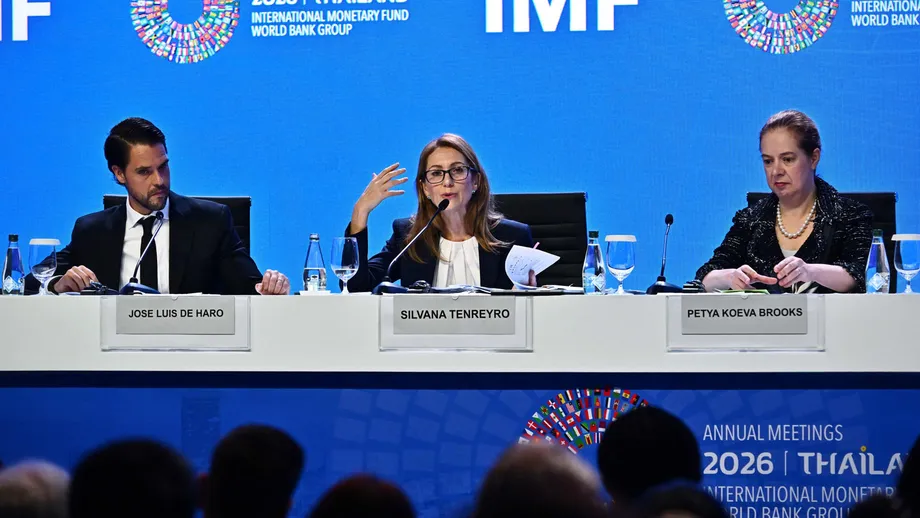
Silvana Tenreyro, the IMF's economic counsellor and research department director, described the strain on the world economy while calling for governments to rebuild room in their budgets and strengthen supply chain security.
The global economy has been resilient, but that resilience is reaching its limits,
Artificial intelligence supports demand and creates risk
Investment in artificial intelligence has helped offset part of the damage from the war. Spending on semiconductors, data centres and power generation creates orders and jobs before any wider improvement in productivity, meaning how much workers and businesses can produce, arrives.
Tenreyro said trade in AI goods grew 29% between 2023 and 2025, compared with 8.3% growth in global trade. Without AI goods, trade growth would have been 4.6%. Those figures show how heavily recent trade momentum has depended on technology spending.
The IMF warns that investors could pull back if expected profits and productivity gains disappoint. In its adverse scenario, US equities could fall 20%, and global GDP could be 1.1% below the baseline projection by 2028. Asia's output could be 1.7% lower than its baseline.
A fall in stock prices can spread into spending decisions. Households whose investments lose value may buy less, while companies may cancel projects or find financing more expensive. The IMF's Global Financial Stability Report also warns against complacency about a possible reversal in AI investment and valuations.
IMF Managing Director Kristalina Georgieva described that dependence at a Bretton Woods Committee event.
We now have an economy that is standing on one leg, the AI leg,
The IMF also identifies a more favourable possibility: continued technology investment, business adaptation and supportive financing conditions could sustain activity through the energy shock and eventually improve productivity. The outlook depends partly on whether today's spending delivers those gains.
Governments have less room to absorb another shock
The IMF forecasts global inflation of 4.7% in 2026 and 4.1% in 2027. Its models put the probability of inflation exceeding 5% in 2027 at about 35%, up from 30% in April.
In another adverse scenario, oil prices staying above $130 a barrel through the first quarter of 2027 would reduce global growth that year by 0.5 percentage points. That would deepen pressure on energy importers at the same time as households face higher prices.
Government finances are also becoming tighter. The IMF projects public debt in advanced economies at 115% of GDP by 2031, compared with 108% in 2025. For emerging and developing economies, it expects debt to rise from 74% to 84% of GDP.
Higher borrowing costs mean more public money goes toward interest payments. Rebuilding fiscal space means creating room in government budgets to respond to emergencies without taking on debt that becomes difficult to service.
The IMF urges governments to make support for households facing higher food and energy costs temporary and targeted. For India, directing assistance toward vulnerable families would address immediate pressure while limiting the burden on public finances.
India's 7% forecast rests on continued domestic spending, services and investment, supported by easing energy disruption during 2027. The next financial year will also test whether inflation falls toward the projected 4.4% and whether the rupee allows strong production growth to translate into faster gains in dollar terms.
Key Points
- The IMF forecasts Indian growth of 7% in FY27 and FY28, up from July estimates of 6.4% and 6.7%.
- Growth of 7.8% in April-June, domestic demand and services activity supported the upgrade.
- The RBI and World Bank project FY27 growth of 7.1%, slightly above the IMF.
- India's consumer inflation is projected at 5% in FY27 and 4.4% in FY28.
- The IMF assumes oil averages $95.74 a barrel in 2026 and $87.39 in 2027.
- The forecast assumes Hormuz reopens in March 2027, with conditions broadly restored by October.
- Rupee weakness has reduced India's projected GDP in dollars and delayed its climb in economic rankings.
- Global growth is forecast at 3.1% in 2026 and 3.4% in 2027, with risks from energy disruption, debt and a reversal in AI investment.