Electronics drive profits past 6 trillion yuan
China's major industrial firms earned 6.03374 trillion yuan in profits during the first nine months of 2026, an increase of 15.5% from a year earlier, according to National Bureau of Statistics figures released on October 27. Electronics supplied 9.6 percentage points of that growth, making the industry responsible for roughly 62% of the total increase.
Contents
- Electronics drive profits past 6 trillion yuan
- What the figures cover
- How AI demand travels through factories
- Advanced manufacturing takes a larger share
- Metals and chemicals join the expansion
- Consumer industries face a different economy
- Larger firms pull further ahead
- Better margins, slower cash collection
- Domestic demand remains the policy challenge
- Key Points
September profits rose 14.4% from a year earlier, accelerating from 4.2% in August and recording their strongest growth since June. Demand for artificial intelligence computing equipment, data centers and the materials needed to build them helped lift earnings across several connected industries.
The gains were uneven. Profits in computer, communication and other electronic equipment manufacturing increased 103.8%, while automobile manufacturing profits fell 22.8% and furniture manufacturing profits dropped by more than half. Electricity, heat, gas and water suppliers also recorded lower combined earnings.
China's industrial recovery is therefore being driven by a powerful but concentrated group of businesses. Technology suppliers and some raw material producers are expanding profits rapidly, while manufacturers serving households face weak spending and intense competition.
What the figures cover
The NBS survey covers industrial enterprises with annual revenue of at least 20 million yuan from their main business operations. Its total includes mining, manufacturing and utilities. Smaller businesses below that revenue threshold fall outside the figures.
Revenue across the surveyed firms reached 106.21 trillion yuan during January through September, up 6.6%. Operating costs increased more slowly, rising 6.1% to 90.30 trillion yuan. Profits grew faster than sales as costs took a smaller share of revenue.
Industrial output, measured by value added, increased 5.3% during the first three quarters. Value added measures the value created during production after allowing for goods and services used up in the process. Profits measure the money businesses retain after their expenses, so the two indicators describe different parts of factory performance.
September's stronger monthly result left cumulative profit growth slightly below the 15.7% recorded for January through August. The nine month figure combines performance across the whole period, while the September figure compares that month with September a year earlier.
The recent sequence shows how the improvement developed:
- 2025: Industrial earnings posted a modest gain after three consecutive years of declines.
- January through August 2026: Cumulative industrial profits rose 15.7% from a year earlier.
- September 2026: Monthly profit growth accelerated to 14.4%, from 4.2% in August.
- October 27, 2026: The NBS released figures showing profit growth of 15.5% for the first nine months.
How AI demand travels through factories
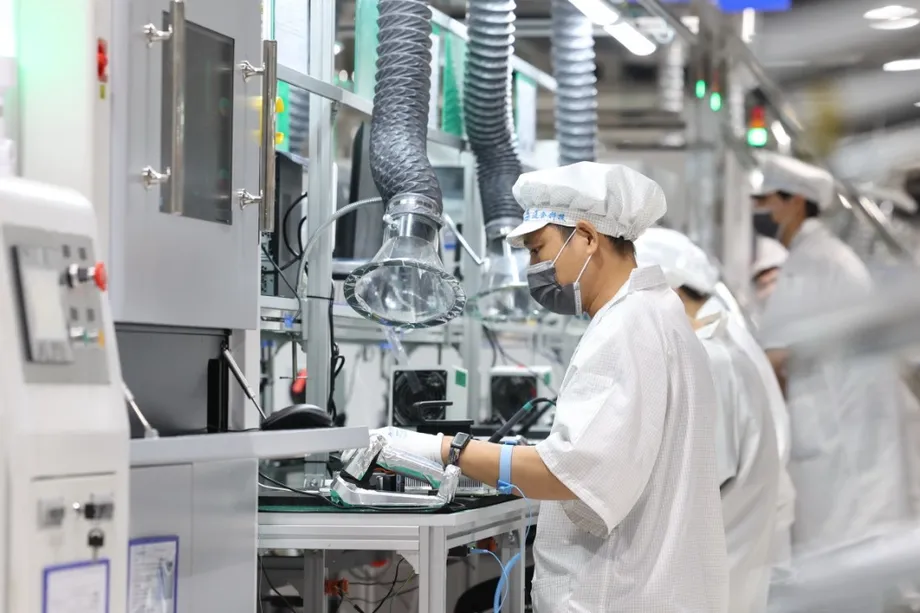
Electronics profits roughly doubled as demand increased for AI computing power and advanced memory technologies. Building and operating AI systems requires a chain of products, from electronic materials and components to computers, servers and communications equipment.
Profits in electronic specialty materials manufacturing rose 220%. That means earnings reached 3.2 times their level a year earlier. Manufacturers of discrete semiconductor devices recorded profit growth of 51.7%, while optoelectronic device manufacturers gained 69.8% and electronic circuit manufacturers gained 62.5%.
Data center construction also supported companies making the connections that move information between machines. Optical fiber manufacturing profits increased 570%, reaching 6.7 times their previous level. Optical cable manufacturing profits rose 110%, more than doubling.
Computer production showed similar strength. Profits increased 280% in computer peripheral equipment manufacturing, 170% in complete computer manufacturing, and 90.9% in industrial control computers and systems. Those results show the investment boom spreading across several stages of the computing supply chain.
Ding Meng, chief China economist at CITIC Bank International, said domestic and overseas demand generated by the AI supply chain had become a major support for industrial earnings. He expected rapid profit growth to continue unless global AI investment suffered a major reversal.
Advanced manufacturing takes a larger share
Profits in high technology manufacturing rose 52%, exceeding the industrial average by 36.5 percentage points. The sector generated 25.5% of total industrial profits, up 6.2 percentage points from a year earlier.
That puts its previous share at 19.3%. In practical terms, advanced manufacturing moved from producing slightly less than one fifth of industrial profits to producing more than one quarter in a year.
The expansion reached beyond computing. Profits in manufacturing instruments for navigation, surveying, weather and marine use increased 190%, while dental equipment and instrument manufacturers recorded growth of 59.6%.
Yu Weining, chief statistician in the NBS industrial statistics department, attributed the changing profit mix to industrial upgrading and the growth of newer productive activities. Xu Jianwei, director of the Industrial Division at the National Development and Reform Commission's Institute of Industrial Economics and Technical Economics, also pointed to a rising share for advanced manufacturing and progress in more valuable stages of production.
The electronics and high technology categories overlap, since some electronics manufacturers belong to both groups. Their figures describe related views of the shift toward more advanced production.
Metals and chemicals join the expansion
Raw material manufacturing profits increased 44.9%, contributing 5.9 percentage points to industrial profit growth. Demand for copper, aluminum and other basic metals from AI infrastructure and new energy industries helped support earnings.
Nonferrous metal smelting and rolling profits rose 79.7%. Nonferrous metals are metals other than iron, including copper and aluminum. Both are widely used in electrical equipment and infrastructure.
Chemical manufacturing profits increased 49.2%, while petroleum processing returned to profit, earning 84.22 billion yuan. Higher international crude oil prices helped improve earnings in related industries.
Mining profits rose 38.2% to about 881.37 billion yuan. Within mining, coal extraction and washing profits increased 57%, while oil and natural gas extraction profits rose 21.3%.
Manufacturing remained much larger in absolute earnings, generating about 4.57 trillion yuan in profits, an increase of 17%. Its total was roughly three quarters of the industrial profit pool.
Higher commodity prices create different outcomes along the production chain. A supplier can receive more for its metal or fuel, while a manufacturer buying those materials faces a larger bill. Companies with limited room to raise selling prices can find their margins squeezed.
Consumer industries face a different economy
Automobile manufacturing profits fell 22.8%, electrical machinery and equipment profits declined 5.9%, and agricultural food processing profits dropped 17.3%. Furniture manufacturers lost more than half their profits as weak household demand continued to weigh on purchases.
Several basic industrial sectors also struggled. Nonmetallic mineral product manufacturers recorded a profit decline of 46.9%, while ferrous metal smelting and rolling profits fell 73.3%. The latter category includes iron and steel production.
Utilities earned about 578.56 billion yuan, down 14.3%. Within that group, electricity and heat production and supply profits declined 17.9%.
CATL, the world's largest electric vehicle battery maker, reported a sharp slowdown in quarterly net profit growth amid competition in batteries and weaker automobile sales. Its experience illustrates the pressure on selling prices and margins even in industries central to China's recent manufacturing expansion.
Shena Yue, senior economist at Oxford Economics, said investment in advanced manufacturing and the use of electronics production capacity remained resilient, while investment and industrial capacity use more broadly were subdued. She identified household demand as the weak link, with the property downturn weighing on housing purchases and related durable goods.
Yue described the limit to relying on overseas sales:
"China's export strength isn't able to fully offset its domestic weakness," she said.
Larger firms pull further ahead
Large industrial enterprises recorded profit growth of 18.8%, compared with 15.4% for medium enterprises and 8.7% for small enterprises within the survey. The gap between large and small firms was 10.1 percentage points.
Ownership figures also showed substantial differences. Joint stock companies recorded profit growth of 20.8%, state controlled enterprises gained 13.1%, and private enterprises gained 8.7%. Firms funded by foreign investors or investors from Hong Kong, Macao and Taiwan recorded growth of just 0.5%.
These classifications describe different features of businesses. A company's size is one feature, while ownership is another. State control, private ownership and joint stock structures can also intersect within the published categories.
Private firms earned about 1.51 trillion yuan in profits, while state controlled enterprises earned about 1.94 trillion yuan. The slower growth among private and smaller enterprises adds another dimension to a recovery already divided by industry.
Better margins, slower cash collection
Industrial firms earned an average profit of 5.68 yuan for every 100 yuan in revenue, up from 5.24 yuan a year earlier. That 0.44 percentage point improvement helps explain why profits increased faster than sales.
Operating costs per 100 yuan of revenue fell by 0.45 yuan to 85.02 yuan. Other expenses per 100 yuan of revenue declined by 0.13 yuan to 8.35 yuan.
Chen Xi, a researcher at the Academy of Macroeconomic Research under the National Development and Reform Commission, attributed efficiency gains to equipment upgrading, the use of AI in manufacturing and tax policy support. He also cited China's extensive industrial supply chains and companies' ability to respond quickly to demand.
Cash collection moved more slowly. Accounts receivable, money customers owe for goods already sold, reached 29.77 trillion yuan at the end of September, up 10%. The average collection period increased by 1.3 days to 71.6 days.
Finished goods inventories rose 11.6% to 7.37 trillion yuan, and inventory turnover time increased by 0.6 days to 21 days. Both receivables and inventories grew faster than revenue, leaving more money tied up in customer bills and goods awaiting sale.
Liabilities rose 7.4% to 116.61 trillion yuan, outpacing asset growth of 6.7%. The ratio of liabilities to assets increased by 0.4 percentage points to 58.6%. That ratio measures how much of companies' assets are financed by obligations to lenders and other creditors.
Domestic demand remains the policy challenge
China's economy grew 4.5% in the third quarter and 4.6% across the first nine months, within the government's annual target range of 4.5% to 5%. Retail sales increased just 1.1% in September, illustrating the slower pace of household spending alongside stronger industrial earnings.
Dan Wang, China director at Eurasia Group, said policymakers saw no urgency for major new stimulus and were relying on technology exports to help reach the growth target. She described manufacturers' profits as thin and said debt concerns were restraining local government spending.
Yu said the next policy priorities included expanding domestic demand, improving supply and speeding the transition toward newer sources of growth. No timetable for a major new stimulus package was announced alongside the figures.
Wen Bin, chief economist at Minsheng Bank, identified support from investment projects moving into construction, efforts to clear overdue payments and measures addressing disorderly price competition. He also pointed to continued global investment in AI infrastructure and export demand for electric vehicles, energy storage and power equipment.
Wen identified tighter global monetary conditions, uncertainty over United States trade policy, geopolitical tensions and energy price fluctuations as risks to demand and business costs. For China's manufacturers, the central test is whether stronger earnings spread beyond technology and commodity suppliers while customers pay bills and household purchases recover.
Key Points
- Industrial profits rose 15.5% to 6.03374 trillion yuan in January through September 2026.
- September profits increased 14.4%, accelerating from 4.2% in August.
- Electronics contributed roughly 62% of the total industrial profit increase.
- High technology manufacturing generated 25.5% of profits, up from 19.3% a year earlier.
- Automobile, furniture, steel and utility businesses faced falling profits.
- Profit margins improved, while customer payment times, inventories and the liability ratio increased.
- Policy priorities include stronger domestic demand, better supply and newer sources of industrial growth.