Homes use less electricity while national demand keeps rising
China's household electricity consumption fell 0.3% in the first nine months of 2026, the first decline for that period in nearly a decade, as typhoons, heavy rain and cooler conditions in major consuming regions reduced demand for air conditioning. Factories, charging services and internet data services continued to use more power, keeping national consumption on a growth track.
Contents
- Homes use less electricity while national demand keeps rising
- How the household decline developed
- Why a warmer than usual September still needed less cooling
- Shanghai leads steep regional falls
- A small retreat after two years of growth
- Industry and services carry national growth
- Manufacturing growth shifts toward equipment and vehicles
- Charging and data services deliver much of the extra demand
- What the forecasts expect next
- Key Points
The National Energy Administration's September electricity release, published on October 21, put household consumption from January through September at 1,234.6 billion kilowatt hours. Total electricity use across the economy reached 8,073.4 billion kilowatt hours, an increase of 3.9% from the same period in 2025.
September tipped the household total into negative territory. Residential consumption fell 6.0% to 121 billion kilowatt hours that month, following a 4.0% decline in August. Through August, the cumulative household figure had still been 0.3% above the previous year.
The gap between homes and businesses is the central feature of the figures: household demand weakened during the summer, while production and services continued expanding their electricity use. September's national total rose 1.2% to 899.7 billion kilowatt hours, slower than the growth recorded across the first nine months.
How the household decline developed
Monthly household consumption had been falling since June. August and September were particularly important because they covered a period when air conditioning normally accounts for substantial electricity demand in densely populated eastern and southern China.
The sequence shows how several monthly declines gradually erased the growth accumulated earlier in the year:
- June: household electricity use fell 3.1% from a year earlier to 125.1 billion kilowatt hours.
- July: household consumption declined 5.1%, compared with a period of extreme heat in northern China and the Huanghuai region in 2025.
- August: consumption fell 4.0% to 188.3 billion kilowatt hours as typhoons and heavy rain reduced air conditioning demand.
- September: consumption dropped 6.0% to 121 billion kilowatt hours, bringing the January to September total down 0.3%.
A monthly figure compares one month with the same month a year earlier. The cumulative figure adds all the months since January. Several weak summer months can therefore reverse an earlier increase, even when electricity use was growing at the start of the year.
Why a warmer than usual September still needed less cooling
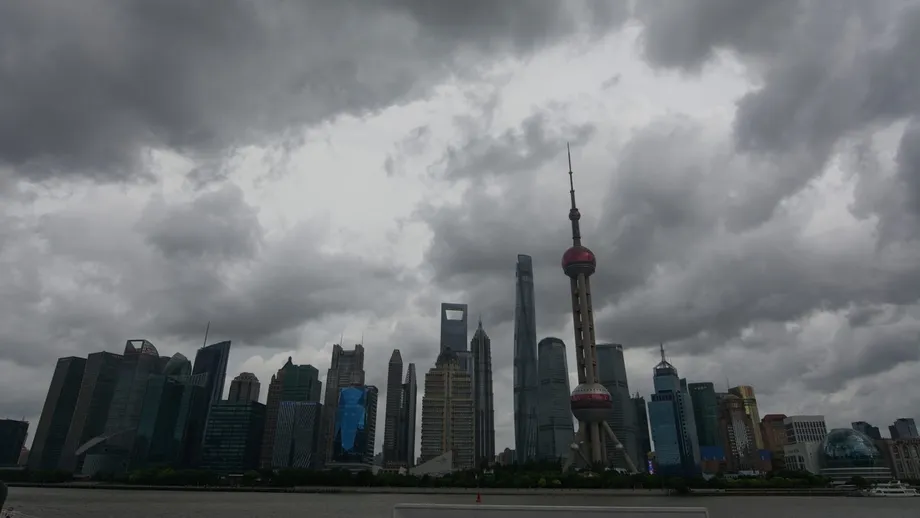
The National Energy Administration attributed September's household decline mainly to Typhoon Shadel and other extreme weather affecting central, eastern and southern China during the first and middle parts of the month. Those regions include many large electricity consumers, so a change in their cooling needs can move the national total.
The China Meteorological Administration put the national average temperature during September at 18.0 degrees Celsius, 0.9 degrees above the usual level. Yet the comparison for electricity demand was with an unusually hot previous September, rather than with an average year.
September 2024 was China's hottest September since records began in 1961, while September 2025 ranked fourth. Shanghai and Zhejiang were among the places that recorded their hottest September in 2025. A month can therefore remain warmer than normal while requiring less air conditioning than the same month a year earlier.
Wu Liqiang, assistant director of the statistics and digital intelligence department at the China Electricity Council, attributed September's slower national electricity growth partly to that high temperature comparison and partly to falling consumption in traditional industries that use large amounts of energy.
Lin Boqiang, director of the China Institute for Studies in Energy Policy at Xiamen University, said household demand has become especially sensitive to weather as ownership of appliances approaches relative saturation. When most families already have major appliances, changes in how long they run can matter more than the addition of new machines.
Shanghai leads steep regional falls
Shanghai recorded the largest September household decline among eight regions identified by Wu, with consumption down 27.8% from a year earlier. Zhejiang and Jiangsu also posted reductions exceeding one fifth.
The regional figures show where reduced cooling demand had its strongest effect:
- Shanghai: down 27.8%.
- Zhejiang: down 22.6%.
- Jiangsu: down 22.1%.
- Hunan: down 21.4%.
- Jiangxi: down 18.4%.
- Hubei: down 15.3%.
- Anhui: down 13.8%.
- Fujian: down 11.8%.
Several of these places had faced exceptional heat in the comparison period. Their declines explain why national household consumption could fall even while China's average September temperature remained above normal. For electricity suppliers, the practical change was less demand from cooling homes in major consuming areas.
A small retreat after two years of growth
Household electricity use reached 1,172.1 billion kilowatt hours in the first nine months of 2024, an increase of 12.6%. It then rose to 1,237.8 billion kilowatt hours in the same period of 2025, growing another 5.6%.
The 2026 total of 1,234.6 billion kilowatt hours was just 3.2 billion below the 2025 figure. It remained 62.5 billion kilowatt hours, or about 5.3%, above the corresponding 2024 total. Those figures put the latest decline in perspective: consumption slipped slightly from an elevated level after two years of growth.
September household demand had also fallen in 2025, dropping 2.6% to 128.7 billion kilowatt hours. At that point, however, the January to September total was still growing by 5.6%. In 2026, the run of monthly declines was enough to pull the cumulative total below the previous year.
Households accounted for about 15.3% of national electricity consumption in the first nine months of 2026, calculated from the administration's totals. The much larger business and industrial share explains how national consumption could continue growing while residential demand fell.
Industry and services carry national growth
China's secondary sector, which includes industry and construction, consumed 5,109.8 billion kilowatt hours from January through September, up 4.1%. Industrial consumption within that category reached 5,063.2 billion kilowatt hours, growing 4.3%.
Services grew faster. The tertiary sector, covering activities such as commerce, transport and digital services, used 1,610.9 billion kilowatt hours during the period, an increase of 6.8%. The primary sector, including agriculture, used 118.2 billion kilowatt hours, up 3.4%.
September followed the same broad pattern. Secondary sector consumption rose 1.7% to 580 billion kilowatt hours, including industrial consumption of 575.1 billion, up 1.8%. Services used 185.2 billion kilowatt hours, an increase of 4.9%, while primary sector use rose 4.1% to 13.5 billion.
Wu put September's additional electricity consumption at 9.48 billion kilowatt hours for the secondary sector and 8.56 billion for services. Their combined increase exceeded the net national gain because declining household demand offset part of the growth elsewhere.
Manufacturing growth shifts toward equipment and vehicles
High technology and equipment manufacturing consumed 961.9 billion kilowatt hours in the first nine months, up 8.7%. That was more than twice the 4.3% growth rate for industry as a whole.
September consumption in high technology and equipment manufacturing reached 116.7 billion kilowatt hours, an increase of 4.6%. Wu described the pattern within manufacturing in these words, translated from Chinese:
Within manufacturing, the pattern of new industries rising and old industries falling continued, with high technology and equipment manufacturing maintaining relatively rapid growth.
The detailed September figures show electrical machinery and equipment manufacturing up 9.8%, special purpose equipment up 5.3%, and general purpose equipment up 5.2%. Computer and communications equipment manufacturing increased its electricity use by 4.6%.
Vehicle manufacturing consumption rose 3.3%, with production of complete new energy vehicles recording a 16.0% increase. Consumer goods manufacturing grew more slowly, at 0.7%.
The four major industries with high energy consumption moved in the opposite direction, declining 0.8% together. Electricity use in ferrous metal smelting and rolling, which includes much of the steel industry, fell 3.0%. Nonmetallic mineral products rose 1.1%, while nonferrous metals and chemical manufacturing registered slight declines.
Charging and data services deliver much of the extra demand
Charging and battery swapping services used 131.5 billion kilowatt hours from January through September, an increase of 55.4%. Internet data services consumed 79.3 billion kilowatt hours, growing 41.6%.
September figures were similarly strong. Charging and swapping services used 16.8 billion kilowatt hours, up 57.0%, while internet data services used 9.8 billion, up 35.4%. Battery swapping replaces a depleted vehicle battery with a charged one, while internet data services require electricity to operate computing equipment and cooling systems.
Wu said the two categories together added 8.65 billion kilowatt hours of consumption in September, accounting for 79.4% of the net increase across the whole economy.
Their combined September consumption was 26.6 billion kilowatt hours, about 3% of the national total of 899.7 billion. A relatively small share of total consumption supplied most of the net increase because these activities grew quickly while household demand and some traditional industries contracted.
The figures also show why total consumption and growth contributions answer different questions. Industry remains China's largest electricity consumer, while charging and data services are becoming increasingly important sources of additional demand.
What the forecasts expect next
Lin views the household decline as a temporary development and expects wider electric vehicle adoption to support residential electricity growth over the medium and longer term. He also identified heating, air conditioning and artificial intelligence applications as factors likely to influence future demand.
Public charging and battery swapping already appear as a fast growing service category in the official figures. Lin's household outlook focuses on how the spread of electric vehicles can also change electricity needs at home.
The economic research institute of State Power Investment Corporation previously forecast household electricity consumption of 2.02 trillion kilowatt hours in 2030, with average annual growth of 5.4% from 2026 through 2030. Its forecast for total national consumption was 12.68 trillion kilowatt hours in 2030, growing at an average annual rate of 4.2% over that period.
The China Electricity Council had also projected national electricity growth of 5% to 6% for the second half of 2026, supported by high technology manufacturing, digital product manufacturing and new infrastructure. September's 1.2% growth was below that projected pace. Full results for the second half were not yet available in the October release.
The council identified uncertainty from international conditions, slower global economic growth and the possibility of a strong El Nino event. For now, the measured change is specific: weather reduced household cooling demand, while equipment manufacturing, charging and data services continued adding to China's electricity needs.
Key Points
- Household electricity use fell 0.3% to 1,234.6 billion kilowatt hours in January through September 2026, the first decline for that period in nearly a decade.
- National electricity consumption still rose 3.9% to 8,073.4 billion kilowatt hours.
- September household demand fell 6.0%, with typhoons, rain and lower cooling needs in major consuming regions driving the decline.
- Shanghai recorded a 27.8% household reduction, the largest among eight regions with double digit falls.
- High technology and equipment manufacturing consumption grew 8.7% over the first nine months.
- Charging and swapping services and internet data services supplied 79.4% of September's net national electricity increase.
- Household consumption remained about 5.3% above its level in the same period of 2024.