A rapidly feeding black hole reveals a crucial inner boundary
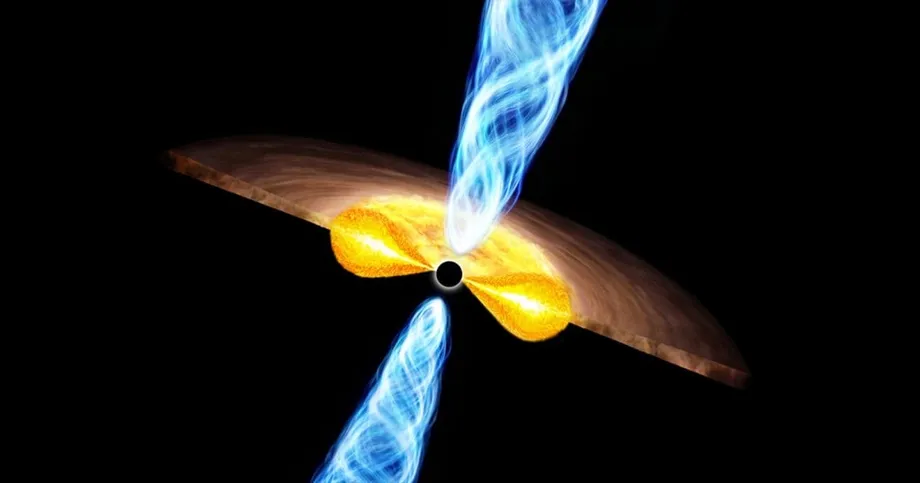
A supermassive black hole about 420 million light years away may owe its powerful jet to a change in the shape and temperature of the matter falling toward it. Observations of the galaxy 3C 120 indicate that its relatively cool, flat disk stops short of the black hole, leaving an inner region filled with much hotter plasma where strong magnetic fields could gather.
Contents
- A rapidly feeding black hole reveals a crucial inner boundary
- Why 3C 120 presents a puzzle
- XRISM reads the disk through iron
- Radio telescopes trace the jet inward
- How rotation could supply the jet's energy
- A structural change ties the measurements together
- Why the result matters beyond one galaxy
- Publication and the next observations
- Key Points
A team led by Associate Professor Hirofumi Noda of Tohoku University and Associate Professor Kazuhiro Hada of Nagoya City University combined observations from Japan's X-ray Imaging and Spectroscopy Mission, known as XRISM, with measurements from three international radio telescope networks. Together, the instruments connected the structure of the incoming matter with the narrow jet emerging near the black hole.
The findings, published in The Astrophysical Journal Letters on October 19, 2026, address a puzzle: how can a black hole consume matter rapidly while also launching a powerful stream of plasma at nearly the speed of light? The type of disk expected during rapid feeding has been thought poorly suited to gathering the magnetic fields needed for that process.
Tohoku University's research announcement, released on October 20, describes a possible answer. The cooler outer disk gives way to a hot inner flow, creating conditions in which magnetic fields could draw energy from the black hole's rotation and channel it into a jet.
Why 3C 120 presents a puzzle
3C 120 lies in the direction of the constellation Taurus. Its central black hole has a mass of roughly 60 million Suns and is both rapidly consuming surrounding matter and producing a powerful jet. That combination makes it a useful target for investigating how feeding and jet production fit together.
Matter approaching a black hole usually has some sideways motion, so it circles inward instead of falling straight down. It gathers into an accretion disk, where friction and other processes heat the material until it emits light and other radiation. Astronomers study that radiation to understand a region they cannot inspect directly.
Rapid feeding is generally expected to produce a relatively cool, geometrically thin disk extending close to the black hole. Here, cool is a comparison with the much hotter plasma closer to the center. A thin disk has a small vertical thickness compared with its width, much like a flattened sheet.
The difficulty is magnetic. A leading explanation for powerful jets requires strong magnetic fields near a rotating black hole. A thin disk is thought to have trouble maintaining the necessary field structure. A hotter, thicker inner flow offers a more favorable setting, making the location where the disk changes form central to the investigation.
XRISM reads the disk through iron
XRISM, a mission of the Japan Aerospace Exploration Agency, detected X-rays emitted by iron in the material around 3C 120's black hole. Iron produces radiation at characteristic energies, creating a recognizable feature called an emission line in an X-ray spectrum. A spectrum separates radiation according to its energy.
The iron line changes shape near a black hole. Material moving toward or away from an observer shifts the energy of the radiation they receive. The strong gravity near the black hole also changes the energy of escaping X-rays. Together, these effects spread and distort the line.
Researchers used that distortion to estimate how far inward the relatively cool disk extends. The university describes its inner edge as lying at about 20 times the black hole's radius. The scientific description expresses the boundary as approximately 20 gravitational radii, a distance scale based on the black hole's mass.
Inside that boundary, the team infers a transition to a hot, geometrically thick flow. The plasma there is thought to reach temperatures of hundreds of millions of degrees. Plasma is gas in which electrons have separated from atoms, allowing the material to interact strongly with magnetic fields.
Radio telescopes trace the jet inward
Radio observations taken at around the same time supplied the other half of the picture. The team used the Global Millimeter VLBI Array, the Very Long Baseline Array and the East Asian VLBI Network to trace the jet as it narrowed toward the black hole.
These networks combine measurements from widely separated telescopes through very long baseline interferometry, or VLBI. The method lets astronomers distinguish much finer details than a single radio telescope could resolve on its own. In this study, it helped them follow the jet toward its origin.
From the jet's shape, the researchers estimated that its base has a radius no greater than about 10 black hole radii. Their combined interpretation places the jet's origin within the hot inner flow identified through the X-ray measurements, close to the black hole.
Noda, the Tohoku University associate professor who co-led the research, explained why combining the observations mattered:
By looking at the same black hole with state-of-the-art X-ray and radio telescopes, we were able to see both the hot plasma surrounding the black hole and the jet emerging from it. This allows us to directly connect the extreme environment near the black hole with the formation of the jet.
How rotation could supply the jet's energy
The team's proposed explanation links three ingredients: a rotating black hole, a hot flow of incoming plasma and strong magnetic fields. The cooler outer disk supplies matter. Closer to the black hole, the hotter and thicker flow provides a region where magnetic fields can accumulate more readily.
Those fields could then extract some of the black hole's rotational energy and direct it into a narrow stream of plasma. The leading theoretical description of this process is called the Blandford-Znajek mechanism. In simple terms, magnetic fields connect the rotating environment near the black hole to material that accelerates outward.
The jet is therefore powered near the black hole while other matter continues to fall inward. This gives the system two linked movements: an inward supply of matter and an outward flow carrying energy into the surrounding galaxy.
For 3C 120, the researchers propose that the change from a thin outer disk to a thick inner flow makes those movements compatible. The exact magnetic field structure and the way rotational energy is transferred into the jet remain subjects for further study.
A structural change ties the measurements together
The paper's title, "Disk truncation triggers relativistic jet launching of a highly accreting supermassive black hole," captures the proposed connection. Disk truncation means that the cooler, thin part of the disk ends before reaching the black hole. Relativistic describes motion fast enough that Einstein's theory of relativity becomes essential to understanding it.
The X-ray measurements locate the inner boundary of that cooler disk. The radio measurements trace the jet toward a region inside it. Read together, the observations give the researchers a spatial explanation for how a rapidly feeding system can maintain conditions favorable to a powerful jet.
That is more specific than simply finding a disk and a jet around the same object. The study connects the disk's changing structure with the location where the jet begins, bringing the incoming and outgoing material into the same physical picture.
3C 120 is especially useful because it feeds relatively rapidly. The research contrasts it with more weakly feeding active galaxies such as M87, where hot, thick flows have already helped support the magnetic explanation for jet production. The new result extends that investigation to a different feeding environment.
Why the result matters beyond one galaxy
Jets carry energy away from the immediate surroundings of supermassive black holes. When they interact with gas in and around galaxies, they can change the conditions under which stars form. Understanding the engine near a black hole therefore helps researchers study changes occurring on much larger scales.
The 3C 120 findings supply a concrete connection between those scales: the structure of the incoming matter may help determine whether a powerful jet can form. A boundary close to the black hole could influence how energy is delivered far beyond it.
The team is conducting further coordinated observations of a more massive black hole using XRISM and global radio observatories. Researchers also plan to compare the measurements with theoretical models and computer simulations, testing how well the proposed geometry explains the behavior of matter and magnetic fields.
Noda described the purpose of that next stage:
Our next goal is to build a more complete picture of how matter, magnetic fields and black hole rotation interact in these extreme environments. Understanding this process may also help us better understand how supermassive black holes influence the evolution of galaxies and the larger structures of the Universe.
Publication and the next observations
The research brings together a Japanese X-ray mission and radio networks spanning several regions. Their complementary measurements are central to the method: X-rays reveal conditions in the accretion flow, while radio observations trace the jet's structure.
The publication sequence and planned follow-up are:
- October 19, 2026: The Astrophysical Journal Letters published the study led by Noda and Hada.
- October 20, 2026: Tohoku University announced the findings and described the combined X-ray and radio observations.
- Next stage: The team is conducting coordinated observations of a more massive black hole and comparing results with models and simulations.
The paper carries the DOI 10.3847/2041-8213/aeaa2c. These publication details are also listed in the official study announcement. Applying the same observing method to another black hole will give the team a way to examine whether the structural transition found in 3C 120 also appears in a different system.
Key Points
- XRISM and three radio telescope networks examined 3C 120, about 420 million light years away.
- The galaxy's black hole has a mass of roughly 60 million Suns and rapidly consumes matter while launching a powerful jet.
- X-ray measurements indicate that the cooler, thin disk ends before reaching the black hole, giving way to a much hotter inner flow.
- Radio observations trace the jet's origin to the region occupied by that hot flow.
- The team proposes that magnetic fields gathering there can tap the black hole's rotational energy to power the jet.
- Further observations will examine a more massive black hole and test the explanation against theoretical models and simulations.