Land losses and ruined homes shape the recovery
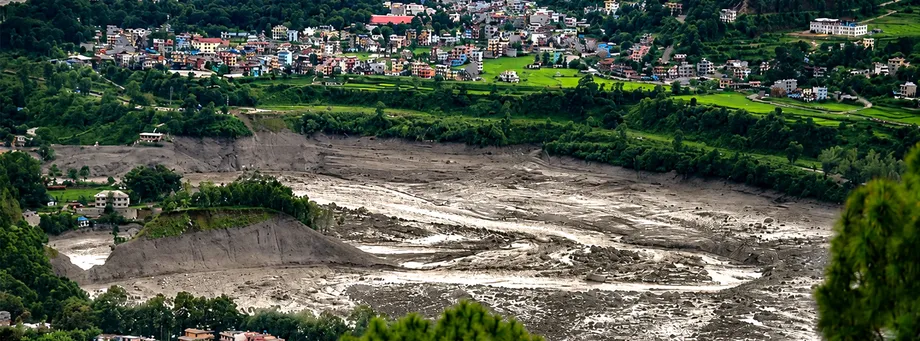
Nepal's National Planning Commission has put preliminary private property damage from the August 26, 2026, Rasuwa and Bhotekoshi floods at Rs79.17 billion, with land accounting for the largest share. Its household survey records 32,872 people affected across 15 local government areas in Rasuwa, Nuwakot, Dhading and Gorkha.
Contents
- Land losses and ruined homes shape the recovery
- Why the wider disaster estimate is much larger
- Nuwakot carries the largest affected population
- Destroyed land makes rebuilding more difficult
- Most damaged structures cannot be used again
- Families want different kinds of permanent housing
- Farms and shops lost the means to earn
- Power, roads and public services add to the burden
- Debt, legal paperwork and safety remain urgent
- Key Points
The findings put household damage at Rs69.57 billion and damage to businesses and establishments at Rs9.60 billion. Preliminary summaries also carried a total of Rs7.917 billion, split into Rs6.957 billion for households and Rs960 million for establishments. The larger figures are repeated in the detailed Nepali account of the survey, including its land and housing breakdowns.
For families deciding where to rebuild, the most pressing figures concern shelter. Of 4,151 damaged structures, 2,989 were completely destroyed and 3,194 were assessed as unusable. Among 3,067 families asked about permanent housing, 797 wanted to return to the place where they lived before the flood, while 939 preferred land provided by the government.
The survey also exposes the distance between counting destroyed property and restoring a community. Families lost farmland, stored food, animals, vehicles and household possessions. Businesses lost premises and equipment while continuing to face bank repayments. Some survivors, displaced once by the 2015 earthquake and again by this flood, are now living in temporary shelters in Nuwakot.
The commission deployed 58 teams comprising 156 technical and administrative staff to collect information. Its findings remain preliminary as work continues on the wider assessment of infrastructure, economic activity, public services and environmental damage.
Why the wider disaster estimate is much larger
The government's earlier Rapid Damage and Needs Assessment, or RDNA, estimated total disaster effects at Rs408.29 billion and recovery needs at Rs723.32 billion. That exercise covered five districts, including Chitwan, and a much broader range of assets and economic losses than the household survey.
A rapid assessment uses government records, mapping and satellite imagery to produce an early estimate for emergency decisions. The more detailed Post Disaster Needs Assessment adds household visits and engineering inspections to work out what needs rebuilding and how much it may cost.
Physical damage is the value of property destroyed or damaged, such as a shop, house or power station. Economic loss includes income that disappears while those assets are out of use. Recovery needs cover the spending required to restore services and livelihoods, including measures to make rebuilt settlements and infrastructure safer.
The RDNA's Rs723.32 billion recovery estimate is about 1.8 times its Rs408.29 billion estimate of damage and economic losses. The household survey's private property total has a narrower scope, excluding roads, hydropower and other sector assessments still being assembled.
The assessment and recovery process has unfolded over several weeks:
- August 26, 2026: Flooding struck the Bhotekoshi and Trishuli river corridor, destroying settlements, businesses and infrastructure.
- September 13: The government's rapid assessment was released, covering Rasuwa, Nuwakot, Dhading, Gorkha and Chitwan.
- October 17: Detailed preliminary household survey findings described damage across four districts.
- October 19: Survivors in temporary shelter at Bada Chautara described continuing uncertainty about housing and work.
Nuwakot carries the largest affected population
Nuwakot accounts for 17,954 of the 32,872 people recorded as directly affected in the household survey, or about 55 percent. Rasuwa follows with 9,676 people, Dhading with 4,584 and Gorkha with 658.
The survey records 16,714 affected men, 16,080 women and 78 people whose gender was recorded as another category or left unspecified. Across the four districts, it lists 6,817 affected households and 499 businesses or establishments, giving a combined total of 7,316.
Nuwakot had 4,164 affected households and establishments, compared with 1,977 in Rasuwa, 1,052 in Dhading and 123 in Gorkha. The business damage tables separately list 1,638 establishments. The relationship between that count and the 499 establishments in the combined survey total has not been explained.
Nuwakot also had the largest number of damaged structures, at 2,256. Rasuwa had 1,236, Dhading 630 and Gorkha 29. This concentration means that housing assistance, repairs and the restoration of local trade will involve especially large demands in Nuwakot.
Destroyed land makes rebuilding more difficult
Land damage affected 3,610 households and covered 507.97 hectares, valued at about Rs35.44 billion in the detailed survey figures. That is roughly 45 percent of the Rs79.17 billion private property total, making land the largest recorded component.
Land beneath privately owned homes sustained an estimated Rs13.26 billion in damage, while damage to building construction investments was put at Rs11.95 billion. The damaged structures occupied 54.65 hectares.
A family whose house has collapsed may need money and materials to rebuild. A family whose plot has also been eroded, buried or left exposed to further flooding faces another decision: whether there is a suitable place to put the replacement house. The housing preferences recorded by the commission make that choice central to recovery planning.
The detailed findings also value losses of cash, valuables, cultural objects and archaeological possessions belonging to 2,330 households at Rs5.02 billion. Permanent household goods belonging to 3,187 households sustained Rs1.45 billion in damage, while temporary household goods belonging to 2,769 households accounted for another Rs663.5 million.
Household vehicles added Rs1.24 billion in damage, involving 1,423 vehicles owned by 1,115 households. Together, these losses reach far beyond the walls of a home: they include savings, transport and the everyday possessions needed to resume ordinary life.
Most damaged structures cannot be used again
The commission's detailed findings list 4,151 damaged structures belonging to 3,067 property owners. A preliminary summary gave 3,967 owners. The structures included 2,792 houses, 651 truss structures, 263 temporary shelters, 288 cattle sheds and storage or traditional outbuildings, and 142 other structures. Another 15 had no recorded type.
Complete destruction accounted for 2,989 structures, or 72.01 percent. Another 508 were buried in soil and mud, 302 sustained partial damage, 141 were tilted and 192 had minor damage. The damage category was unspecified for 19.
Engineers assessed 3,194 structures, or 76.95 percent, as unusable. A smaller preliminary count put that number at 3,104, while retaining the same percentage. The detailed count of 3,194 matches the stated share of all 4,151 structures.
Only 332 structures could return to use after major repairs and 320 after minor repairs. Another 97 were usable without repairs, while reuse status was unspecified for 208. These figures leave most owners facing replacement rather than a straightforward repair.
Families want different kinds of permanent housing
The commission asked 3,067 affected families where they wanted to live permanently. Almost half, 49.59 percent, preferred their former location or another plot they owned. That total combines several distinct choices.
Returning to the former location was the preference of 797 families, or 25.99 percent. Another 565 families, 18.42 percent, wanted to use land they owned elsewhere within their district. A further 159, or 5.18 percent, chose their own land elsewhere in Nepal.
Government assistance was the preferred route for another large group. Some 939 families, 30.62 percent, chose government provided land where they would not hold ownership. Another 590, or 19.24 percent, preferred communal housing arranged by the government. Seventeen families gave no preference.
These choices point to several housing programmes rather than a single solution. Assistance to rebuild on private land, access to another plot and communal accommodation would meet different needs. The detailed account puts housing construction for the 3,067 families at about Rs12 billion; the wider RDNA estimates nearly Rs95.83 billion for housing recovery across its broader area.
Khalte residents Nangsi and Singhbir Tamang illustrate why permanence matters. Their community had moved after the 2015 earthquake made mountain villages vulnerable to landslides. About 250 households relocated to the riverside settlement, initially as a temporary arrangement. The August flood swept Khalte away, forcing another move.
By October 19, 511 people were sheltering at Bada Chautara in Nuwakot, including 212 children. Nangsi and Singhbir had moved from a donated tent toward a room roofed with tin, but uncertainty about how long they could stay remained a daily concern.
Farms and shops lost the means to earn
Standing crops belonging to 2,951 households sustained Rs232.1 million in damage. Stored food losses reached Rs104.1 million across 1,876 households, while livestock, poultry and fish farming losses affected 1,011 households and amounted to Rs214.2 million.
Households lost 664 large animals, 4,601 smaller animals, 63,633 birds and 24,508 kilograms of fish. Businesses separately lost 130 large animals, 2,058 smaller animals, 153,052 birds and 28,150 kilograms of fish. For those owners, replacing animals and production facilities is part of restarting their income.
The business tables list 774 wholesale and retail traders, 337 accommodation and food service establishments, 166 agriculture, forestry and fishing businesses, and 136 other service providers. These groups account for most of the 1,638 establishments in that breakdown. Businesses also recorded Rs940 million in damage to 403 vehicles.
Gopal Bahadur Sharki, a shoe shop owner in Devighat, reopened a temporary shop among the rubble after the flood destroyed his premises. He described the reason for returning to work:
Now I am running my shop in this situation here to survive,
The wider RDNA estimated that nearly 4,800 businesses sustained damage. It put combined commercial damage and economic losses at about Rs146.19 billion, including income lost during disruption, and estimated rebuilding commercial establishments at Rs45.45 billion.
Power, roads and public services add to the burden
The rapid assessment placed nearly Rs300 billion of the disaster's estimated effects on private businesses, households and privately owned infrastructure. Arjun Bhandari, a National Planning Commission joint secretary and coordinator of the RDNA, described where much of the physical damage occurred:
Most of the physical damage has occurred in private enterprises, private housing, hydropower projects, schools, vehicles and communication infrastructure,
Thirteen hydropower projects were affected, eight of them privately owned. Five solar plants also sustained damage. The assessment described affected energy capacity of 759 megawatts, including facilities operating or under construction, and estimated hydropower and transmission damage and losses at about Rs151 billion.
The RDNA also recorded 69 kilometres of damaged road along the Galchhi, Trishuli and Rasuwagadhi corridor. Broken transport links make it harder for businesses to obtain supplies and customers, while damaged access roads complicate repairs at energy projects.
Public service damage included 18 schools with 56 affected buildings and 308 classrooms or rooms. Of those rooms, 156 were completely damaged and 152 partially damaged. Seven health facilities were affected, including four health posts that were completely destroyed.
Banking and communications were disrupted as well. Seventeen branches of 12 banks and financial institutions sustained damage, alongside three Nepal Telecom towers and one Ncell tower. Restoring those services is part of making affected settlements workable places to live and trade again.
Debt, legal paperwork and safety remain urgent
Business owners who lost their premises face continuing concern about bank repayments. The Cabinet approved a first phase of recovery measures including customs duty exemptions for replacement commercial vehicles and freight carriers, tax relief and concessional facilities. The announced measures do not give a complete timetable for individual borrowers to receive assistance.
Families with missing relatives face another barrier to financial recovery. Nepal's shorter death declaration process, introduced in October, was intended to allow disaster families to seek legal recognition after 45 days. Death registration can determine access to bereavement payments, insurance, pensions and property transfers.
At Bada Chautara, survivors described missing relatives alongside the loss of housing and work. Their needs therefore extend across several systems at once: shelter allocation, identity and property records, financial assistance and support through bereavement.
Campaigners have also called for particular vigilance against human trafficking in districts affected by the Bhotekoshi and Trishuli floods. Women and children displaced by disasters may face greater risk amid disrupted housing and livelihoods. Nuwakot Deputy Superintendent of Police Iqbal Hawari participated in an interview addressing that concern.
The commission is still preparing the wider needs assessment, and no completion date has been given. Its next task is to connect verified damage, household preferences and sector recovery costs with practical financing decisions. For survivors, the immediate priorities are a stable place to live and a reliable way to earn.
Key Points
- Detailed preliminary survey figures put private property damage at Rs79.17 billion, with smaller totals also circulating in preliminary summaries.
- The household survey records 32,872 affected people across four districts; Nuwakot accounts for about 55 percent.
- Land damage is valued at Rs35.44 billion across 507.97 hectares.
- Of 4,151 damaged structures, 2,989 were completely destroyed and 3,194 were assessed as unusable.
- Among 3,067 families asked about permanent housing, 797 wanted their former location, 939 preferred government provided land and 590 chose communal housing.
- The broader rapid assessment estimates Rs408.29 billion in disaster effects and Rs723.32 billion in recovery needs across five districts.
- Housing, business debt, disrupted services and legal paperwork remain central to recovery.