A cinema debut meets a difficult commercial test
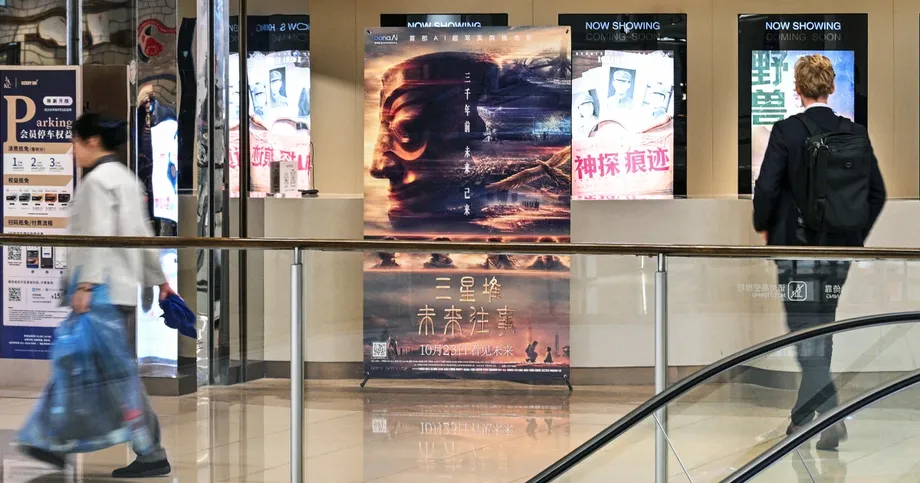
Sanxingdui: Future Past collected 914,000 yuan at Chinese cinemas by midday on October 25, 2026, two days after its release, according to ticketing platform Lighthouse. The 100-minute film cost more than 10 million yuan to make. On its opening day, just 0.9% of available seats were occupied.
Contents
- A cinema debut meets a difficult commercial test
- Plenty of screenings, few occupied seats
- Ancient symbols drive a story about algorithms
- AI generated the images, people made the decisions
- Why a simple embrace became difficult
- Audiences want a reason to buy a ticket
- Lower costs meet the realities of film revenue
- Online popularity faces a different market
- More projects are moving toward release
- Key Points
Bona Film Group is promoting the science fiction adventure as China's first theatrical feature made throughout with artificial intelligence. Its opening brings a practical question into focus: can technology that attracts huge audiences on phones persuade people to buy cinema tickets?
Lighthouse projected a final gross of 2.505 million yuan at that point. Even that forecast, which can change as ticket sales develop, amounted to less than one quarter of the film's reported minimum production cost. The producer receives only part of the money collected at cinemas.
Bona's shares had already reached their daily trading limits on three dates before release. Investors were responding to the promise of a cheaper production system. Moviegoers were deciding whether this particular story was worth their money.
Jiang Defu, Bona Film Group's chief executive and the film's producer, acknowledged the difficult reception while describing the release as an experiment in production and distribution:
We are the first to try it, the first to get a theatrical release permit, and the first to be tested by the audience.
The company says the film secured a public screening permit from the National Film Administration. It received that permission in the animation category, with original digital characters rather than human performers.
Plenty of screenings, few occupied seats
Chinese cinemas gave the film substantial access to screens. Maoyan listed more than 10,000 screenings for its opening Friday, October 23. Lighthouse recorded bookings at 6,901 cinemas and a 2.9% share of scheduled screenings.
Opening day ticket revenue reached 317,000 yuan, representing 1.2% of the national box office. Its share of revenue was therefore well below its share of screenings. Occupancy rose slightly to 1.2% on October 24, while the number of screenings in prime viewing slots fell from 7,922 to 2,919.
Advance sales had offered an early warning. Maoyan recorded 65,000 yuan by Thursday evening and 80,000 yuan by Friday morning. Tickets were listed at between 20 and 90 yuan, although checks in several major cities found many prices between about 20 and 50 yuan.
By midday on October 25, Lighthouse listed 797,000 yuan in revenue eligible for distribution among the businesses involved. Its estimated allocation to the producer was 314,000 yuan, compared with 417,000 yuan for cinemas. The difference between total ticket receipts and the producer's share helps explain why a film needs ticket sales far above its production budget to recover its costs through theatrical release alone.
The main developments unfolded quickly:
- September 27: Bona announced the October 23 release date.
- September 28, October 9 and October 12: Bona shares reached their daily upper trading limits.
- October 12: Bona warned investors that the film's box office returns were uncertain.
- October 22: A special screening in Beijing attracted more than 300 viewers.
- October 23: The film opened nationwide and earned 317,000 yuan.
- October 25: Cumulative ticket revenue reached 914,000 yuan by midday.
Ancient symbols drive a story about algorithms
Sanxingdui: Future Past, written and directed by Yue Ming, connects the ancient Shu civilization with a future in which humans have handed their decisions to a powerful AI. When global systems fall into disorder, seven ancient symbols become clues to resolving the crisis.
The film draws its visual identity from Sanxingdui's distinctive bronze objects, including the Bronze Sacred Tree, Bronze Standing Figure and masks with protruding eyes. Its imagined world extends from ancient palaces and ceremonies to space travel.
The seven symbols serve as fictional marks connecting different points in time. The plot also imagines encounters between ancient Shu and Egypt. These invented adventures give the production room to create large scenes without building physical sets or sending actors to locations.
Producer Qu Ji Xiaojiang has said she wanted new technology to help record and spread Chinese historical culture. Jiang described the project at the Beijing screening as an attempt to bring ancient Shu civilization and AI together. Human judgment is also central to the story: the crisis begins when people surrender too much decision making to algorithms.
AI generated the images, people made the decisions
Bona's production involved around 100 professionals over more than two years. The team generated more than 1.2 million source images and completed over 100 iterations of the full film. Those figures describe a lengthy process of selection, revision and replacement.
The AIGMS production division retained responsibility for the creative concept, narrative direction and final artistic decisions. AI handled generation and execution across characters, environments and other visual material. The production used original digital identities rather than replicas of real actors.
Bona organized the work across 17 familiar film disciplines, including writing, directing, production, art, cinematography, lighting, sound and editing. Although the film had no conventional camera shoot, people still had to decide what each shot should communicate and how it should connect to the next.
Boka Film Cloud's Infinite Canvas system brought scripts, storyboards, characters, sets, lighting and audiovisual material into a shared production environment. Vidu, developed by Shengshu Technology, provided the principal technical support for the released film.
The team aimed for theatrical specifications including 4K pictures, high dynamic range color and surround sound. High dynamic range allows a wider range of brightness and richer detail in light and dark areas. A cinema screen also makes small visual faults much easier to see than a phone does.
Why a simple embrace became difficult
One planned scene exposed the distance between generating an attractive image and telling a story through movement. A woman was supposed to walk toward a boy, bend down and embrace him. The model could show the characters standing separately, but their bodies blurred when their arms overlapped.
The filmmakers changed the scene. They had the woman approach and pause, then used the exchange of looks and the boy's reaction to carry the emotion. Writing, image generation and editing had to develop together as the team worked around the tool's limits.
Characters also needed to retain the same faces, skin details, costumes and expressions across hundreds of shots. Bronze masks had to keep matching patterns when the camera angle or lighting changed. A detail that shifts between shots can interrupt the viewer's sense that the story takes place in one continuous world.
Bona trained its principal characters as reusable digital assets and used modeling, other production techniques and manual correction to fill gaps. Teams inspected frames in successive rounds. The production says it adjusted subtle facial expressions frame by frame.
New models brought another complication: better images made older work look dated. The team changed supporting models twice during production and continued updating shots shortly before release. About half the shots shown in trailers released in March and May were replaced in the final version.
AI reduced some physical production expenses, but repeated generation and checking consumed time. The two years spent on this film show how much human work can sit behind a production described as entirely generated by AI.
Audiences want a reason to buy a ticket
Iris Yang attended a free preview and said the film's quality would not have persuaded her to pay. She explained the standard she would expect from an AI cinema experience:
If AI generation can match the theatrical experience of Avatar, I think I would be willing to pay for it.
Zhang Jun, an independent AI director, made a similar point about the limits of selling the production method:
The audience won't automatically pay for the tickets just because it's an AI-generated film
Liu Haibo, a professor at Shanghai University's Shanghai Film Academy and president of the Shanghai Film Critics Society, identified several obstacles beyond the technology. The film had no stars, its title gave little sense of the story, and its initial promotion left potential viewers without enough information to judge its appeal.
AI CINEMA cofounder Zhou Zhenyu described the market response as calm rather than a rush either to support or reject AI. He said viewers choose films for their subject, content and quality, while cinemas had offered neither special pricing nor a distinct promotional campaign for this release.
Feedback from screenings included praise for large visual scenes, alongside concerns about limited facial emotion and abrupt connections between some sequences. For a story built around humanity's relationship with machines, getting viewers emotionally involved with digital characters is a central creative task.
Lower costs meet the realities of film revenue
Jiang put production spending above 10 million yuan and estimated that a comparable film using live action would cost at least 300 million yuan. Qu gave a higher hypothetical estimate of 800 million to 900 million yuan. Both described major potential savings, although they used different estimates for a conventional version.
Qu said spending had shifted toward computing power, electricity and storage. Physical locations, camera equipment and the daily expenses of a large shooting unit were less central. Repeated attempts to produce acceptable images became a major use of production time.
Bona's broader AI business already presents investors with an eye catching margin. Its financial results for the first half of 2026 recorded AI film and television revenue of 1.9323 million yuan against costs of 61,300 yuan, producing a gross margin of 96.83%.
Gross margin is the share of revenue left after the costs assigned directly to that business. Company profit also depends on expenses such as administration, financing and taxes. Bona's cinema and theater circuit business recorded a negative gross margin of 3.99% during the same period, while its film business recorded 35.51%.
The AI division remained small: its revenue represented 0.42% of Bona's total revenue of 458 million yuan. Its entire revenue for 2025 was 2.387 million yuan. Investors were valuing the possibility of expansion while the first theatrical release was still trying to establish a paying audience.
Online popularity faces a different market
AI short dramas received more than 200 billion views on Douyin in September. Bona also had experience with an online Sanxingdui story before making the feature. Its series Sanxingdui: Future Revelation, comprising 13 episodes, launched in July 2024 and had accumulated more than 200 million views across platforms by October 2026.
Cinema tickets ask viewers for both money and a longer commitment of time. Sanxingdui: Future Past needs to hold attention for 100 minutes, with a coherent story and convincing characters. Online viewing numbers measure a different kind of consumption from paid admissions.
The release also arrived during a weak period for Chinese cinemas. Lighthouse figures put national box office revenue for the first half of 2026 about 40.6% below the same period in 2025. Admissions fell by more than 200 million, or about 34.2%.
Bona is therefore testing its production method in a market where conventional films are also struggling. A February release, Tuanyuan Ling, had already promoted itself as China's first AIGC animated film and collected about 15.006 million yuan. Bona's more specific claim centers on a hyperrealistic feature using AI throughout production and receiving theatrical approval.
More projects are moving toward release
Bona has disclosed three further AI film projects: Jihua Wai: Guanghan Xingdong, Zhonghua Zhiguai: Luocha Haishi and Dongfeng Bida. The first two had completed project registration, and Guanghan Xingdong was in production. As of Bona's October 12 announcement, it had neither a public screening permit nor an announced release date.
Huayi Brothers has announced an H·AI program covering nine short dramas and the film Euler's Identity. China Film's second Young Filmmakers Program has a planned investment scale of 1 billion yuan through 2030, covering at least 30 projects or works, including original films, AI theatrical features and shorts. The amount reserved for AI films has not been disclosed.
Huace has also moved AI projects, including Zizhi Tongjian, into production. Independent short drama producer Chen Lanyi is developing Gui Lu with her own investment, production and distribution, combining AI with live action to keep the project within her budget.
Liu expects a group of AI features and longer productions to reach audiences in the first half of 2027. Beyond China, the AI science fiction feature Gods Don't Give Gifts was scheduled for a US release on December 4. Growing production activity is bringing more films toward audiences while Sanxingdui's opening receipts show the immediate commercial challenge.
Key Points
- Sanxingdui: Future Past opened in China on October 23, 2026, and earned 914,000 yuan by midday on October 25.
- Opening day occupancy was 0.9%, rising to 1.2% the following day.
- The film cost more than 10 million yuan and took over two years of work by around 100 people.
- Lighthouse projected a final gross of 2.505 million yuan as of October 25.
- Human filmmakers controlled the story and artistic decisions while AI generated production material.
- Bona and other Chinese companies are developing further AI films, with audience interest and commercial returns still being tested.