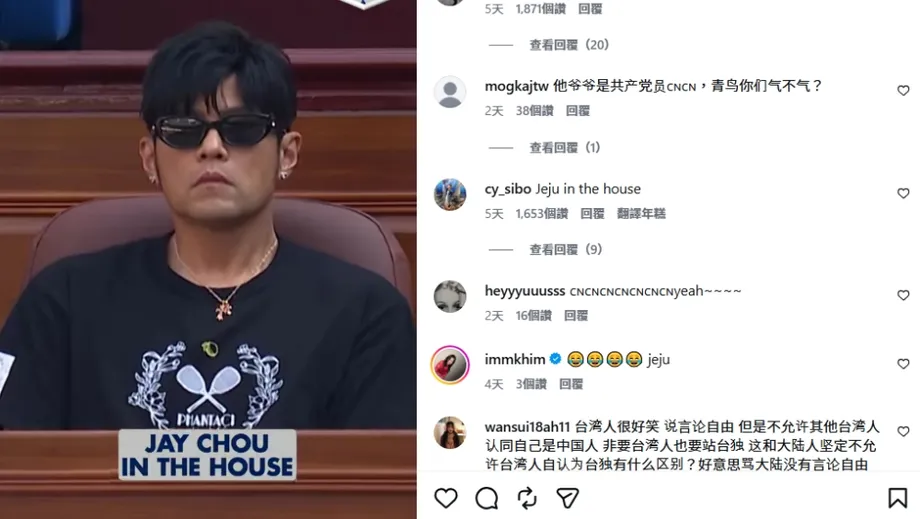
A brief introduction becomes an identity dispute
Jay Chou's reported appearance at the 2026 Shanghai Rolex Masters has sparked an online argument over national identity after the singer shared a video introducing him as a Chinese singer. Accounts dated October 11 and 12 describe Chou smiling and nodding at Shanghai's Qizhong Tennis Center, then reposting the introduction on Instagram with its original audio intact.
Contents
The wording attributed to the event host was "great, famous Chinese singer Jay Chou." Some Taiwanese commenters objected to the description and called him a Taiwanese singer. Other users argued that Chinese could refer to the language of his music, while supporters in mainland China interpreted his decision to share the clip as acceptance of the introduction.
The distinction matters: the host made the introduction, while Chou's reported actions were a nod, a repost and a like. Those actions became the basis for competing political interpretations, but they were not an explicit statement explaining how he understood the word Chinese.
The controversy also revived discussion of an earlier tennis appearance, when Australian Open event information displayed CHN beside his name rather than TPE. Together, the two episodes show how a celebrity's involvement in sport can turn a short introduction or an administrative label into a wider dispute about identity.
What happened at the Shanghai event?
Chou attended as a special guest, reportedly accompanied by his wife, Hannah Quinlivan. One account says the Shanghai tournament gave him the designation "super close friend," presenting his appearance as part of its relationship with the singer.
The event host introduced Chou to the audience in English. The fullest version of the introduction reproduced in the accounts was:
great, famous Chinese singer Jay Chou
Other accounts reproduce the shorter wording "famous Chinese singer Jay Chou," while one says the description was delivered in both English and Chinese. These differences concern how much of the introduction was recorded in the reports, rather than a disagreement over the central phrase Chinese singer.
Chou reportedly smiled and nodded as the camera showed him in the stands. He later shared a tournament video containing the introduction on Instagram. Some accounts specify that the repost appeared in his Stories and that he also liked the clip.
His accompanying caption reportedly focused on cheering for the players. It did not explain the identity wording. One account also says he did not delete the video or issue an apology following the reaction. That describes his reported response at the time, not a separate declaration of nationality or political allegiance.
How the argument developed online
The objections centered on whether the host should have described Chou as Taiwanese. Some Instagram users asked the presenter to check the description, while others insisted that Taiwanese singer was the appropriate wording. The English comment "Do your research again!" was among the responses reproduced in the coverage.
A second line of argument concerned language. Some commenters suggested that Chinese singer meant a singer performing in Chinese, without necessarily stating a national identity. In English, however, the phrase can be understood as a description of nationality or cultural identity. Chinese language singer would identify the language more explicitly. The short introduction alone does not establish which meaning the host intended.
Supporters took a different view, arguing that Chou's decision to circulate the unedited clip demonstrated that he was comfortable with the wording. Discussion on the Taiwanese forum Mobile01 also included criticism of the backlash and comments suggesting that the dispute was unnecessary because the introduction came from someone else.
Several accounts described critics as "bluebirds," a political label used for some Taiwanese activists and supporters associated with the green political camp. The accounts do not establish the affiliation of individual commenters. Their reactions should therefore not be treated as a representative position of Taiwanese people, or even of everyone within one political grouping.
What a repost does and does not establish
The central interpretive divide is between sharing a video and endorsing every word within it. A repost makes the introduction visible to another audience. It can reasonably be discussed as evidence that Chou chose to circulate the moment, but it cannot establish his exact reasons without an explanation from him.
The reported like strengthens the argument made by those who see approval in his actions. Even so, a like does not identify which part of a clip someone approves of: the introduction, the welcome, the tournament appearance or the video as a whole.
There is also a distinction between the host's description and the caption attributed to Chou. The host used an identity label; Chou's caption reportedly supported the players. Treating the caption as a political statement would go beyond its reported content.
No direct explanation from Chou about the wording is reproduced in these accounts. Nor is there a statement from the host clarifying the intended meaning. The strongest supported conclusion is that he reportedly shared a clip containing the description and that users disagreed over what that action meant.
The Australian Open label returns to the debate
The Shanghai discussion revived an earlier episode involving Chou's participation in a special Australian Open event in early 2026. Reports describe it as a competition decided by a single point and say event information listed CHN beside his name rather than TPE.
The official Australian Open draw for the 2026 1 Point Slam confirms the listing: entry 46 reads "CHOU, Jay (CHN)." The PDF states that it was created at 15:35 on 14 January 2026. It does not identify who supplied or selected the code.
CHN is the sporting abbreviation for China. TPE refers to Chinese Taipei, the designation used for Taiwan in many international sporting competitions. These codes identify sporting representation within an event's records; they should not automatically be treated as proof of citizenship or a person's complete political views.
Some accounts describe the CHN entry as a nationality code, while another claims Chou entered it himself in overseas competition information. The underlying entry form and explanation of who selected the code are not reproduced. That leaves an important gap between the documented label and the assertion that Chou personally chose it.
The two tennis incidents therefore involve different kinds of evidence. Shanghai concerns spoken words and a social media repost. The Australian Open episode concerns a documented event listing. Users connected them as signs of a consistent position, but the listing alone does not explain how it was created or what Chou intended.
The reported sequence of events
The accounts place the Australian appearance before the Shanghai controversy and date the online discussion to October 2026. They do not provide an exact date for Chou's appearance at Qizhong or for his Instagram repost.
- Early 2026: Chou reportedly takes part in an Australian Open special event, with CHN displayed beside his name in the official draw created on 14 January 2026.
- October 2026: He reportedly attends the Shanghai Rolex Masters at Qizhong Tennis Center with Hannah Quinlivan.
- After the Shanghai introduction: He reportedly shares the video on Instagram and likes it, prompting arguments over the phrase Chinese singer.
- October 11: A dated report describes the repost and reactions on Instagram and Mobile01.
- October 12: Further commentary appears, including an item timestamped 22:28 that discusses the incident as a dispute over an ordinary guest introduction.
This sequence separates the reported events from the publication dates. October 11 and 12 show when accounts of the controversy appeared; they do not establish precisely when the host spoke or when the video was posted.
The accounts also give no reliable measure of the reaction's scale. They reproduce comments and describe discussion across platforms, but provide no verified totals for views, reposts or participants. Claims about what Taiwanese or mainland Chinese audiences collectively believe would therefore be broader than the evidence supports.
Why his music became part of the argument
Commenters also pointed to Chou's music as evidence of his connection to Chinese culture. The works mentioned include Dong Feng Po, Qing Hua Ci, Lan Ting Xu and Long Quan. Reports cite their use of traditional cultural imagery and musical elements as reasons that the Chinese singer description should not be surprising.
The term China style, often used for this strand of popular music, refers to work drawing on Chinese literary, historical or musical traditions. In Chou's case, the songs cited in the debate help explain why listeners associate his public image with those traditions.
Cultural expression and national identification nevertheless answer different questions. A song can demonstrate engagement with a cultural tradition without settling how its creator wishes to be described in every international setting. The music is relevant to Chou's artistic identity, but it is not a substitute for a direct explanation of the Shanghai introduction.
Some accounts also invoke earlier interviews in which Chou reportedly described himself as Chinese. One makes the more specific claim that he referred to Taiwan as a province of China. No full interview transcript, date or recording accompanies those assertions, so they should not be presented as newly verified quotations or as statements made during the tennis event.
The unresolved details are concrete: what the host intended, why Chou shared the clip, and how the Australian event code was assigned. The accounts identify no scheduled statement or other announced date for clarification. Until such an explanation emerges, the dispute is best understood as competing interpretations of reported public actions, rather than a new, explicit declaration by the singer.
Key Points
- October 2026 accounts describe Jay Chou being introduced as a Chinese singer at the Shanghai Rolex Masters.
- He reportedly nodded, shared the video on Instagram and liked it; his caption focused on supporting the players.
- Some Taiwanese commenters objected, while other users interpreted the repost as acceptance of the wording.
- The official Australian Open 1 Point Slam draw, created at 15:35 on 14 January 2026, lists Jay Chou as CHN.
- No direct explanation from Chou or the Shanghai host is reproduced in the accounts.
- The exact event and repost dates, the scale of the reaction and responsibility for the Australian code remain unestablished.