A $399 robot draws a crowd before its first deliveries
Microduck, a robot standing 25 centimetres tall and priced at $399, has passed 20,000 preorders after NVIDIA chief executive Jensen Huang brought a small flock onto the stage at GTC Berlin on October 21, 2026. The next challenge for its French developer, Pollen Robotics, is turning that demand into deliveries, with the first orders targeted to begin shipping before Christmas.
Contents
- A $399 robot draws a crowd before its first deliveries
- What happened on the Berlin stage?
- What buyers get for $399
- How a virtual duck learns to walk
- Why friction and tiny delays matter
- Which parts are open to developers?
- A larger order book means a larger delivery task
- Where will Microduck ship first?
- Key Points
Hugging Face chief executive Clem Delangue disclosed the surge after Huang's appearance. On October 22, he shared the growth in reservations and predicted that the total would pass 20,000 the following day. By October 23, the threshold was reported to have been exceeded. The figure counts preorders; customers were still waiting for the first shipments.
The appeal was easy to see. Huang asked the small robots to sit, rest and perform a somersault as they shuffled around making electronic noises. Their articulated beaks, short legs and sometimes hesitant responses gave a demonstration of artificial intelligence an unusually playful face.
Behind the spectacle sits a more practical proposition: a robot that arrives with seven preset behaviours and a game controller, while giving developers software to teach it new movements. Buyers can start by operating it without writing code, then explore how a machine learns to balance, walk and recover after falling.
Demand has also prompted a hiring appeal from Delangue. Microduck follows Pollen's desktop robot Reachy Mini, which the company says has already shipped more than 10,000 units. Microduck's larger reservation total puts production capacity, delivery schedules and customer support at the centre of its Christmas ambitions.
What happened on the Berlin stage?
Huang's demonstration took place at Berlin's Tempodrom during his October 21 keynote. Four Microducks walked onto the stage after a video showing how an AI agent could help prepare robot training.
The robots sat down, stood up and pretended to sleep when asked. When Huang told four of them to rest, three dropped immediately, while the fourth needed repeated encouragement. Another faced the wrong direction near the end of the presentation, prompting Huang to call for its attention.
Huang also requested a somersault. Descriptions of the demonstration include that movement, while NVIDIA's written recap specifically lists sitting, standing and sleeping. The presentation combined prepared training footage with physical robots responding on stage.
Those moments helped make the clip widely shared, but NVIDIA was also presenting a development workflow. Huang told the audience that the robots' movements had been learned in a virtual environment before being transferred to the machines in front of him.
The key dates trace a short route from product launch to a much larger audience:
- August 27, 2026: Pollen Robotics opened Microduck preorders.
- September 2026: NVIDIA's acquisition of Hugging Face was reported, bringing Pollen into its corporate group.
- October 21, 2026: Huang demonstrated Microduck at GTC Berlin.
- October 22, 2026: Delangue shared rising preorder figures and forecast 20,000 reservations the next day.
- October 23, 2026: Preorders were reported to have passed 20,000.
- Before Christmas 2026: Pollen targets the start of deliveries for the first orders.
What buyers get for $399
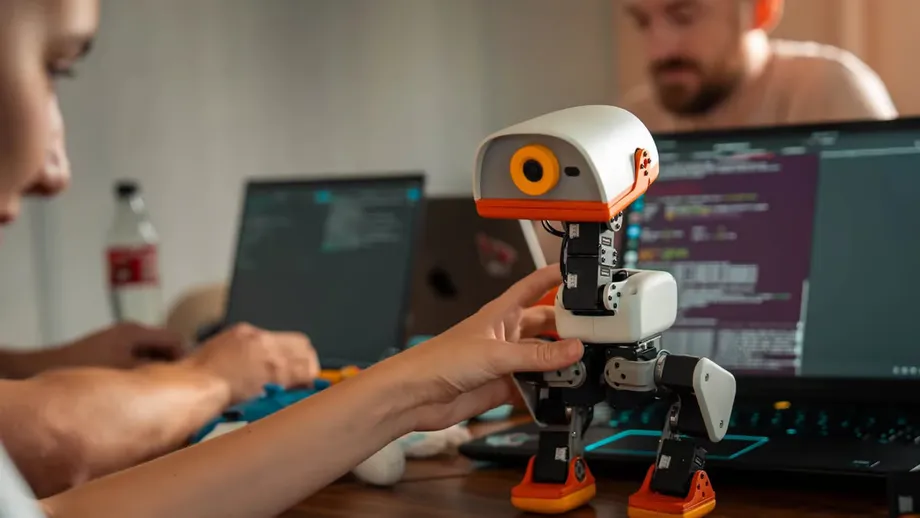
Pollen lists Microduck at an introductory preorder price of US$399, excluding taxes and shipping. Four colours are offered: Cream, Graphite, Lavender and Sky. The robot weighs less than 800 grams and has 15 motors, allowing its small body to make a range of coordinated movements.
A camera, a small depth or distance sensor and two inertial measurement units help it sense its surroundings and movement. An inertial measurement unit measures changes such as rotation and acceleration, information that helps a walking robot track its balance. A speaker produces its electronic sounds.
Microduck's beak can move and grasp small objects. Its advertised behaviours include walking, sitting, crouching and standing up after a fall. With wheels fitted to its feet, it can also roll around. Demonstrations describe it following a laser dot across the floor.
The included controller gives buyers a direct way to operate the robot. Teaching it a new movement is a separate activity, involving the programming tools and training software that Pollen publishes for developers.
Pollen is positioning Microduck for people who want to experiment with robotics as well as those attracted by its appearance. Its promotional videos feature adults playing with it, and Delangue has suggested its market could extend beyond children. The product's immediate attraction is movement and interaction, rather than household chores.
How a virtual duck learns to walk
Microduck's movements are trained through reinforcement learning. In simple terms, a virtual robot tries movements, receives a score for useful results and gradually learns which actions work. A successful step earns a better result than losing balance, so repeated practice produces a movement strategy.
Developers call that strategy a policy: software that selects actions from information about the robot and its surroundings. Once a policy performs well in simulation, it can be loaded onto a physical Microduck.
NVIDIA's demonstration presented five broad stages. An AI agent helped set up a course, the robot and environment were simulated, training ran in the cloud, the resulting policy was checked locally on RTX Spark, and the selected behaviour was transferred to the real machine.
Huang, NVIDIA's chief executive, described the cloud resources used for training during the presentation:
on quite a few NVIDIA supercomputers
RTX Spark therefore served as part of a larger chain of machines and software. NVIDIA presented it as a tool for preparing and checking work locally, with demanding training jobs also using remote computing resources. NVIDIA gave no figures for Microduck's training time, computing cost or number of attempts, leaving the resources needed to reproduce the demonstration unspecified.
A digital twin is the virtual copy used in this process. It lets developers practise movements without repeatedly dropping a physical robot, wearing out its motors or rebuilding an obstacle course.
Why friction and tiny delays matter
NVIDIA's technical description identifies Isaac Lab as the training framework and Isaac Sim as a tool for assembling environments and evaluating behaviour. It also describes the Newton physics engine modelling friction, delays and mechanical clearances, the small spaces between moving parts.
Those details affect whether a movement learned on a computer works on a real floor. A foot needs enough grip to push forward. A motor responds after a small delay. A joint has physical limits. Training software needs to account for these conditions so that the learned movement remains useful outside the simulation.
NVIDIA says Isaac Lab 3.0 can run up to 4,096 simulated environments in parallel and reach 1.25 million training steps per second. Running many virtual robots at once allows a system to gather movement experience much faster than a single physical robot practising alone.
The company's technical account describes adapting a walking policy for ramps and obstacles using an RTX PRO 6000 Blackwell Workstation Edition. These performance figures describe particular training tools and computing setups; an owner planning a project would need to choose hardware and resources suited to that task.
The workflow also names Hermes Agent from Nous Research and NVIDIA's Nemotron 3.5 Bolt model. A more detailed technical description assigns them planning tasks, while an assistant called Astra helps create resources using FreeCAD and Blender. Together, these tools connect a requested behaviour or environment with the simulation work needed to train it.
Which parts are open to developers?
Pollen publishes Microduck's software development kit, simulator and reinforcement learning tools under the Apache 2.0 licence. A software development kit is a collection of code and interfaces that programmers use to build applications or control a device.
Developers can inspect the software, train different movements and share their work with the community. The simulator also provides a way to explore the project before buying a robot. Someone could begin with a virtual walking experiment and later transfer a suitable policy to physical hardware.
Pollen draws a specific boundary around that access: its mechanical and electronic design files are not open. People can work with the published software and training tools, while the files needed to reproduce the robot's physical construction remain outside that release.
The camera and other sensors also make data handling a practical consideration for a robot used at home. Published code gives developers material to inspect when checking how a program uses sensor information. Buyers still need understandable information about the applications they install and any services those applications connect to.
A larger order book means a larger delivery task
Pollen's own figures put Reachy Mini shipments above 10,000 units. Microduck has attracted more than 20,000 preorders, creating a substantial new production task for the team behind both products. One figure measures robots already shipped, while the other measures reservations awaiting fulfilment.
Delangue, the Hugging Face chief executive, linked the popularity of the two robots to a need for more staff:
With the explosive popularity of Microduck and Reachy Mini, Pollen Robotics and Hugging Face need to expand our team in all roles.
Pollen joined Hugging Face in 2025, and NVIDIA's acquisition of Hugging Face was reported in September 2026. That ownership chain places the small consumer robot within the same corporate group whose computing technology featured throughout the Berlin demonstration.
NVIDIA used Microduck to promote RTX Spark and its robotics software. Pollen gained an audience for a product that had been available to preorder since August. The combination helps explain why a playful stage appearance also carried a commercial message about the tools used to develop robots.
Delangue has floated the possibility that Microduck could become the best selling robot of 2026. An independently verified annual sales ranking is not available. The immediate business task is supplying the reservations already recorded and supporting customers as they begin using the machines.
Where will Microduck ship first?
Pollen's official store lists the United States, Canada, the European Union, the United Kingdom, Norway, Switzerland, Japan and South Korea among the initial markets. Japan and South Korea give the first release an Asian presence, although availability does not extend across the region.
Hong Kong is absent from that list. The roughly HK$3,112 equivalent of the US$399 price is a currency conversion, with taxes and delivery costs excluded. Hong Kong supply arrangements and a local retail price have yet to be announced.
Pollen plans to begin fulfilling the first orders before Christmas 2026. Actual arrival times depend on production and logistics, so buyers need to check the delivery terms attached to their own orders when planning a holiday purchase.
Microduck's reservation surge gives Pollen a clear measure of interest. The next milestone is more concrete: getting the first robots into customers' hands, with the advertised movements, controller and development tools ready for use.
Key Points
- Microduck passed 20,000 preorders after Jensen Huang's October 21 demonstration at GTC Berlin.
- The introductory price is US$399 before taxes and shipping, with four colours available.
- The robot stands 25 centimetres tall, weighs less than 800 grams and uses 15 motors.
- It comes with seven preset behaviours and a controller; developers can train and share additional movements.
- Pollen publishes the software and training tools under Apache 2.0, while mechanical and electronic design files remain closed.
- The first deliveries are targeted to begin before Christmas 2026, subject to production and logistics.
- Initial markets include Japan and South Korea. Hong Kong availability has not been announced.