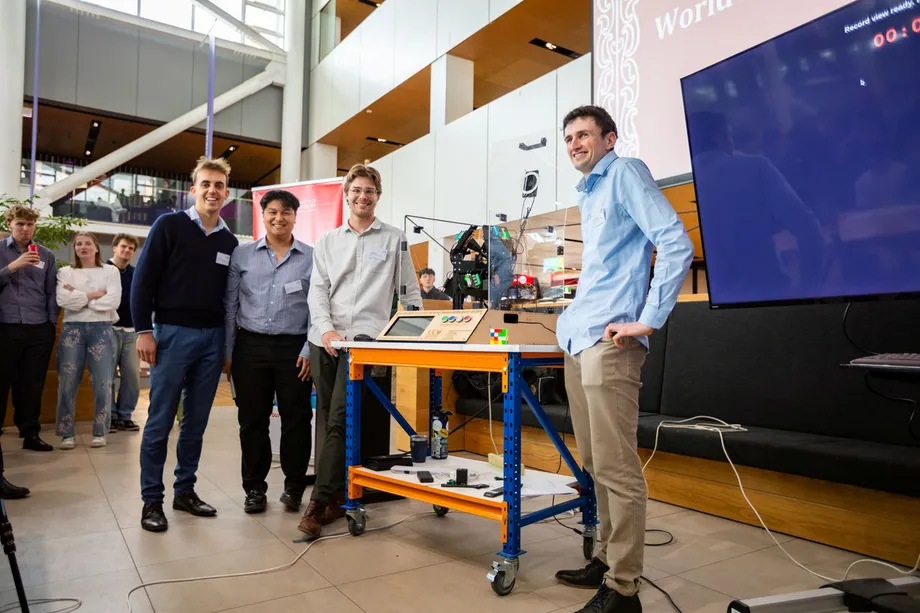
A Year of Work Produces a Solve Under 10 Seconds
Four engineering students at the University of Canterbury in Christchurch, New Zealand, recorded a time of 9.806 seconds for a robot solving a 4x4 Rubik's Cube during an official Guinness World Records attempt on Friday, 16 October 2026. The result is faster than both the previous robotic record of 45 seconds and the human benchmark of about 15 seconds cited by the university.
Contents
Caleb Everitt, Hayden Watson, Maz Cameron and Johann Torres spent about a year developing the machine as their final project in mechatronics engineering, a field that combines mechanical engineering, electronics and computer programming. Their result is awaiting confirmation from Guinness World Records, and no date for that decision has been announced.
The university's project announcement, published on 16 October, describes a machine built with four cameras, motors commonly used in drones, specialised motor controllers and suction cups. Its design allows it to turn layers along all three axes of the cube without repeatedly changing the orientation of the whole puzzle.
The students worked with a very limited budget funded by the university's Mechanical Engineering Department. Their challenge was to make several different systems work together: cameras had to identify colours, software had to calculate a solution, and the mechanism had to execute the moves without the cube jamming.
The Video That Set the Target
A social media video gave the students their starting point. It showed the robot holding the existing record taking 45 seconds to solve a 4x4 cube. The team noticed that a human could finish the same type of puzzle in roughly 15 seconds and decided to investigate why the machine was slower.
Maz Cameron, who handled software development, described the ambition behind the project:
We knew that robots could be better than humans, and we wanted to be the people to break that gap,
Their 9.806-second result was 35.194 seconds quicker than the 45-second robotic benchmark, a reduction of about 78%. Against the university's rounded human benchmark of 15 seconds, it was about 5.2 seconds quicker, or roughly 35% less time.
The project developed over about a year, with the key public dates falling in October:
- During development, the students used the video of a 45-second robotic solve as their initial target.
- On Friday, 16 October 2026, they recorded 9.806 seconds during their official Guinness attempt.
- By 19 October, the project had also featured in an interview with Cameron about the team's work.
Four Students, Four Connected Jobs
Everitt took responsibility for mechanical design, including the robot's physical structure. Torres handled the electrical system and motor control. Watson developed the computer vision system, while Cameron worked on the software that brought the solving process together.
Those responsibilities formed a chain. Watson's cameras supplied information about the cube. Cameron's software used that information to work out the required moves. Torres's motor controls translated instructions into motion, and Everitt's mechanism had to keep the puzzle moving accurately.
A weakness anywhere in that chain could disrupt a solve. A colour identified incorrectly would give the software the wrong starting position. A motor movement that stopped in the wrong place could leave layers misaligned. Even a correctly calculated solution depended on the physical machine carrying it out reliably.
Cameron credited the team's complementary skills and willingness to spend extra time on the project. The students refined the software, strengthened the structure and tested different ways of handling the cube as they worked toward a time below the human benchmark.
How Four Cameras Read the Puzzle
Watson's part of the project began with a practical question: how could the robot reliably recognise the colours on a scrambled cube? The machine uses four cameras to gather the information needed to describe the puzzle's starting arrangement.
Hayden Watson, responsible for computer vision, explained the process:
The robot has four cameras; it looks at the cube, and sees where all the different colours are,
The colour information then goes to an open source algorithm, a set of programmed instructions that calculates the moves needed to solve the puzzle. In simple terms, the cameras read the problem, the algorithm plans the solution, and the motors carry it out.
Lighting made the first step more difficult. Similar colours had to remain distinguishable under different conditions, so the students developed and tested the camera system for accuracy. Fast movement would be of little use if the machine began with an incorrect picture of the cube.
A 4x4 cube has 16 small squares on each face, compared with nine on a standard 3x3 cube. Across six faces, that means 96 coloured squares instead of 54. It also has more movable layers, making both the solving task and the physical control more demanding.
A Design That Avoids Extra Repositioning
Everitt identified a mechanical limitation in the previous record holder: it could perform face rotations along only two of the cube's three axes. To reach another direction, it had to reposition the whole cube before continuing.
A cube's three axes can be understood as three directions running through its centre: left to right, top to bottom, and front to back. Turning a layer around one of those axes changes the arrangement of the puzzle. Reorienting the whole cube changes how the machine holds it, adding movement between solving steps.
Caleb Everitt, the team's mechanical designer, explained the difference:
The previous robot can only do face rotations in two out of the three cube axes, so it has to reorientate the cube, which essentially wastes a move. Whereas we don't do that because we can access all three faces,
The Canterbury design gives the mechanism access to all three axes without that repeated repositioning. This reduced the movement needed to execute a solution, while the faster motors reduced the time taken by the movements that remained.
Why Suction Cups Helped Beat Gravity
The students also had to control how quickly the cube returned to its base position after being pushed. At the speeds they were targeting, simply letting it drop under gravity took too long.
Everitt said that beating the human benchmark required a more active way of moving the puzzle:
One of the reasons that we needed suction cups was because to beat the human record, the time it takes for the cube to drop down from being pushed back to the base position is too slow if we just use gravity,
Suction cups gave the mechanism a way to move the cube more quickly and precisely. Their role was part of a broader effort to control the puzzle throughout the solve, including the short intervals between rotations.
The team also improved structural rigidity, making the robot's frame resist unwanted bending or movement. A firm structure helps keep the mechanism aligned when its motors accelerate and stop. Extensive testing addressed another central problem: preventing the cube from jamming during rapid movements.
Drone Motors Within a Limited Budget
Torres worked with motors commonly used in drones, paired with specialised controllers. The motors supplied speed and power, while the controllers provided the precision needed to turn the puzzle through the required movements.
A motor controller regulates how a motor behaves in response to software instructions. For this machine, speed had to come with accurate positioning. The next turn depended on the previous movement leaving the cube ready to move again.
The university said the students chose these components while working within the department's very limited funding. The project therefore involved more than finding powerful motors. The team had to combine affordable parts with a mechanism and control system capable of using that power accurately.
Cameron described the combination of a more complex puzzle and a small budget as part of the appeal. The result reflects several changes working together: faster motors, access to all three axes, more precise handling and software refined through testing.
What Happens to the Robot Next?
The machine will remain at the University of Canterbury as its builders move into engineering employment. All four students have secured graduate roles across New Zealand for the following year, 2027.
The project marks the end of four years of study and gives the students a completed system in which their separate areas of responsibility had to function together. Its performance depended on both calculation and construction, from recognising the starting colours to completing the final turn.
The team hopes the robot will inspire younger people to consider engineering. For future students, the machine will offer a concrete example of how a demanding target can be broken into smaller problems involving vision, software, motors and mechanical design.
The immediate next step is Guinness World Records' decision on the submitted attempt. The university has announced a solve of 9.806 seconds; formal recognition would turn that recorded performance into a confirmed world record.
Key Points
- Four University of Canterbury students recorded a 9.806-second solve of a 4x4 Rubik's Cube on 16 October 2026.
- Guinness World Records confirmation is pending.
- The time was about 78% shorter than the previous robotic benchmark of 45 seconds cited by the university.
- The robot uses four cameras, an open source solving algorithm, drone motors, specialised controllers and suction cups.
- Its mechanism accesses all three cube axes without repeatedly reorienting the whole puzzle.
- The students spent about a year on the project, and the robot will remain at the university.