A national estimate built one animal at a time
Kazakhstan estimated its snow leopard population at 152 to 189 animals in 2024, including 104 to 135 living in protected areas. Behind those figures lies years of work matching photographs, mapping mountain habitats and tracking animals whose movements carry them into China and Kyrgyzstan.
Contents
- A national estimate built one animal at a time
- Why a snow leopard is difficult to count
- Spot patterns turn photographs into identities
- Families reveal where recovery is taking place
- Collars follow the journey between cameras
- Protection must follow animals across borders
- Nepal shows how tracking changes the map
- DNA can identify a cat without a photograph
- What the population figures tell Kazakhstan
- Turning animal movements into land protection
- Key Points
The United Nations Development Programme set out those numbers in its 2024 conservation assessment. Kazakhstan's Forestry and Wildlife Committee subsequently put the population at 190 to 200. The longer record shows recovery from an estimated 80 to 100 animals in 1995, when shrinking habitats, human pressure and declining prey had pushed numbers down.
The practical challenge is simple to describe: ten photographs may show ten snow leopards, or one animal returning ten times. Researchers must identify individuals before they can turn sightings into a useful population estimate.
International Snow Leopard Day, observed on October 23, draws attention to that work. The date marks the adoption of the Bishkek Declaration in 2013 by representatives of all 12 countries where the species lives. In Kazakhstan, the effort now combines cameras, satellite collars and habitat surveys, while genetic research elsewhere shows how even a small piece of biological evidence can identify a cat.
Why a snow leopard is difficult to count
Kazakhstan's snow leopards occupy mountains across the south, southeast and east, including the Tien Shan, Zhetysu Alatau, Altai and Saur-Tarbagatai ranges. Their grey and white coats blend into rocky slopes, and they are most active around dawn and dusk.
Most adults live alone and use territories that can extend across hundreds of square kilometres. Broad paws help them move over snow, while a long tail provides balance and can wrap around the body for warmth. Cubs remain with their mothers until they become independent at about two years old.
A researcher watching one valley therefore sees only a small part of an animal's life. A cat may move through several camera locations, disappear over a ridge or cross a national border. Counting requires repeated observations and a way to recognise the same individual wherever it appears.
Spot patterns turn photographs into identities
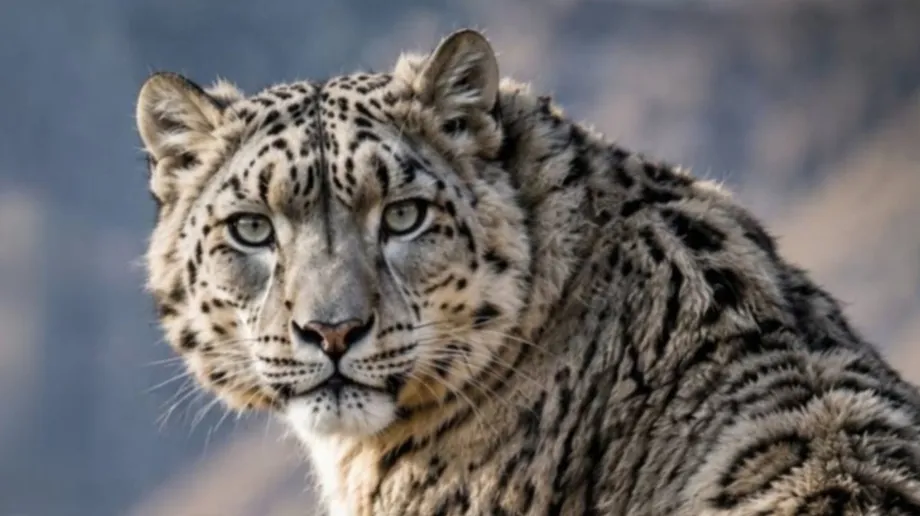
Each snow leopard has a distinctive pattern of spots. Researchers compare those markings across photographs to decide whether a camera has recorded a new animal or one already identified. Repeated appearances help establish where particular cats travel.
Between 2018 and 2024, a project supported by UNDP, the Global Environment Facility and Kazakhstan's government installed 294 camera traps across 14 pilot protected areas and eight forestry enterprises. It also supplied 28 thermal imagers, which detect heat and help wildlife teams observe animals in difficult conditions.
The equipment network covered a wider forest and biodiversity project. UNDP's 2024 assessment identified eight protected areas providing protection for snow leopards; the Forestry and Wildlife Committee's later account listed nine areas where the species occurs.
Ile-Alatau offers a closer view of monitoring on the ground. The committee estimates that about 40 snow leopards live there, with more than 50 camera traps supporting observation. Researchers work with Kazakhstan's Institute of Zoology, and four animals in the park have received satellite collars since 2023.
Camera placement also depends on local knowledge. In Katon-Karagay National Park, cameras photographed a snow leopard between December 2024 and January 2025. The committee credited Arshatinsky forestry inspector Zhomart Amanbayev with choosing suitable locations for the equipment.
Families reveal where recovery is taking place
Merke Forestry in Zhambyl Region recorded a snow leopard on camera in 2019. In March 2021, UNDP shared footage showing three cats there. At Kolsai Kolderi National Park, another camera captured a snow leopard moving at night.
Altyn-Emel National Park produced a particularly useful finding in 2021: researchers identified a breeding group. Snow leopards had previously disappeared from the area. UNDP attributes their return to protection of the park, recovering ecosystems and a growing supply of prey.
Young animals give managers information beyond the presence of a passing adult. A breeding group identifies a place where snow leopards are raising their next generation, making protection of food and habitat especially valuable. Katon-Karagay cameras also recorded a family in August 2026.
UNDP and the Institute of Zoology worked together from 2019 to 2024 to map potential snow leopard habitat. Their cooperation established an annual population reporting system in 2019, creating a regular framework for assembling observations from different mountain areas.
Collars follow the journey between cameras
Kazakhstan first fitted a snow leopard with satellite tracking equipment in November 2021 at Altyn-Emel. By the end of 2023, researchers had equipped 11 animals in the Northern and Central Tien Shan. The Forestry and Wildlife Committee later reported that the national total had reached 16 since 2021.
A camera records an animal at one location. A satellite collar repeatedly records its position, allowing researchers to connect those points into a route. The resulting map shows which slopes, passes and valleys an animal uses beyond the camera network.
On October 19, 2026, a snow leopard named Altai received a collar at Katon-Karagay National Park. It was the first such operation in Kazakhstan's Southern Altai, extending tracking into a different mountain landscape.
The operation involved park employees E. Kassymov and Zh. Amanbayev and Institute of Zoology researchers A. Grachev, M. Bespalov, S. Bespalov and S. Saparbayev. Pernod Ricard Kazakhstan supports the project. Researchers plan to use Altai's movements to identify important habitat and travel routes.
The main milestones show how the monitoring effort has developed:
- 2019: Kazakhstan established an annual snow leopard population reporting system.
- November 2021: The first satellite collar was fitted at Altyn-Emel.
- End of 2023: Eleven snow leopards had received tracking equipment.
- October 17, 2024: Four protected areas in Kazakhstan and Kyrgyzstan signed a conservation agreement.
- October 19, 2026: Altai became the first snow leopard fitted with a satellite collar in Kazakhstan's Southern Altai.
Protection must follow animals across borders
Kazakhstan's tracking programme has mapped snow leopard movements into China and Kyrgyzstan. Those journeys make cooperation between neighbouring countries a practical part of protecting the animals.
UNDP's October 2024 announcement records the signing of a memorandum covering Kolsai Kolderi National Park, Almaty State Nature Reserve and Ile-Alatau National Park in Kazakhstan, together with Chon Kemin Nature Park in Kyrgyzstan.
The agreement runs for five years from its signing on October 17, 2024. It covers joint monitoring, protection of habitat and prey, research cooperation and public participation. Its working horizon therefore extends into 2029.
Mirslav Amankulov, Kyrgyzstan's vice minister of natural resources, ecology and technical supervision, explained why shared protection matters. He put his country's population at more than 400 animals and said:
As it is a migratory species, its habitat is not limited to the territory of the country.
Katon-Karagay also belongs to a reserve spanning an international border. Its snow leopards form part of a population shared across borders, giving Altai's future tracking data value beyond the park itself.
Nepal shows how tracking changes the map
Four snow leopards fitted with GPS collars in eastern Nepal between 2013 and 2017 returned 4,707 location records. The study, published in 2025, found that three of the four crossed into India or China, each making five to seven international crossings.
Those three animals spent between 10% and 34% of their tracked time outside Nepal. Some mapped ranges extended as much as halfway beyond the country. The findings give a concrete comparison for Kazakhstan's experience: mountain cats regularly use territory on both sides of political boundaries.
The Nepal research also shows why the method used to draw a range matters. For one male, an outline enclosing all recorded locations produced an estimated range of about 398 square miles. A method that followed the recorded points more closely produced about 120 square miles.
The wider outline includes space between distant locations; the tighter method follows the pattern of recorded use. Those different approaches helped produce estimates up to 97 times larger than older Nepalese figures. Researchers followed individual animals for periods ranging from 20 to 659 days.
Nepal's national survey counted 397 snow leopards, while about 42% of its suitable habitat lay outside protected areas. Both Nepal and Kazakhstan face the practical task of protecting routes that connect reserves with the surrounding mountains.
DNA can identify a cat without a photograph
Hair and scat contain DNA, the biological instructions carried in cells. Researchers can compare selected parts of that DNA to identify individual animals and investigate family relationships, without needing to capture them.
A 2011 study in Nepal tested 71 scat samples suspected to come from snow leopards. Nineteen contained confirmed snow leopard DNA. Ten yielded enough genetic information to identify nine animals: three males and six females.
Two samples collected about four kilometres apart belonged to the same snow leopard. Their matching DNA allowed researchers to count that cat once. The nine identified individuals formed a minimum count for the study area, while a population estimate requires a way to account for animals that sampling missed.
Some suspected samples came from other carnivores, and some contained DNA too damaged for analysis. Collection and storage therefore affect how much researchers can learn from evidence found in the mountains.
Genetics can also examine the species across much longer periods. In 2025, Stanford University researchers and collaborators, including the Snow Leopard Trust, expanded the number of sequenced snow leopard genomes from four to 41. A genome is an organism's complete set of genetic instructions.
The team found exceptionally low genetic diversity and concluded that snow leopard populations had remained small for at least 900,000 years. Limited diversity may make adaptation to environmental change more difficult, adding a biological concern to the immediate need to protect habitat and prey.
What the population figures tell Kazakhstan
The United Nations' biodiversity policy overview, published in May 2026, gives a useful comparison within Kazakhstan's monitoring record: 130 snow leopards in 2019 and an estimated 152 to 189 in 2024.
Using those figures, the increase amounts to 22 to 59 animals, or about 17% to 45% over five years. The range expresses uncertainty around the population estimate. The publications give no single margin of error for comparing that series with the committee's subsequent estimate of 190 to 200.
UNDP's 2024 assessment placed about 70% of the animals inside protected areas, estimating their number there at 104 to 135. The later UN overview describes about 70% of the species' range as protected. One measure concerns animals; the other concerns the land where they live.
Both measures help managers decide where to direct effort. Protected populations depend on functioning habitats inside reserves, while routes through the remaining mountain landscape connect animals and breeding areas. The species remains classified as vulnerable by the International Union for Conservation of Nature and is listed in Kazakhstan's Red Book.
Turning animal movements into land protection
Satellite data are already influencing decisions about protected boundaries, according to the Forestry and Wildlife Committee. Chairman Daniyar Turgambayev has described their use in planning protection, while the committee says tracking evidence has supported expansion of some protected areas.
UNDP's 2024 assessment records scientific and feasibility studies for six proposed protected areas covering more than 1.6 million hectares, plus proposed expansions of three existing areas by more than 214,000 hectares. Evidence of snow leopards in Merke helped support the case for a regional nature park there.
Kazakhstan's wider protected area network grew from 28.7 million hectares in 2019 to 30.9 million in 2025, an increase of 2.2 million hectares. The biodiversity concept approved in December 2025 sets a target of 33.2 million hectares by 2035 and calls for stronger ecological corridors between protected areas.
The same policy, covering 2026 to 2035, contains 13 measurable indicators and seeks a fully operational digital biodiversity monitoring system by 2035. For snow leopard conservation, the practical goal is to connect information about individual animals with decisions about land, infrastructure and protection.
Poaching, loss of prey, habitat damage and climate change continue to threaten the species. UNDP also identifies expanding agriculture and poorly managed tourism as pressures. Kazakhstan's parks and reserves received nearly three million visitors in 2024, compared with about 809,000 in 2019, making management of human activity increasingly relevant.
Cameras show which cats are present, collars show where they travel, and genetic samples can identify animals that remain unseen. Used together, these methods give Kazakhstan a more detailed basis for protecting both the snow leopard and the mountain territory it needs.
Key Points
- Kazakhstan's official 2024 estimate was 152 to 189 snow leopards, up from 130 in 2019. The Forestry and Wildlife Committee subsequently estimated 190 to 200.
- A UNDP partnership installed 294 camera traps and supplied 28 thermal imagers across a wider biodiversity monitoring network.
- Sixteen snow leopards have received satellite collars since 2021, according to the committee.
- Altai received the first satellite collar fitted to a snow leopard in Kazakhstan's Southern Altai on October 19, 2026.
- A conservation agreement signed in October 2024 connects four protected areas in Kazakhstan and Kyrgyzstan for five years.
- DNA sampling can identify individual cats, while tracking data help planners protect routes between mountain habitats.