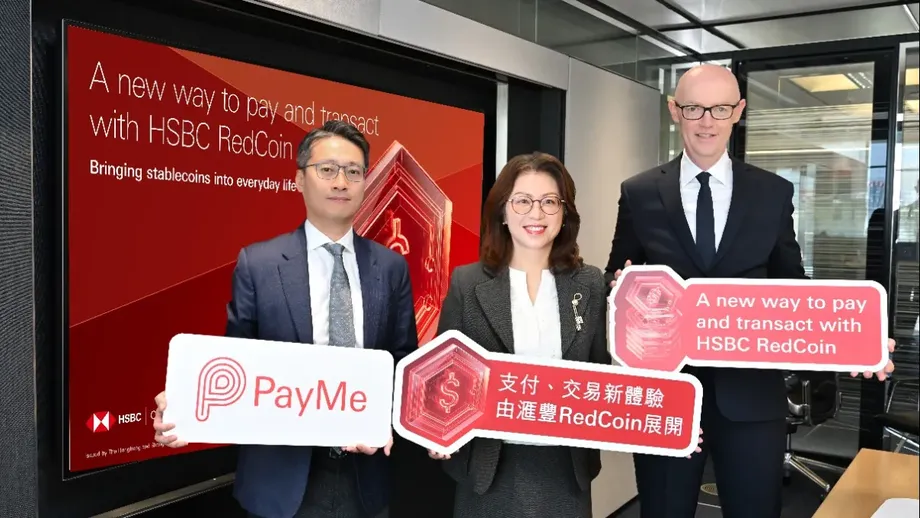
A major PayMe rollout meets a conflicting bank notice
HSBC's Hong Kong dollar stablecoin, RedCoin (RCHKD), is described in launch announcements dated October 23, 2026, as reaching more than 3.3 million PayMe users and a payment network of more than 100,000 merchants. Customers would exchange HK$1 for one RedCoin, then use the token to pay friends, relatives and participating businesses inside an app they already know.
Contents
- A major PayMe rollout meets a conflicting bank notice
- How RedCoin would work inside PayMe
- What keeps one RedCoin worth one dollar?
- What changes for shops and everyday payments?
- Why the HK$100 investment plan matters
- What HSBC's surveys reveal about demand
- From licensing to the proposed investment wallet
- RedCoin joins a larger digital asset business
- Fraud warnings accompany the payment plans
- Key Points
HSBC's official product pages, however, carry a conflicting message. Its RedCoin product page describes the coin as forthcoming in 2026 and explicitly says the bank has not yet issued any stablecoins in Hong Kong. Its Chinese product page carries the same warning. The timing of those notices relative to the October 23 announcements is unresolved, leaving actual availability in need of confirmation from the bank.
The licensing position is firmer. The Hong Kong Monetary Authority's licensed issuer register lists The Hongkong and Shanghai Banking Corporation Limited under licence FRS02, effective April 10, 2026. The register, revised on April 23, also lists Anchorpoint Financial Technology Limited under FRS01.
Beyond the immediate payment service, HSBC's plan connects RedCoin to investment. A wallet scheduled for its Hong Kong banking app later in 2026 would let customers buy tokenised investment products, including a new share class of its Hong Kong dollar money market fund, with a proposed minimum investment of HK$100.
How RedCoin would work inside PayMe
PayMe's proposed rollout begins with two familiar activities: sending money to another person and paying a business. Customers would activate a stablecoin wallet within PayMe rather than download a separate cryptocurrency wallet. The announced schedule envisages access spreading across the app's existing user base over several days, with full availability expected before the weekend following October 23.
Wallet activation is described as requiring no minimum balance and no additional account opening process. Once the app is updated and the wallet activated, customers would be able to exchange Hong Kong dollars for RedCoin and make transfers through an interface similar to the existing PayMe experience.
The 3.3 million figure describes the customers eligible for the service. Actual wallet activations, the amount of RedCoin issued and the number of merchants receiving payments would provide the first measures of adoption. HSBC has placed its initial focus on useful applications, trust and customer protection rather than an opening circulation target.
What keeps one RedCoin worth one dollar?
HSBC describes RedCoin as a stablecoin redeemable at one token for HK$1. A stablecoin is a digital token designed to keep a steady value against a reference currency. Here, the intended experience is straightforward: HK$100 converts into 100 RedCoins, with each coin designed to be redeemable for one Hong Kong dollar.
HSBC's official explanation says every RedCoin will be fully backed at all times by high quality, highly liquid assets held separately. Liquid assets are assets that can readily be turned into cash. Keeping the backing assets segregated means holding them apart from other assets, supporting the money available for redemption.
HSBC says its technology and security infrastructure will support the service, with financial crime controls designed to meet Hong Kong's Stablecoins Ordinance. HSBC Digital Assets Custody is named as the provider of safekeeping services. The official product pages also state that use is subject to relevant regulatory approval and that product features may change.
The announced service centres on PayMe and, later, HSBC's banking app. HSBC has yet to disclose the blockchain used for RedCoin or arrangements for transfers to external cryptocurrency wallets and trading on major exchanges. Those details determine where customers could send the token beyond the bank's own platforms.
What changes for shops and everyday payments?
Lawrence Li, HSBC's head of retail banking products and chief executive of PayMe, has described a deliberately familiar payment experience. The aim is for RedCoin transactions to match existing Hong Kong dollar payments in speed, security, convenience and stability. Hong Kong already has mature electronic payment services, so customers may notice little difference at checkout.
Merchants would initially be able to accept payments without upgrading their systems. Li said most would receive their money on the same day, in line with existing arrangements. Faster merchant settlement is a possible later improvement. Settlement means completing the movement of money so that the business receives the proceeds of a sale.
For a small shop, the practical considerations are when the money arrives, whether the payment works reliably and whether accepting it requires extra equipment. HSBC's approach seeks to keep those routines familiar while introducing a different form of digital money behind the transaction.
Launch incentives are intended to encourage customers to try the wallet. HSBC has described transaction discount vouchers, additional payment rewards and RewardCash, while retaining existing PayMe promotions. Detailed reward terms were to be announced later.
Why the HK$100 investment plan matters
HSBC plans to add a stablecoin wallet to its HSBC HK Mobile Banking App before the end of 2026. Customers would then be able to use RedCoin to subscribe to tokenised investments, starting with a forthcoming share class of the bank's existing Hong Kong dollar money market fund.
A tokenised fund uses digital tokens to represent ownership of fund shares. A money market fund typically invests in cash and debt with short maturities. Buying the fund moves the customer from holding a payment token into holding an investment, with the risks and terms of that fund.
The proposed HK$100 entry point would make a small initial investment possible. HSBC executives have also described immediate subscriptions, faster settlement and the ability to distribute income daily. Accounts of the planned settlement speed range from immediate completion to completion within a short period. Li contrasted the intended service with other products that can take one or two days.
John O'Neill, HSBC's managing director of digital assets and currencies, has identified investment as a major area for expansion. Gold funds and funds managed by third parties are under consideration alongside the initial money market fund offering. Their final terms and launch dates have not been announced.
What HSBC's surveys reveal about demand
An HSBC commissioned survey found that access through existing apps, faster payments and quicker settlement were among the factors encouraging people to use stablecoins. That helps explain the choice of PayMe: customers could encounter the product through an existing payment routine rather than through a new trading platform.
Fifty three percent of respondents agreed that Hong Kong dollar stablecoins could improve the city's economic competitiveness by supporting payments at all hours, trade, tourism and commerce across borders. Those are broader ambitions than the initial service for personal transfers and merchant purchases inside PayMe.
Another HSBC survey described as covering more than 1,000 customers found that 74% could identify at least one stablecoin use. Fifty seven percent identified digital asset trading and tokenised investment, while 53% identified personal transfers. Payments to merchants and remittances across borders each drew 52%.
About a quarter of respondents in that survey believed stablecoins were issued by governments. RedCoin's proposed issuer is HSBC, operating under an HKMA licence. Explaining who issues the token, who holds the backing assets and how customers redeem it will therefore be part of making the product understandable.
From licensing to the proposed investment wallet
Hong Kong's Stablecoins Ordinance took effect in August 2025, establishing a licensing framework for issuers of stablecoins linked to traditional currencies. The HKMA register is maintained under section 21 of the ordinance, which is Chapter 656 of Hong Kong law.
The main dates trace the move from a legal framework to proposed everyday use:
- August 1, 2025: The Stablecoins Ordinance took effect.
- April 10, 2026: HSBC and Anchorpoint received the first issuer licences, effective that day.
- August 12, 2026: Anchorpoint began the first phase of issuance of its HKDAP stablecoin.
- September 30, 2026: HSBC announced the RedCoin name.
- October 23, 2026: Launch announcements described the start of RedCoin wallet availability through PayMe.
- Before the end of 2026: HSBC plans to add a banking app wallet and access to tokenised investment products.
Anchorpoint, a venture involving Standard Chartered Hong Kong, HKT and Animoca Brands, provides a useful comparison. Its initial HKDAP service focused on institutions, companies and professional investors. HashKey Exchange completed the first minting and redemption transaction, while OSL Group was also identified as an authorised distributor.
HSBC's proposed route starts with retail customers through an existing app, then expands towards investment and institutional applications. Anchorpoint began with institutional distribution. The two approaches test different ways of bringing regulated Hong Kong dollar tokens into use.
RedCoin joins a larger digital asset business
Nearly 100 HSBC employees participated in trials ahead of the announced rollout, testing the full process from minting tokens to activating wallets and making live transfers. Minting means creating new units of a digital token. HSBC also worked with regulators and prospective users during preparations.
Maggie Ng, HSBC's Hong Kong chief executive and head of retail banking and wealth in the city, described the change the bank is responding to:
Money, assets and information are moving from traditional infrastructure to always-on, data-rich and increasingly programmable digital networks,
Programmable networks can use software to carry out transactions when specified conditions are met. HSBC's existing activities include digital bonds for institutional investors through HSBC Orion, HSBC Gold Token for retail customers and tokenised deposit services for companies. The bank has also participated in the HKMA's e-HKD pilot programme and Project Ensemble.
HSBC has put its digital bond issuance at about US$8.5 billion and the cumulative value of its tokenised gold at US$2.5 billion. RedCoin would extend that work into ordinary retail payments, while O'Neill has said the bank is discussing corporate and institutional applications with partners.
Fraud warnings accompany the payment plans
HSBC's official pages warn against fraudulent stablecoins claiming to be issued by, or associated with, the bank. Ng has also warned that HSBC has not authorised outsiders to exchange RedCoin on behalf of customers and that claims to provide such a service are scams.
The proposed customer route is through HSBC's own apps. A request from an intermediary to hand over money for RedCoin sits outside that described process. The warning is especially relevant while the bank's public product notices and the October 23 launch announcements give conflicting availability messages.
For customers, the practical promise is a familiar payment wallet linked to a new form of money and, eventually, investments starting at HK$100. For merchants, the first phase aims to preserve existing checkout and settlement routines. The next concrete milestone in HSBC's announced programme is the banking app integration planned before the end of 2026.
Key Points
- October 23 announcements describe RedCoin becoming available to more than 3.3 million PayMe users, with payments across a network of more than 100,000 merchants.
- HSBC's official product pages still describe issuance as forthcoming and warn that it has not yet issued stablecoins in Hong Kong.
- The HKMA register confirms HSBC's issuer licence FRS02 took effect on April 10, 2026.
- RedCoin is designed to be redeemable for HK$1 per token and fully backed by segregated reserve assets.
- HSBC plans banking app access and tokenised money market fund subscriptions from HK$100 before the end of 2026.
- Initial merchant arrangements aim to avoid system upgrades, with most merchants receiving funds the same day.
- HSBC warns customers against outsiders claiming they can exchange RedCoin on their behalf.