A wider police network, from shopping malls to public housing
Hong Kong police are seeking access to shopping mall security cameras as part of a proposed HK$4.07 billion expansion of SmartView, a surveillance network intended to reach about 60,000 cameras by 2028 and 66,500 by 2031. Police Commissioner Joe Chow has also said facial recognition functions are planned for cameras managed by police within 2026, while the government develops a legal framework.
Contents
- A wider police network, from shopping malls to public housing
- What the camera targets actually include
- How mall and MTR connections would work
- Facial recognition would add a new search capability
- What police say about privacy and access
- Why the bill goes beyond cameras
- Staff time savings and the procurement plan
- The timetable and the crime figures behind the case
- Fire cooperation develops alongside the surveillance plan
- Key Points
The Security Bureau and Hong Kong Police Force set out the spending proposal in a February 2026 SmartView development paper prepared for the Legislative Council Panel on Security meeting on February 24. It proposes funding approval in March and a contract award in April, followed by construction and integration work through March 2031.
Secretary for Security Chris Tang said police were in the final stages of discussions with major shopping malls about connecting their internal closed circuit television systems. Access would depend on operational needs. Locations with higher crime risks could require live monitoring, while footage from other places might be retrieved after an incident.
For shoppers and residents, the practical change is who can reach a recording and how quickly. A camera originally operated by a mall or housing organisation could become accessible through the same system officers use to search footage from streets and other public facilities.
Police say SmartView helped detect 899 cases between its launch in April 2024 and January 2026, including six murders and 30 robberies. The expansion would combine a much larger camera network with software intended to help officers find people, vehicles and developing incidents more quickly.
The proposal also carries continuing costs beyond installation. Annual operating expenditure is projected to rise from HK$72.926 million in the 2026–27 financial year to HK$243.119 million from 2036–37 onward.
What the camera targets actually include
SmartView completed its first phase by the end of 2025 with about 5,000 newly installed cameras and approximately 6,000 cameras connected from other government departments and organisations, according to the legislative paper. That gives a starting network of roughly 11,000 cameras. Tang's account referred to more than 5,000 cameras integrated from other departments and public bodies.
The government's target of about 60,000 cameras by 2028 includes both new equipment and connections to existing systems. The legislative proposal describes adding more than 20,000 cameras annually during the second phase. A third phase, running from 2028 to 2031, would add about 6,500 more, with the Northern Metropolis among the areas identified for additional coverage.
The 60,000 target is about 5.5 times the roughly 11,000 cameras installed or connected by the end of 2025. The increase therefore involves much more than putting new cameras on poles: it requires bringing many separate networks into a common police system.
Planned locations extend beyond crime hotspots to major roads, critical infrastructure, approaches to MTR stations, Light Rail platforms and public transport interchanges. The proposal also identifies tunnels, common areas of public housing estates, recreation and sports venues, the airport and boundary control points as places where existing systems could be connected.
How mall and MTR connections would work
Shopping mall discussions are part of the police plan to integrate suitable cameras operated by private commercial organisations. Chow said some malls had responded positively. Tang said police were also discussing whether additional notices should tell visitors that cameras were connected to the police network.
Public housing footage has already been connected to SmartView. Extending access to other organisations would change the investigation process: officers currently may need to contact several camera operators, obtain recordings separately and piece together a person's or vehicle's movements.
The proposed system would let investigators directly search relevant footage from connected cameras. Police expect this to reduce the time spent obtaining and reviewing recordings, particularly when a target moves through areas covered by different organisations.
The police SmartView information page says the force is working with government departments and stakeholders including the MTR Corporation to study connections. The legislative paper separately identifies station approaches and Light Rail platforms as expansion locations. The extent of any connection to cameras operated by the railway remains under discussion.
Tang's description allows for different levels of access at different locations. Live monitoring would give officers information while an event is happening; retrieving stored footage would help reconstruct it afterward. The choice would depend on the crime risk and operational needs of the location.
Facial recognition would add a new search capability
Chow said police planned to incorporate facial recognition into cameras they manage during 2026. He also said the government was working on the related legal framework. Facial recognition uses software to compare features in a person's face with reference images, helping identify possible matches for review.
The February legislative paper describes a broader artificial intelligence video analytics toolbox. It says police want additional functions for the early identification of people involved in serious crime or wanted persons. Its description of those functions does not specifically name facial recognition; Chow's comments provide the more specific plan.
Automatic number plate recognition was added to SmartView in July 2025. This software reads vehicle registration plates from camera images, making it easier to search for a particular vehicle. The system also has crowd analysis functions, which help assess how many people are gathering in a place.
Police propose using more complete live information to track target vehicles and predict their location during interception operations. For public events, the planned software would assess crowd density and help officers identify behaviour presenting a safety risk.
A detailed launch date for facial recognition, the reference images it would use, its matching thresholds and the procedures for checking a possible match have not been specified. Those details will shape how the capability operates alongside the legal framework being developed.
What police say about privacy and access
Hong Kong police say cameras installed under the programme record public places only. Their information page states that an independent consultant conducted a privacy impact assessment and that the force maintains communication with the Office of the Privacy Commissioner for Personal Data.
Police also say they have internal operating guidelines and commissioned independent security risk assessments and audits covering infrastructure, hardware, software and data transmission. The expansion budget includes further security assessment, audit and privacy assessment work within a broader HK$90.9 million allocation that also covers supervision, testing and commissioning.
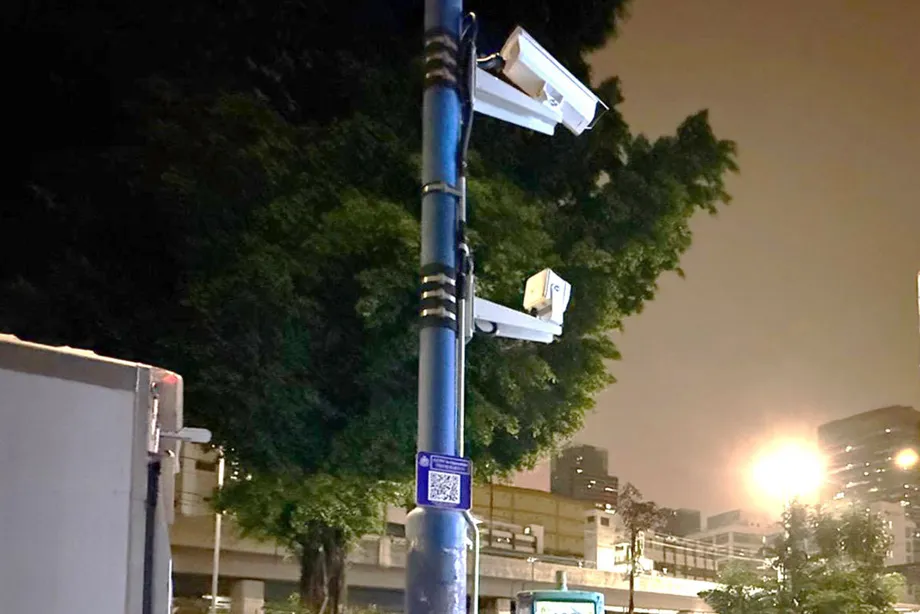
Signs are already placed near cameras installed under the programme to tell people that an area is under surveillance. For cameras belonging to other departments and organisations that connect to SmartView, the police page says the relevant operator decides whether to display the connection notice.
The mall discussions bring that notification policy into everyday commercial spaces. Visitors may already expect a shop or mall to record them for security, while a connection to SmartView gives police a more direct route to that footage. Tang said additional notification was being discussed.
Tang also said footage could be shared with other government departments when needed in future. The privacy and access arrangements therefore concern both police use of connected cameras and the circumstances in which other departments could receive recordings.
Why the bill goes beyond cameras
The proposed HK$4,066,482,000 in expenditure runs from 2026–27 to 2031–32. Optical fibre connections account for HK$1.311 billion, making communications infrastructure the largest individual category. Implementation and support services account for HK$956.447 million, while hardware, including cameras, servers, storage and network equipment, accounts for HK$893.207 million.
Software is budgeted at HK$353.044 million and contract information technology staff at HK$215.675 million. Other allocations cover site preparation, training, assessments and a HK$203 million contingency. Together, fibre connections and implementation services account for about 56 percent of the proposed expenditure.
The existing video management system began operating in 2024. Police say the much larger volume of footage will require greater processing capacity, upgraded network equipment and stable transmission links. In simple terms, more cameras also mean more video to move, store and search.
Annual running costs would rise as coverage grows. The HK$243.119 million forecast from 2036–37 is about 3.3 times the HK$72.926 million forecast for 2026–27. Hardware maintenance would account for HK$144.579 million of that later annual bill, with further spending on software support, communications, contract staff and consumables.
Staff time savings and the procurement plan
Police estimate that the expansion would free staff time worth HK$19.74 million annually from 2028–29. Officers would spend less time on repetitive searches and viewing recordings, allowing them to perform other duties requiring police judgement.
The Security Bureau and police explain the intended benefit in the legislative paper:
The manpower saved will be redeployed to other increasingly heavy police duties that require the professional judgement of police officers.
The financial annex describes these as notional savings. The time saved is spread across staff who also perform other tasks, so the plan retains posts and redirects capacity. The expected financial benefit is therefore the value of work time made available for other duties.
The cost and benefit analysis puts combined expenditure and staff costs at HK$5.694 billion across 2026–27 to 2036–37. After subtracting HK$177.66 million in cumulative notional savings, it records a net cost of about HK$5.517 billion for that period.
Police propose direct engagement procurement. The paper cites national security, public safety, geopolitical risks, supply chain stability, information security and compatibility with the first phase as reasons for that approach. These considerations would guide the selection of providers for a system intended to operate for many years.
The timetable and the crime figures behind the case
The expansion plan was announced on February 13, 2026, with legislative scrutiny and a funding request scheduled to follow. The proposal sets out this sequence:
- April 2024: SmartView begins operating.
- July 2025: Automatic number plate recognition is added.
- End of 2025: The first phase is completed.
- February 24, 2026: The expansion proposal is scheduled for discussion by the Legislative Council Panel on Security.
- March 2026: The government plans to seek Finance Committee funding approval.
- April 2026: Contract award and the start of the second phase are targeted.
- March 2028: The second phase is scheduled for completion, with about 60,000 cameras targeted by 2028.
- April 2028 to March 2031: The third phase would add about 6,500 cameras, with full operation scheduled for March 2031.
Hong Kong recorded 89,137 crimes in 2025, down 5.9 percent from 2024. Violent crime fell 15.9 percent to 8,823 cases. The detection rate rose seven percentage points to 58.7 percent.
Police present SmartView as a way to support investigations and improve responses to incidents while crime patterns change. The 899 cases in which the system assisted investigators cover April 2024 through January 2026, whereas the annual crime figures cover 2025.
The proposed expansion also has an event management role. Police want faster assessments of crowd density and better information for deploying officers when an incident develops. Camera locations would be selected using crime records, pedestrian flows, local risks and public order considerations.
Fire cooperation develops alongside the surveillance plan
Tang separately described closer cooperation with fire authorities in mainland China and Macao. During a major fire in Hong Kong, firefighters from those jurisdictions could assist with spraying water around the perimeter.
Recent exercises, tests and technical improvements have allowed mainland fire engines to connect to Hong Kong street hydrants through adapters, Tang said. The adapters provide a practical connection between equipment from different jurisdictions, allowing visiting vehicles to draw water from local hydrants.
The fire arrangements concern assistance during major emergencies, while SmartView concerns camera access, investigation and public event management. Both involve making systems operated by different organisations work together, with the fire exercises addressing the physical compatibility of equipment.
Key Points
- Hong Kong proposes HK$4.066 billion in SmartView expansion expenditure from 2026–27 to 2031–32.
- The network is intended to reach about 60,000 cameras by 2028 and 66,500 by 2031, combining new cameras with existing systems.
- Police are discussing shopping mall connections and studying access to systems operated by the MTR and other organisations.
- Commissioner Joe Chow said facial recognition is planned for cameras managed by police during 2026, while a legal framework is developed.
- Police say SmartView assisted in detecting 899 cases between April 2024 and January 2026.
- Annual operating expenditure is projected to reach HK$243.119 million from 2036–37 onward.
- The proposal schedules a funding request for March 2026 and full operation for March 2031.