AI agents move to the centre of banking trials
The Hong Kong Monetary Authority announced a new framework for responsible artificial intelligence on 15 October 2026, after more than 60% of use cases in its second generative AI sandbox explored systems capable of planning and carrying out tasks within authorised limits.
Contents
- AI agents move to the centre of banking trials
- What changes when AI can take action?
- Accountability, resilience and trust in practice
- Who is responsible for an AI agent?
- Fraud detection and more accessible banking
- Customer service that understands local needs
- Investment support and financial crime reviews
- ICBC Asia puts figures on potential gains
- Shared data and the next testing phase
- Key Points
The framework, called ART for Accountability, Resilience and Trust, comes as banks test applications ranging from sign language translation and fraud detection to investment information, debt recovery and financial risk monitoring. Its central challenge is practical: as AI gains more freedom to act, banks need clear responsibility for its decisions and ways to intervene when something goes wrong.
The HKMA's ART framework announcement sets out three main initiatives: new supervisory guidance, a training data sharing platform with Cyberport and the University of Hong Kong, and further testing alongside proposed governance arrangements for AI agents.
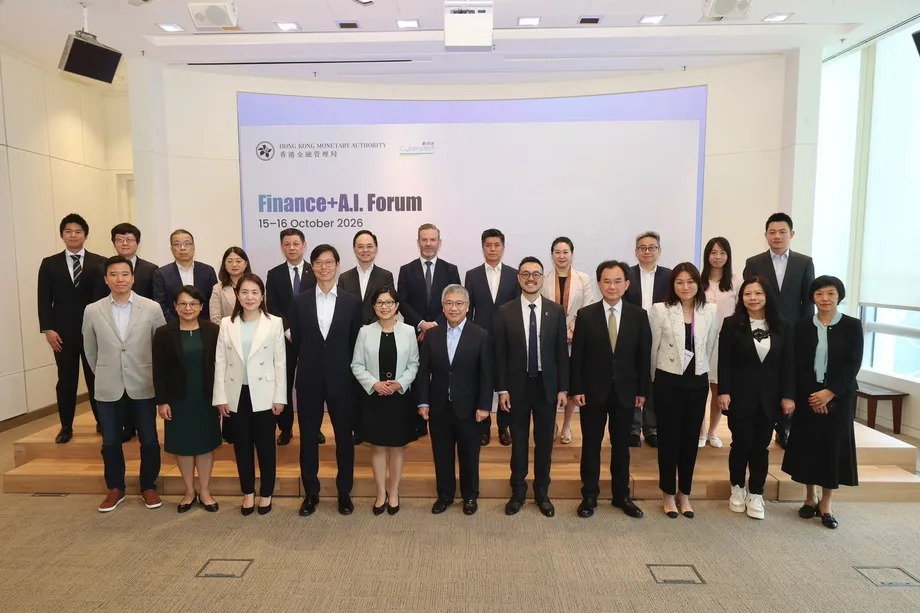
The authority said technical trials in the second sandbox cohort had concluded with positive results. Banks are showcasing their work at the Finance + A.I. Forum, jointly hosted by the HKMA and Cyberport on 15 and 16 October.
Arthur Yuen, the HKMA's Deputy Chief Executive, described the transition from AI that generates content to AI that can execute tasks as a new stage for the industry. He said:
The progression from generative to agentic A.I. represents an important new stage of innovation for the banking sector.
Yuen placed ART under the authority's Fintech 2030 strategy, linking wider adoption to clear accountability, resilient operations and effective human oversight.
What changes when AI can take action?
Generative AI produces material such as text, summaries or answers. Agentic AI can go further by planning a sequence of steps and using tools or systems to complete a task. In banking, that can mean moving from answering a question to gathering records, checking policies and preparing a service recommendation.
The HKMA said the sandbox explored automated planning and the execution of multiple tasks within defined boundaries and controls. More than three in every five use cases examined agentic applications, making them a substantial part of the trial programme.
A regulatory sandbox gives participating institutions a controlled setting to test technology with supervisory input. Here, the work has also helped shape the latest Supervisory Guidance for Responsible Adoption of Artificial Intelligence.
Hong Kong's programme is moving through several stages:
- 2025: The HKMA announced the second GenA.I. Sandbox cohort and unveiled its Fintech 2030 strategy.
- 15 October 2026: The authority announced ART and confirmed the second cohort's technical trials had concluded.
- 15 and 16 October 2026: The Finance + A.I. Forum brings together the regulator, Cyberport and banks to showcase the work.
- The following weeks: The HKMA plans to publish a discussion paper seeking views on governance for agentic AI.
Accountability, resilience and trust in practice
The supervisory guidance contains nine principles covering responsibility, governance, decision authority and checks across the life of an AI application. The three ART pillars group those expectations into questions that bank managers must be able to answer.
Accountability means identifying who is responsible for developing, approving, operating and overseeing a system. A bank needs clear decision powers and review arrangements from the start of an application through its use and later changes.
Resilience means keeping applications safe and robust, including when they fail. Banks need controls that help them recover effectively and maintain service when an AI system cannot continue operating normally.
Trust covers fairness, transparency, explainability and privacy. In plain terms, banks should be able to explain relevant AI decisions, handle information responsibly and respond to customers and others affected by their systems.
The Hong Kong Association of Banks welcomed ART, saying it provided clearer direction for governance and regulation. The association said the industry would strengthen internal governance and risk management while implementing the relevant supervisory requirements.
Who is responsible for an AI agent?
The HKMA's planned discussion paper will examine accountability anchored in an agent's intended purpose. The proposed approach connects responsibility to the people or business units that put forward, define, approve or own that purpose.
A bank would need to understand what each agent actually does, which business processes it enters and how it interacts with third parties. Its actions, tool use and decisions should be traceable so the bank can check what happened and identify who was responsible.
The proposed arrangements include internal inventories recording each agent's scope, intended purpose, authorisation, underlying models and systems, and responsible parties. The HKMA will also consider a registry of material AI agents, meaning agents important enough to warrant particular supervisory attention.
Intervention is another central proposal. When an agent's behaviour or decisions depart from its intended purpose, a bank should act quickly to correct or restrict it. In extreme cases, an emergency stop mechanism, often called a kill switch, would suspend its operation.
Banks would also need fallback arrangements so work can return to people or an alternative system. Stopping an agent and keeping banking services running are connected tasks: customers may still need their transaction or enquiry handled after the AI is paused.
The discussion paper is expected within weeks of the announcement. Its publication date, consultation deadline and final governance requirements have not yet been announced.
Fraud detection and more accessible banking
HSBC Hong Kong tested two applications in the sandbox: generative AI sign language translation and deepfake detection. The first explores more direct access to banking services for customers who use sign language. The second targets deceptive material produced with advanced technology.
Deepfakes are images, audio or video generated or altered to imitate real people. Banks face risks when such material is used to impersonate customers or disguise fraudulent activity.
Kazimierz Kelles-Krauz, HSBC Hong Kong's head of digital channels and AI for retail banking and wealth management, said AI was changing both customer expectations and fraud techniques. He described its potential to help banks anticipate and detect scams, with sandbox participation allowing testing under controlled risk and regulatory guidance.
Ping An Digital Bank completed an anti fraud strategy platform that uses AI facial recognition during identity checks. The system examines customer selfie photographs in real time to identify suspected fabricated or synthetic faces.
Bank of China Hong Kong also tested the feasibility of identifying AI generated voices in customer service calls. Together, these projects show banks applying AI to the same channels that criminals can use to imitate a person's appearance or voice.
Customer service that understands local needs
Bank of China Hong Kong completed technical validation of an intelligent investment information assistant and an AI voice customer service application. The investment assistant combines internal and external data to generate current, personalised investment and product information for staff.
The bank said this would help frontline employees understand customer investment needs and willingness to accept risk. Its voice application was tested on languages commonly used in Hong Kong, including conversations that switch between Chinese and English.
Recognising that mixture matters in everyday service. A caller may use both languages in the same sentence, so understanding the request requires more than treating the conversation as entirely Chinese or entirely English.
Nanyang Commercial Bank tested an intelligent time deposit service that uses conversation to understand customer needs, recommend products and help complete transactions. The project aims to reduce repeated data entry during the process.
The bank said the system uses AI cross checking and human oversight. Customers must personally authenticate every final transaction, keeping their approval at the point where money is committed.
Bank of China Hong Kong said it had also been selected for GenA.I. Sandbox++, where it plans pilots involving consumer experience and intelligent training for frontline employees.
Investment support and financial crime reviews
Standard Chartered tested generative AI in financial transaction monitoring and customer financial analysis. Its financial crime application analyses suspicious transaction data and investigation material to help employees prepare reports.
The customer analysis work combines transaction information with market intelligence to produce meeting briefs and investment insights for relationship managers. These employees handle customer relationships and help clients navigate banking products and services.
Standard Chartered said professional staff provide final review and decisions on AI analyses. It also said it had developed more than 300 AI use cases globally, covering areas including wealth management and business across borders.
China Construction Bank Asia tested its Smart RM Assistant, which uses several AI agents to support different parts of a relationship manager's work. The agents connect request handling, customer information retrieval, knowledge searches, communication support, compliance review and follow up service suggestions.
A relationship manager can enter a customer number or other identifying information in ordinary language. The platform then gathers the relevant customer profile, account details and past interactions, and combines them with product guidance and internal policies.
Both banks are targeting the time employees spend searching for information and assembling it into something useful. Their projects also show why the HKMA is focusing on traceability: a recommendation may depend on several data sources and multiple processing steps.
ICBC Asia puts figures on potential gains
Industrial and Commercial Bank of China Asia presented three applications involving loan repayment, annual customer risk reviews and financial market monitoring. Its figures offer a more detailed view of the operational gains banks are seeking.
The bank said its debt collection application combines robotic process automation with the ICBC group's large AI models to identify repayment risks earlier. Robotic process automation carries out repeated computer tasks according to set workflows. ICBC Asia said the recovery rate for repayments on high risk loans could rise above 50%.
For annual customer risk reviews related to anti money laundering, the bank used technologies including optical character recognition. This turns text in scanned documents or images into information a computer can process. The bank reported an efficiency improvement of more than 60%.
Its financial market application combines generative AI and an internally developed agent to answer questions about foreign exchange swap positions and risk exposure. A foreign exchange swap involves exchanging currencies and agreeing to reverse the exchange later; staff need to monitor the resulting positions and risks.
ICBC Asia said data queries that previously took hours could be completed in two minutes, and reported a 95% improvement in trading efficiency. The bank did not provide the starting recovery rate, detailed measurement methods or sample sizes for these performance figures.
The examples put ART's operating requirements into concrete settings. Faster information retrieval can help traders and risk managers, while repayment and customer review systems place AI inside processes with direct consequences for borrowers and bank compliance teams.
Shared data and the next testing phase
The HKMA is working with Cyberport and the University of Hong Kong on an AI training data sharing platform. The official announcement identifies data quality assurance as a core design principle.
Training data supplies the examples from which an AI model learns patterns. Quality checks matter because inaccurate, incomplete or unsuitable information can affect how a system responds. The platform places that issue alongside governance and operational controls in the ART programme.
GenA.I. Sandbox++ will provide further testing of agentic applications. The next stage combines practical experiments with discussion of how responsibility should work when AI systems have greater access to data, tools and banking workflows.
The projects already described reveal two concrete forms of oversight: Standard Chartered's professional review of AI analysis and Nanyang Commercial Bank's requirement for customer authentication before a transaction is finalised. The proposed intervention arrangements add another layer, allowing banks to limit or stop agents and switch to people or backup processes.
Hong Kong's immediate task is to connect those safeguards with the wider use of AI across banking. ART sets the direction, while the forthcoming consultation will examine how banks should document agents, assign responsibility and respond when automated activity goes off course.
Key Points
- The HKMA announced ART on 15 October 2026, centred on Accountability, Resilience and Trust.
- More than 60% of use cases in the second GenA.I. Sandbox explored agentic AI.
- The programme includes supervisory guidance, a training data sharing platform and further testing through Sandbox++.
- A forthcoming discussion paper will examine agent accountability, a registry of important agents and intervention mechanisms.
- Bank trials cover accessibility, fraud detection, customer service, investment support, loan repayment and risk monitoring.
- Proposed safeguards include traceable decisions, emergency suspension and a return to people or backup systems.