Pakistan joins a rapidly growing advertising business
OpenAI announced on October 21, 2026, that advertising on ChatGPT was expanding to Pakistan and 25 other countries, taking its advertising business to 89 markets. More than 100,000 advertisers have run campaigns since the company began testing ads in the United States in February.
Contents
- Pakistan joins a rapidly growing advertising business
- How the expansion reaches 89 countries
- What the $1 billion figure means
- Who will see ads, and who will not?
- How OpenAI says it will protect conversations
- Why advertisers want to reach people during a conversation
- The tools behind buying and measuring ads
- Sponsored agents move the business beyond standard ads
- Revenue growth ahead of a possible listing
- Key Points
The expansion follows a sharp rise in advertising revenue. OpenAI said in August that the business had reached an annualised revenue run rate of $1 billion. The company is developing another source of income alongside subscriptions as it prepares for a potential initial public offering, or IPO, through which investors could buy its shares on a stock exchange.
For users in Pakistan, Bangladesh, Cambodia and the other new markets, the immediate change concerns which ChatGPT plans can display advertising. Ads will appear on Free and Go, while Plus, Pro and Enterprise subscriptions will remain free of ads.
Businesses can purchase advertising through technology partners or directly through OpenAI's Ads Manager. The expansion gives local advertisers access to people using ChatGPT to compare products, plan purchases and consider services, placing commercial messages inside an experience built around questions and answers.
How the expansion reaches 89 countries
Latin America accounts for 14 of the 26 additional markets, including Argentina, Chile, Colombia and Peru. Those launches follow the introduction of ChatGPT advertising in Mexico and Brazil. Other countries named in the announcement include Nigeria, South Africa, Serbia and Ukraine, alongside Pakistan, Bangladesh and Cambodia.
The increase from 63 to 89 markets represents growth of about 41% in the number of countries covered. The 14 Latin American additions make up slightly more than half of the latest expansion.
Europe provided an earlier major step. In its European expansion announcement, originally published on August 18, OpenAI said ads would reach 31 European markets the following week. Those included Germany, France, Spain, Italy, Sweden, Norway, Denmark, the Netherlands and Austria. An August 31 update confirmed that advertisers in those markets could use Ads Manager directly.
OpenAI's rollout has moved from a single national pilot to a much broader commercial operation within eight months. The main milestones are:
- February 2026: OpenAI began testing ChatGPT advertising in the United States.
- August 18: The company announced an expansion to 31 European markets, following launches in eight other markets after the US pilot.
- August 31: Direct access through Ads Manager became available in those 31 European markets.
- September: OpenAI introduced tools using artificial intelligence for advertisers and began testing business sponsored agents with selected US advertisers.
- October 21: Another 26 countries joined, bringing advertising availability to 89 markets.
What the $1 billion figure means
OpenAI's advertising business reached an annualised revenue run rate of $1 billion in August, compared with a reported $100 million in March. Those figures describe a tenfold increase in the business's estimated annual revenue pace over five months.
A run rate takes revenue earned over a shorter period and projects what it would amount to over a full year at the same pace. For example, a business earning roughly $83.3 million each month would be operating at about a $1 billion annual rate. OpenAI's figure describes the pace reached in August rather than money collected across a completed year.
Advertiser participation has also grown. The platform had about 20,000 advertisers in late August, compared with more than 100,000 who had run campaigns by the October announcement. That puts the later total at roughly five times the earlier figure.
OpenAI says more than 1.2 billion people use ChatGPT each week. That gives advertisers a large potential audience, although advertising eligibility depends on the user's plan, age and market. For OpenAI, the commercial opportunity is to earn money from some of the people accessing ChatGPT without a subscription or through its cheaper Go plan.
Who will see ads, and who will not?
Free and Go users are the audience for ChatGPT advertising. Go is a paid plan, so paying for ChatGPT does not automatically remove ads. Users who want a subscription without advertising must choose among the plans OpenAI identifies as free of ads: Plus, Pro and Enterprise.
OpenAI's January 16 announcement described Go as costing $8 per month and providing expanded messaging, image creation, file uploads and memory. That post said Go had launched in 171 countries. Its subscription reach is broader than the 89 markets now covered by the advertising business.
OpenAI says advertising helps pay for free access and access at a lower cost. This makes the plan structure central to the company's business model: subscriptions provide one stream of income, while ads help fund access for other users.
Age and subject matter also affect eligibility. Under the principles announced before testing began, OpenAI said it would withhold ads from accounts belonging to people who say they are under 18, or whom the company predicts are under 18. It also said ads would be kept away from sensitive or regulated subjects, including health, mental health and politics.
How OpenAI says it will protect conversations
OpenAI says advertisers cannot buy influence over ChatGPT's answers. In its statement on the expansion, the company described how advertising should appear to users:
"Ads in ChatGPT are clearly labeled and separate from ChatGPT's answers, and advertising does not influence the answers ChatGPT provides," OpenAI wrote.
OpenAI also says it keeps conversations private from advertisers and never sells user data. Users can turn off advertising personalisation and erase the data used for ads. Those controls address both the commercial messages people see and the information used to tailor them.
Fidji Simo's January post set out five advertising principles: mission alignment, answer independence, conversation privacy, choice and control, and long term value. OpenAI also said it would put user trust and the user experience ahead of advertising revenue, rather than optimise the service to keep people using it for longer.
For someone asking ChatGPT to compare products, these commitments concern two different parts of the screen: the answer generated in response to the question and the separately labelled commercial message. OpenAI's stated policy is that buying the second does not determine the first.
Why advertisers want to reach people during a conversation
OpenAI presents ChatGPT advertising as a way to reach people while they are explaining their needs and weighing choices. Its European announcement described users planning travel, choosing software for a business, decorating a home, learning a concept or starting a hobby.
A conversation can contain more detail than a short search query. A person choosing business software might explain their budget, the size of their team and the tasks they need to complete. OpenAI's commercial proposition is that ads can become useful at the point when those preferences are taking shape.
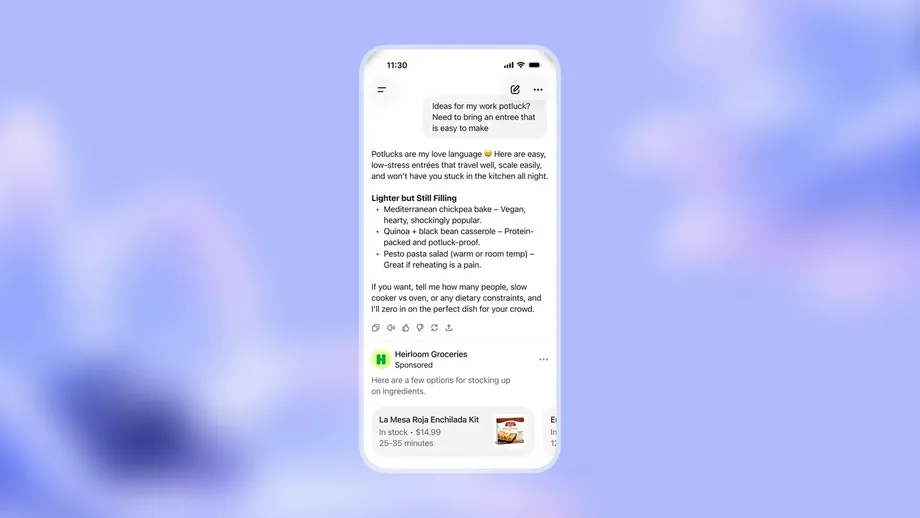
In an example accompanying the October expansion, OpenAI described someone preparing for a first marathon. The person could ask about meals for race week, then refine the suggestions around dietary preferences and cooking time. A grocery delivery advertisement could appear as a relevant service during that planning process.
For businesses in the newly added countries, this creates another place to compete for attention before a purchase. OpenAI says the platform is intended for companies ranging from local shops to multinational brands. Advertisers can enter through technology partners or manage purchases themselves through Ads Manager.
The tools behind buying and measuring ads
OpenAI's August announcement shows that the advertising platform already extends beyond simply displaying a message. The company described support for conversion optimisation, geographic targeting, custom audiences and tools for measuring business results.
Advertisers commonly pay through CPM, a price for every thousand ad displays, or CPC, a price for each click. Conversion optimisation shifts the focus toward a desired result, such as a purchase or registration. It helps advertisers direct spending toward the action they want people to take.
Geographic targeting lets an advertiser focus on a location, while custom audiences let campaigns target defined groups. These functions matter for a business serving a limited area, where reaching people outside its market may bring little value.
OpenAI also named OpenAI Pixel, Conversions API and integrations with outside measurement services. A pixel and an API are ways for a business to send information about relevant activity, such as a completed purchase, to an advertising measurement system. OpenAI says these tools help businesses understand results beyond clicks.
The practical question for advertisers is whether spending leads to useful outcomes. A campaign may attract attention, yet a retailer will also want to know how many people buy something. OpenAI's measurement tools are intended to connect those stages more closely.
Sponsored agents move the business beyond standard ads
OpenAI began testing business sponsored agents with selected advertisers in the United States in September, alongside new tools using artificial intelligence. The experiment points toward commercial interactions that go beyond showing a conventional advertisement.
An agent is software designed to work through tasks rather than only provide an answer. In commerce, an agent could help a person explore or evaluate products. OpenAI says it is examining more ways for businesses to interact with consumers within ChatGPT.
Asmita Dubey, L'Oréal Group's chief digital and marketing officer, described the beauty company's reason for testing with OpenAI:
Testing early with OpenAI enables us to pioneer helpful experiences and journeys, from discovery, to evaluation, to agentic commerce, ensuring L'Oréal remains the most trusted, expert answer wherever beauty conversations take place.
Agentic commerce refers to shopping experiences in which AI agents help carry out parts of the process. Dubey's statement connects three stages: finding a product, judging whether it suits a customer and using an agent during the commercial journey. The sponsored agent test remains a distinct initiative involving selected US advertisers.
Revenue growth ahead of a possible listing
OpenAI is expanding advertising as it considers a possible stock market listing. Executives have reportedly signalled 2027 as a potential year, although no confirmed listing date was given. Microsoft held roughly 27% of OpenAI following the company's October 2025 recapitalisation, which reorganised its ownership and financial structure.
Advertising gives OpenAI another way to generate revenue from ChatGPT's audience. Its approach also creates a visible difference with rival Anthropic, which pledged to keep Claude free of advertising after making OpenAI's ads a focus of its first Super Bowl campaign in February.
OpenAI says its next phase will include new advertising formats, campaign objectives, buying options and measurement capabilities. For Pakistan and the other newly added markets, the immediate development is access to the existing advertising platform, with Free and Go users forming the eligible audience and businesses able to buy through partners or Ads Manager.
Key Points
- OpenAI added Pakistan and 25 other countries on October 21, taking ChatGPT advertising to 89 markets.
- Fourteen of the new markets are in Latin America, including Argentina, Chile, Colombia and Peru.
- More than 100,000 advertisers have run campaigns since the US testing programme began in February.
- OpenAI said advertising reached a $1 billion annualised revenue run rate in August.
- Ads appear on Free and Go plans. Plus, Pro and Enterprise remain free of ads.
- OpenAI says ads are labelled, separate from answers and unable to influence those answers.
- Businesses can purchase ads through technology partners or directly through Ads Manager.
- New advertising tools and formats are planned as OpenAI prepares for a possible stock market listing.