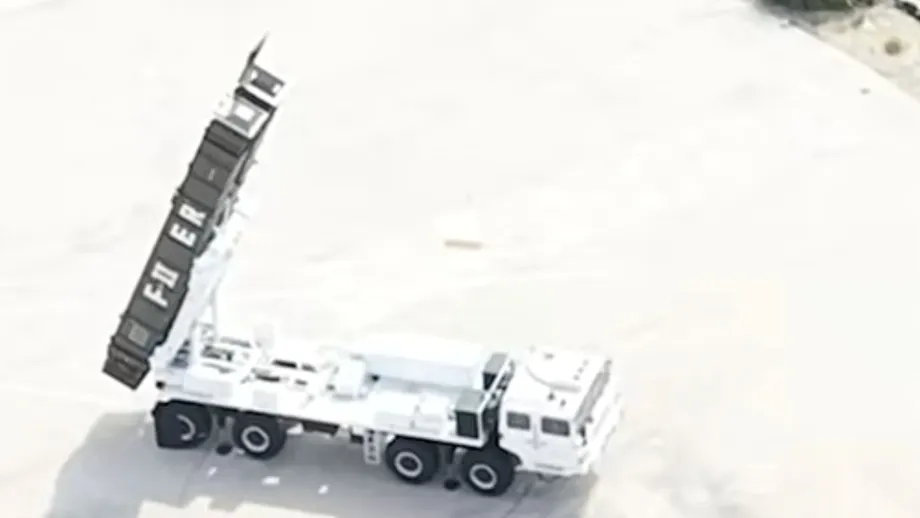
A new missile test with a familiar target: missile defences
Pakistan announced on 13 October 2026 that it had successfully tested the Fatah-II ER, an extended range version of its surface-to-surface missile, a week after testing an extended range Fatah-IV cruise missile. The military described the new Fatah-II as a hypersonic ballistic missile designed to strike targets farther away and evade interception through its flight path and ability to manoeuvre.
Contents
- A new missile test with a familiar target: missile defences
- What changes from the original Fatah-II?
- What does hypersonic mean here?
- How accurate is the Fatah family?
- A development programme stretching back to 2021
- Fatah-IV adds a different route to the target
- Why Indian air bases are part of the context
- Senior leaders welcome the launch
- Key Points
Lieutenant General Nauman Zakaria, commander of the Pakistan Army Rocket Force Command, witnessed the launch alongside senior officers, scientists and engineers, according to Inter-Services Public Relations (ISPR), the military's media wing. The test followed a training launch of the baseline Fatah-II in April 2026.
The existing Fatah-II has a stated range of 400 kilometres and carries a warhead weighing 365 kilograms. Pakistan did not release the ER version's maximum range, measured speed, detailed flight profile, payload or propulsion specifications, or a date for its entry into service. Published flight data and an independent assessment of its performance were also unavailable.
ISPR said the new missile carried advanced navigation equipment and avionics, the electronic systems that help control flight. In its statement announcing the test, the military's media wing described the intended benefit:
It is capable of engaging targets with high precision and defeating the enemy's missile defence systems due to its unique trajectory and manoeuvrability features.
The announcement places greater reach and the ability to survive interception at the centre of Pakistan's latest missile development. Those aims have practical significance for military installations farther from a launch position, particularly after the reported use of Fatah missiles against Indian military targets during the fighting in May 2025.
What changes from the original Fatah-II?
The baseline Fatah-II, also written as Fatah-2, was developed by Pakistan's state owned Khan Research Laboratories and the National Engineering & Scientific Commission. Its published specifications describe a missile 7.5 metres long and 600 millimetres in diameter, with a domestic range of 400 kilometres. An export version is listed with a shorter range of 280 kilometres.
The domestic figure is 120 kilometres greater than the export figure, or about 43% farther. Both figures describe earlier configurations; Pakistan has announced the ER model as a further extension of the missile's reach.
The baseline weapon uses inertial guidance and global navigation satellite signals. Inertial guidance tracks movement using instruments inside the missile, while satellite signals help correct its position. Automatic aiming, levelling, positioning and orientation systems help prepare the launcher and missile for firing.
Released footage has prompted an assessment that the ER missile appears longer than the baseline model while retaining roughly the same diameter. More internal space could accommodate additional fuel. Improved propulsion efficiency or changes to solid fuel composition are other possible explanations for greater range, although Pakistan has not described the engineering changes.
What does hypersonic mean here?
Hypersonic means travelling faster than five times the speed of sound, known as Mach 5. Many ballistic missiles reach that speed during part of their flight, especially as they descend towards a target. For a defender, the missile's speed, altitude and ability to change course together determine how difficult interception becomes.
ISPR's description focuses on trajectory, meaning the path through the air, and manoeuvrability. A missile that changes direction can force a defence system to keep updating its prediction of where to intercept it. The practical issue is how quickly the defender can detect, track and respond to those changes.
Retired Pakistani Brigadier Saad Muhammad, discussing the original Fatah-II after its December 2023 test, said its flatter trajectory made it harder to detect on radar and destroy. A lower flight path can shorten the time available to a radar because the curvature of the Earth limits how far it can see objects close to the ground.
His assessment concerned the earlier missile. The October announcement extends Pakistan's claim of difficult interception to the ER version, with speed and manoeuvrability presented as central features of the new weapon.
How accurate is the Fatah family?
The baseline Fatah-II has a stated circular error probable, or CEP, of 50 metres or less. CEP is a statistical measure: it describes the radius around an aim point within which half the missiles would be expected to land under the conditions used to calculate it.
A smaller CEP means tighter grouping around the target. For a military planner, that affects how a weapon might be used against a particular building, radar position or other installation. Guidance quality, target coordinates and conditions during flight all matter to the eventual result.
A related missile called SMASH, described as an anti-ship ballistic variant of Fatah-II, has a reported CEP of 10 to 15 metres depending on its seeker configuration. A seeker is a sensor that helps a missile locate or follow its target, particularly during the final stage of flight.
The baseline Fatah-II and SMASH are described as using a single rocket stage with two levels of thrust. The motor provides different amounts of push during flight. Their published characteristics show how the family has been adapted for different tasks, while the ER announcement concentrates on greater reach against targets on land.
A development programme stretching back to 2021
Pakistan's October launch follows several years of development, training and reported combat use across the Fatah family. The main publicly described milestones are:
- 24 August 2021: Pakistan tested its locally developed Fatah-I rocket system.
- 27 December 2023: Pakistan conducted the first reported Fatah-II test and announced a range of 400 kilometres.
- May 2025: Fatah-I and Fatah-II missiles were reportedly used against Indian military targets during fighting between the two countries.
- September 2025: Pakistan conducted a Fatah-IV training launch over a stated range of 750 kilometres.
- April 2026: The Army Rocket Force Command conducted a baseline Fatah-II training launch.
- Early October 2026: Pakistan tested an extended range Fatah-IV cruise missile.
- 13 October 2026: Pakistan announced the Fatah-II ER test.
ISPR said the April Fatah-II launch trained troops, checked technical parameters and assessed subsystems intended to improve accuracy and survivability. Those activities connect missile development with the practical work of preparing soldiers and equipment for operational use.
The October ER launch was described as the Army Rocket Force Command's second missile test that month and its fourth publicly announced test of 2026. Pakistan had also issued at least seven overland notices to airmen during the year. Such notices warn aircraft about restricted or potentially hazardous airspace, including areas reserved for missile testing; the number of completed launches was not specified.
Fatah-IV adds a different route to the target
The Fatah-IV test a week before the Fatah-II ER launch involved a ground launched cruise missile. ISPR said that extended range weapon carried advanced avionics and navigation aids and that its test checked additional subsystems intended to improve accuracy and survival against defences.
A cruise missile generally stays powered through much of its journey and uses aerodynamic lift, more like an aircraft. A ballistic missile is accelerated by a rocket and follows a trajectory shaped substantially by momentum and gravity, although it may also manoeuvre. The two types can present different tracking and interception problems.
Pakistan's September 2025 Fatah-IV training launch covered a stated 750 kilometres. The military described that weapon as capable of flying close to the terrain to evade missile defences. The later ER test adds another development step to the cruise missile programme.
Pakistan is known to operate the Fatah-I, with a range of 140 kilometres, and the baseline Fatah-II. The family also includes the Fatah-III, listed with a range of 450 kilometres, and Fatah-IV. Their operational status remains unclear despite the announced tests, including the earlier Fatah-IV training launch.
Why Indian air bases are part of the context
Fatah missiles reportedly targeted Indian military installations during the India-Pakistan conflict in May 2025. India reported intercepting incoming missiles. A Fatah-II was reported intercepted near Sirsa Air Force Station on 10 May, with debris recovered around Sirsa and Jalandhar.
Air bases matter because they support aircraft, maintenance facilities, fuel supplies and the equipment needed to keep air operations running. Greater missile range can bring more installations within reach from a given launch area, while also giving the launching force more choice about where to position its weapons.
Former Indian Brigadier Rahul Bhonsle, an artillery specialist, compared the original Fatah-II with India's Pinaka multiple barrel rocket launcher when discussing the December 2023 test. He viewed the development as an addition to Pakistan's artillery capability and placed it within the wider adoption of rocket artillery by armies.
India's defensive systems discussed in that period included the Russian S-400, the locally developed SAMAR and the Very Short Range Air Defence System, or VSHORADS. They serve different defensive roles and engagement distances. Protecting an air base can also involve hardened shelters and dispersing aircraft and support equipment so that fewer assets are concentrated in one place.
Senior leaders welcome the launch
President Asif Ali Zardari, Prime Minister Shehbaz Sharif, Field Marshal Asim Munir and the service chiefs congratulated the scientists and engineers after the test. Munir was identified in the announcement as chief of army staff and chief of defence forces.
Lieutenant General Zakaria praised the scientists and engineers who worked on the missile. His presence at the launch connected the development effort directly with the Army Rocket Force Command, which also conducted the April training launch and the preceding October cruise missile test.
Interior Minister Mohsin Naqvi also congratulated the nation. In a statement celebrating the launch, he credited the army's technical teams:
The scientists and engineers of the Pakistan Army have accomplished a matter of pride.
The announcements describe two parallel changes in Pakistan's conventional missile forces: efforts to reach farther with ballistic and cruise missiles, and efforts to make those weapons more difficult to intercept. For military installations in the region, the concrete concern is the combination of distance, warning time and the protection available at each location.
Key Points
- Pakistan announced the Fatah-II ER test on 13 October 2026, describing the weapon as a hypersonic ballistic missile.
- ISPR claimed greater reach, precise targeting and the ability to evade missile defences through trajectory and manoeuvrability.
- The baseline Fatah-II has a stated range of 400 kilometres and carries a warhead weighing 365 kilograms.
- The ER test followed an extended range Fatah-IV cruise missile test the previous week.
- Pakistan has not published the new missile's maximum range or measured flight performance.
- Reported Fatah missile use against Indian military targets in May 2025 gives the latest development a direct regional security context.