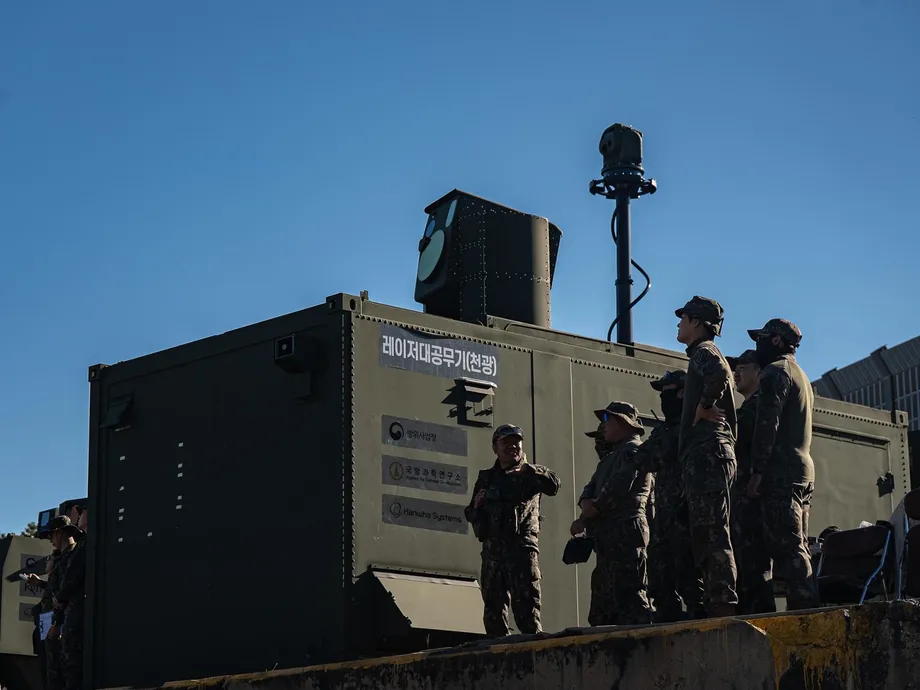
Two laser systems put through an Army test
Two South Korean laser weapons shot down all three target drones during an Army exercise in Yangpyeong, Gyeonggi Province, on October 14, 2026, according to Hanwha Systems. The demonstration paired the stationary Cheongwang air defense system with a separate vehicle mounted laser rated at about 30 kilowatts, bringing an existing defense weapon and a more mobile design into the same exercise.
Contents
- Two laser systems put through an Army test
- Cheongwang and the mobile cannon are separate projects
- Why electricity changes the cost calculation
- Cooling makes a mobile laser practical
- Lasers joined jamming and gunfire
- A series of demonstrations since deployment
- A 50 kilowatt vehicle aimed at overseas buyers
- South Korea is also considering a mobile successor
- Key Points
Hanwha announced the results on October 15. About 500 people attended the Army TIGER+ integrated future combat training event, including Army Chief of Staff General Kim Gyu-ha, military officials and representatives from industry, universities and research organizations.
The three successful interceptions gave the participating laser systems a combined success rate of 100 percent in the demonstration. Hanwha did not disclose which weapon destroyed each drone, the target models, the interception distances or the vehicle carrying the mobile laser.
The exercise comes as Hanwha seeks overseas customers for Cheongwang and develops a more powerful armored vehicle carrying a 50 kilowatt laser. Its sales argument rests on a striking cost comparison: the company puts the cost of a Cheongwang laser shot at about 2,000 won, or roughly $1.50, while conventional air defense ammunition can cost much more.
Cheongwang and the mobile cannon are separate projects
Cheongwang, whose name means "light of the sky," is formally called the Laser Air Defense Weapon Block-I. South Korea's Agency for Defense Development led its development, with Hanwha Systems participating as the prototype contractor and manufacturer. Deployment began in December 2024.
The 30 kilowatt mobile cannon demonstrated alongside it was developed under the management of the Korea Research Institute for Defense Technology Planning and Advancement, known as KRIT, with Hanwha as lead developer. Its components were made smaller and lighter so the weapon could be carried on a combat vehicle.
The two systems address different deployment needs. A stationary installation can protect a particular location, while a vehicle carrying a laser can be repositioned. For troops and procurement officials, mobility matters because the place needing protection may change as units move or threats shift.
A kilowatt measures power, or how quickly energy is delivered. The 30 kilowatt rating describes the mobile laser's output. The announced result from Yangpyeong covers the two participating weapons together.
Why electricity changes the cost calculation
Hanwha's estimate of about 2,000 won per Cheongwang shot is central to the weapon's appeal. Small drones can be cheap enough to send repeatedly, forcing defenders to weigh the value of each incoming target against the price and supply of the ammunition used to destroy it.
The cost figures accompanying the demonstration put air defense missiles at several million to tens of millions of yen each, with some artillery ammunition costing hundreds of thousands of yen. The laser irradiation estimate was approximately 200 yen. The potential saving on each engagement is therefore substantial.
The 2,000 won figure covers laser irradiation. Electricity charging and maintenance of the cooling system add expenses, alongside the broader costs of buying, operating and maintaining the equipment. A military planning its budget must pay for the complete system as well as the energy used during an interception.
Hanwha says Cheongwang can operate for 24 hours with a power supply and without separate ammunition deliveries. Conventional guns and missile launchers need replacement rounds after firing; a laser instead depends on electrical power and equipment capable of handling the heat produced during operation.
Cooling makes a mobile laser practical
The 30 kilowatt vehicle mounted cannon uses phase change cooling technology to control heat. In simple terms, a cooling material absorbs heat as it changes physical state. That helps manage the thermal load created when powerful equipment operates.
Hanwha's mobile design combines this cooling approach with smaller, lighter components. Both features matter on a combat vehicle, where the laser, its supporting equipment and the cooling system must fit within limits on space and weight.
A powerful laser needs to direct energy at a target while keeping its own equipment at a workable temperature. Cooling is therefore part of the weapon's operating capability, alongside its beam output. The company says the technology supports mobility and stable operation.
The vehicle mounted demonstration gives the Army a chance to evaluate how this equipment fits into a broader combat exercise. The announced results focus on the drone interceptions, while the engineering choices show what Hanwha is trying to make transportable.
Lasers joined jamming and gunfire
The Yangpyeong exercise also included electronic jamming and a K21 armored vehicle firing at incoming drones. The Army was demonstrating several ways to counter the same category of threat, rather than presenting laser weapons in isolation.
Electronic jamming uses radio interference to disrupt communications or navigation that a drone may rely on. Gunfire attacks the aircraft physically. A laser directs concentrated energy at it. Using different methods gives defenders more than one way to respond to drones with different designs and flight behavior.
South Korea has a concrete reason to improve those defenses. In December 2022, five North Korean drones crossed the border, with one reaching Seoul. Fighter jets, attack helicopters and warning shots failed to bring them down.
Cheongwang has since moved into service at sensitive locations. About five units were deployed at major government facilities as of June 2026, including the Ministry of National Defense building. For those sites, the mission is direct: stop a small aircraft before it can conduct surveillance or carry out an attack.
A series of demonstrations since deployment
The October exercise followed another successful interception demonstration on September 16 at the 2026 Defense Drone Technology Exhibition. Hanwha said Cheongwang destroyed four drones and two larger unmanned aircraft in succession at the Army's Seungjin training ground.
The September and October events together account for nine announced target interceptions, six in September and three in October. Cheongwang carried out the September interceptions, while the October result was shared across the stationary system and the separate mobile laser.
The main dates show how deployment, demonstrations and export preparations have progressed:
- December 2024: South Korea began fielding Cheongwang Block-I.
- June 2026: About five units were deployed at major government facilities.
- September 2026: Hanwha presented its 50 kilowatt armored vehicle concept at the MSPO defense exhibition in Kielce, Poland.
- September 16, 2026: Cheongwang intercepted six targets at the Defense Drone Technology Exhibition.
- October 14, 2026: Cheongwang and the 30 kilowatt mobile cannon intercepted three drones during Army TIGER+ training.
- October 15, 2026: Hanwha announced the Army exercise results.
Hanwha describes Cheongwang as the world's first operationally deployed laser weapon. Its deployment began before the December 2025 delivery of Israel's Iron Beam, although Iron Beam has progressed further in actual combat use. Fielding a weapon and using it during combat are separate milestones in bringing a defense system into service.
A 50 kilowatt vehicle aimed at overseas buyers
Hanwha's next export project is a laser armored vehicle rated at 50 kilowatts. That is 20 kilowatts more than the mobile cannon used in the October exercise, an increase of about 67 percent in rated output.
The company says the design responds to overseas customer requirements for greater mobility and power. Hanwha displayed a model at MSPO 2026 in Kielce, placing the project before potential buyers at a major European defense exhibition.
Hanwha Systems manager Hyungun Park said at the exhibition that a prototype had been built and production was planned by the end of 2027. The company's development schedule also points to completion by 2027. Park said discussions about Cheongwang exports were taking place with potential buyers in Europe, Asia and the Middle East.
Shin Joo-hun, head of Hanwha Systems' Laser Systems Business Center, described the company's ambitions for the technology:
Laser weapons are core assets that will fundamentally change the game of air defense.
Shin said Hanwha would pursue global expansion with Cheongwang and the 50 kilowatt armored vehicle. These projects give the company both an already deployed system to market and a more powerful mobile design under development.
South Korea is also considering a mobile successor
South Korea's proposed defense budget for 2027 includes funding to begin research on a mobile Block-II version of Cheongwang. The proposal adds a domestic military development track alongside Hanwha's work on the 50 kilowatt vehicle for overseas customers.
The projects have different stated purposes and schedules. Block-II appears in a government budget proposal for research, while Hanwha has described a built prototype and a production target for its export vehicle. The next concrete milestones are the budget decision and the company's planned progress toward production by the end of 2027.
For South Korea, the immediate change is that laser defense is already protecting selected facilities and being exercised alongside other weapons. For Hanwha, the October demonstration provides another public performance result as it seeks buyers for systems designed around low irradiation costs, electrical power and greater mobility.
Key Points
- Cheongwang and a separate 30 kilowatt mobile laser destroyed all three target drones during an October 14 Army exercise in Yangpyeong.
- About 500 people attended, including Army Chief of Staff General Kim Gyu-ha.
- Hanwha estimates Cheongwang's laser irradiation cost at about 2,000 won per shot, with other operating expenses added separately.
- Cheongwang began deployment in December 2024, and about five units were protecting major government facilities by June 2026.
- Hanwha is developing a 50 kilowatt armored vehicle for export, with production planned by the end of 2027.
- South Korea's proposed 2027 defense budget includes research funding for a mobile Cheongwang Block-II.