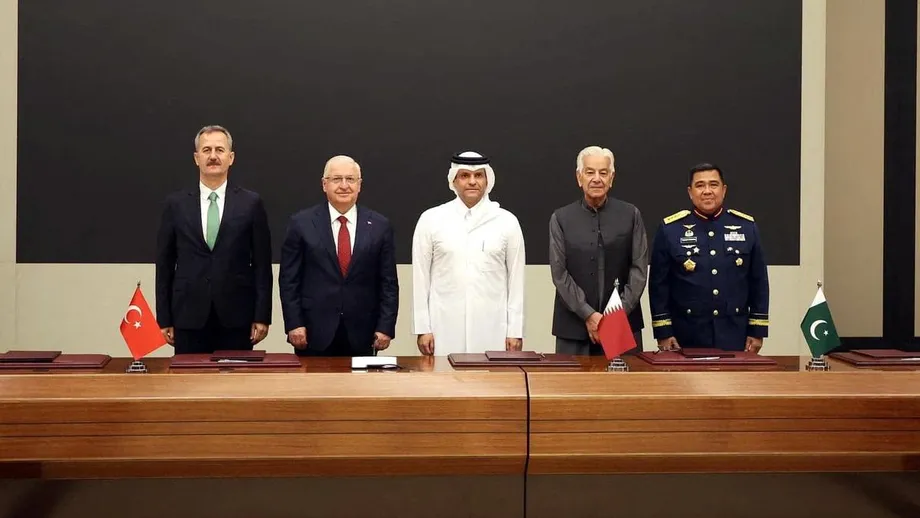
Four countries put factories and technology at the centre of defence ties
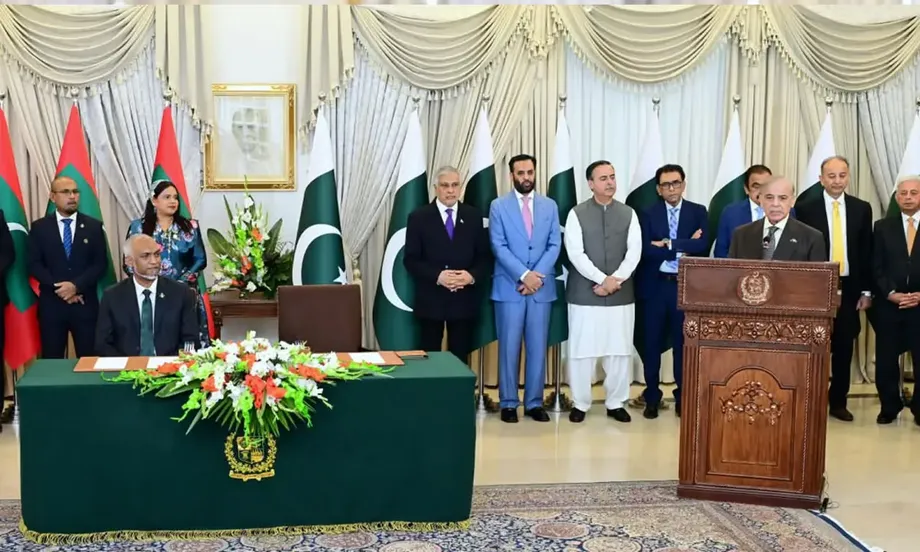
Pakistan, Türkiye, Qatar and Indonesia signed the Badr Memorandum of Understanding in Doha on Wednesday, October 21, 2026, creating a framework for cooperation in military manufacturing, technical training, research and development. The agreement brings together four defence ministries and industrial bodies, with two boards assigned to turn proposals into approved projects and implementation schedules.
Contents
- Four countries put factories and technology at the centre of defence ties
- What the Badr agreement covers
- Two boards will move proposals toward production
- What each partner could contribute
- Existing ships, a tank and investment provide a starting point
- Pakistan puts technology transfer and domestic capacity first
- How Badr fits alongside the Makkah defence pact
- Why the countries want more control over supply
- The steps leading to Doha
- Key Points
The pact combines military objectives with an industrial ambition: helping participating countries build more of the equipment they need, share technology and develop the people and factories needed to support it. Türkiye's Defence Ministry said the arrangement would also help meet the requirements of allied and friendly countries, extending its intended reach beyond the four participants.
Pakistan's Defence Minister Khawaja Muhammad Asif, Turkish Defence Minister Yasar Güler, Qatar's Deputy Prime Minister and Minister of State for Defence Affairs Sheikh Saud bin Abdulrahman bin Hassan Al Thani, and Indonesian Deputy Defence Minister Yusuf Jauhari signed the memorandum. Haluk Görgün, head of Türkiye's defence industries agency, also signed on Türkiye's behalf.
Qatar's Defence Ministry identified the participating institutions as the four defence ministries, Pakistan's Defense Industrial Production Organization and Türkiye's Presidency of Defence Industries. That structure places organisations responsible for manufacturing alongside those responsible for military requirements.
The immediate task is to connect those requirements with production capacity. A military may need a new system, while an industrial partner can supply technology, another can manufacture components and another can provide investment. Badr is intended to organise those contributions into joint work rather than leave each purchase as a separate transaction.
What the Badr agreement covers
The memorandum covers defence manufacturing, technical military training and joint research and development. Accounts of the agreement also describe joint exercises, technology sharing, joint production and training exchanges. Together, these activities connect the design of equipment with its manufacture, operation and maintenance.
Research and development means work to create new equipment or improve existing systems. Technology transfer can give a partner the knowledge, processes or technical rights needed to make or support equipment locally. Its practical value depends on what each project allows the participating companies and institutions to share.
Türkiye's Defence Ministry described the economic purpose of the agreement in a statement:
The agreement holds substantial economic importance,
The ministry said the countries would draw on their respective military production capabilities to strengthen industrial cooperation and meet the needs of allied and friendly nations. This gives Badr two linked aims: improving the participants' military capabilities and expanding the capacity of their defence industries.
Two boards will move proposals toward production
Badr establishes an Executive Board to identify joint projects and a Strategic Board to approve them and set their timelines. The cooperation mechanisms take effect upon signing, giving the four countries a process for selecting work rather than simply expressing an intention to cooperate.
The division assigns different jobs to the two bodies. The Executive Board will identify projects that partners could undertake together. The Strategic Board will decide which proposals proceed and establish their schedules. Those decisions will shape how broad commitments become specific manufacturing, training or research programmes.
No named initial projects, contract values, production volumes or firm delivery dates were announced. Türkiye's defence industry is expected to take the largest share of the joint projects, but the allocation will depend on the proposals selected and approved.
Other friendly countries may join under criteria agreed by the four participants. The name Badr means full moon, with the agreement's public explanation presenting it as a symbol of how the countries' capabilities complement one another.
What each partner could contribute
Türkiye enters the arrangement with established defence manufacturing relationships across the group. Defence industry analyst Arda Mevlutoglu, managing director of Mergen Analytical Strategies, described the potential division of contributions:
Turkiye contributes technological expertise, systems integration and a mature defence industry; Pakistan and Indonesia offer manufacturing capacity, skilled workforces and sizeable domestic markets; and Qatar provides investment potential and demand,
Systems integration means making different parts of military equipment work together, including its sensors, communications and weapons. Manufacturing capacity and trained workers are needed to turn a design into equipment that can be produced, repaired and supplied over time.
Albert Vidal, a research associate at the International Institute for Strategic Studies, said Pakistan and Indonesia were willing to buy Turkish weapons while locating part of their production at home. He said this could lower costs for Turkish companies and create jobs in the two purchasing countries, while Qatar could contribute financial resources.
Mevlutoglu said the partnership could support integrated supply chains. In practical terms, companies in different countries could produce parts, assemble equipment and provide maintenance within the same programme. Such arrangements would give buyers a larger role in sustaining their equipment and manufacturers a broader base of orders and investment.
Existing ships, a tank and investment provide a starting point
Pakistan's naval manufacturing project with Türkiye already illustrates how purchases can be linked to local production. Of four ships in the programme, two are to be built in Istanbul and two at Karachi Shipyard. Pakistan's share is therefore half the ships, giving its shipyard a direct role in construction.
Indonesia and Türkiye are also jointly building a tank. Qatar and Türkiye signed a bilateral defence industry memorandum in October 2025, and Qatar has invested in Türkiye's defence sector for more than a decade. Türkiye also maintains a military base in Qatar.
Burcu Ozcelik, a senior research fellow at the Royal United Services Institute, described the purpose of bringing these relationships together:
The rationale is to streamline these distinct defence export and joint production agreements under a more structured and resilient networked hub, rather than reinvent the wheel with each new defence agreement,
Badr therefore starts with existing industrial relationships. Its added task is to make cooperation among all four countries easier to organise, including projects that might connect financing, design, production and support across several borders.
Pakistan puts technology transfer and domestic capacity first
Asif said Pakistan wanted to explore opportunities for greater self reliance, industrial collaboration, joint production and technology transfer. He also placed joint research, training exchanges and the development of industrial capacity among the partnership's priorities.
The Pakistani defence minister described the agreement's political purpose:
This memorandum reflects our shared commitment to contributing to regional peace and stability,
Asif said cooperation would proceed in accordance with relevant domestic and international laws and regulations. Those requirements will form part of the decisions on technology sharing and industrial work, alongside the capabilities and needs of the partners.
Pakistan had been discussing broader defence relationships with the other participants before the signing. During a November 2025 visit to Qatar, President Asif Ali Zardari offered to expand cooperation in defence production. In September 2026, Indonesian naval chief Admiral Muhammad Ali met Pakistan's military leadership in Rawalpindi, with professional training, defence collaboration and joint exercises among the stated priorities.
Görgün, Türkiye's defence industries chief, said the memorandum provided a foundation for joint production and technology cooperation. He described the intended result in a statement:
We believe that the Badr Memorandum of Understanding will contribute to transforming the complementary capabilities of Qatar, Pakistan, Indonesia, and Turkey into concrete projects,
How Badr fits alongside the Makkah defence pact
Türkiye, Pakistan and Saudi Arabia signed the separate Makkah Joint Defence Agreement in August. That agreement includes a commitment to treat an armed attack on one participant as an attack on all. Badr's stated focus is industrial cooperation, technology and the development of military capabilities.
The two arrangements have different memberships and functions. Saudi Arabia belongs to the Makkah pact, while Qatar and Indonesia are participants in Badr. Türkiye and Pakistan take part in both, connecting the industrial initiative with a wider network of military relationships.
Saudi Arabia, Pakistan and Türkiye agreed to begin implementing their collective commitments after an October 5 emergency meeting in Riyadh, as described in the Makkah pact activation. Asif said Pakistani and Turkish forces were providing support while Saudi forces conducted combat operations, and identified reconnaissance as part of Pakistan's involvement.
Accounts published around the Badr signing described substantial Turkish and Pakistani military assistance to Riyadh as still limited. Asif's earlier description identified supportive and reconnaissance roles, while the size and timing of deployments had not been published.
Türkiye submitted the Makkah agreement to parliament for ratification on October 21. A deployment of Turkish troops abroad would require separate parliamentary approval. These legal steps concern the collective defence arrangement, while Badr's boards are tasked with organising industrial projects.
Why the countries want more control over supply
The signing comes amid the US and Israeli war with Iran and Houthi attacks on Saudi Arabia, which have increased security concerns across the Gulf. Türkiye has been helping Gulf countries, including Qatar, strengthen their defences during the conflict.
Mevlutoglu identified dependence on foreign suppliers, technology restrictions and disruptions to supply chains as reasons for countries to widen their partnerships. Military equipment requires more than an initial purchase: users also need spare parts, maintenance, trained personnel and access to technical support.
Joint production can move some of those tasks into the purchasing country. A local workforce may assemble equipment, manufacture agreed components or maintain systems closer to where they are used. The scope of that work will depend on the terms negotiated for each Badr project.
Mevlutoglu said Qatar was likely to retain its strategic relationship with Washington, while Türkiye sought greater technological independence within NATO. The approach he described is one of adding partners and domestic capacity while maintaining existing security relationships.
For the four governments, the practical measure of progress will be the work approved through the new boards: which technologies are shared, where equipment is made and which institutions gain the ability to build and maintain it.
The steps leading to Doha
Badr follows a series of bilateral industrial discussions and broader defence agreements. The sequence shows how existing relationships developed into a framework involving all four countries:
- October 2025: Qatar and Türkiye signed a bilateral defence industry memorandum.
- November 2025: Pakistan's president discussed expanding defence production cooperation during a visit to Qatar.
- August 7, 2026: Saudi Arabia, Pakistan and Türkiye signed the Makkah Joint Defence Agreement.
- September 2026: Indonesia's naval chief held talks in Pakistan covering training, defence collaboration and joint exercises.
- October 5, 2026: The Makkah pact's participants met in Riyadh and agreed to begin implementing collective defence commitments.
- October 21, 2026: Pakistan, Türkiye, Qatar and Indonesia signed Badr in Doha, while Türkiye submitted the separate Makkah agreement to parliament.
The next operational steps for Badr lie with the Executive Board and Strategic Board. Their selection and approval of projects will determine how the memorandum changes production, technical training and research across the four participating countries.
Key Points
- Pakistan, Türkiye, Qatar and Indonesia signed the Badr Memorandum of Understanding in Doha on October 21, 2026.
- The framework covers defence production, technical training, research, technology cooperation and joint industrial work.
- An Executive Board will identify projects, while a Strategic Board will approve them and set schedules.
- Existing partnerships include naval construction in Pakistan and Türkiye, a Turkish and Indonesian tank project, and Qatari investment in Türkiye's defence industry.
- Badr focuses on industrial capabilities; the separate Makkah agreement includes collective defence commitments.
- Other friendly countries may join under criteria agreed by the four participants.