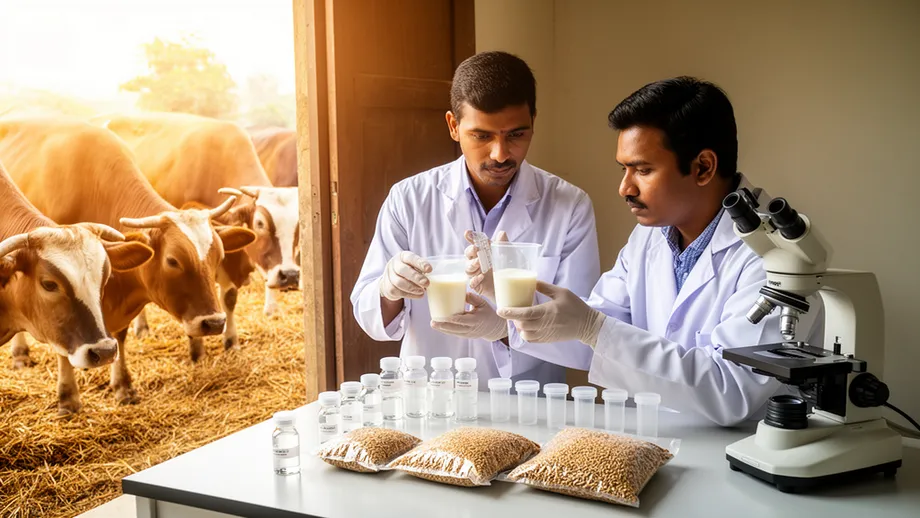
605 samples reveal a problem that starts with cattle feed
A review of 605 milk samples from Bangladesh estimates that 58.7% contained aflatoxin M1, a toxic substance that enters milk after dairy animals eat contaminated feed. Its calculations identify infants and young children as priority groups for closer investigation, while an unusually high concentration in one Dhaka dataset shows how sharply contamination can vary.
Contents
- 605 samples reveal a problem that starts with cattle feed
- Detection and concentration tell different stories
- Earlier studies show why the averages vary
- How the evidence developed
- Regional differences deserve closer testing
- Heat treatment leaves the feed problem unresolved
- Contaminated feed provides the route into milk
- Why infants and toddlers receive priority
- What better surveillance would require
- Key Points
The systematic review, published in Veterinary Medicine and Science in 2026, combined 20 datasets from 12 reports published between January 2000 and January 2026. The estimated average concentration was 143 nanograms per litre. Removing the unusually high Dhaka dataset reduced that figure to 93 nanograms per litre, a fall of about 35%.
Aflatoxin M1, usually shortened to AFM1, can remain in milk after pasteurisation and treatment at ultra high temperatures, known as UHT processing. Controlling it therefore requires attention to what cattle eat, how feed is stored and how milk is tested before reaching consumers.
The review brings together evidence collected over many years rather than results from a new nationwide inspection. Its central finding is a recurring food safety concern across several surveys, alongside substantial uncertainty about the level of contamination in particular places and supply chains.
The estimated prevalence had a 95% confidence interval of 51.6% to 65.5%, describing uncertainty around the pooled figure. A wider prediction interval, from 32.1% to 81.1%, describes the variation researchers might encounter in another comparable survey. For families, farmers and regulators, that variation makes local testing important: a national average can hide both relatively low measurements and much higher concentrations.
Detection and concentration tell different stories
A positive test answers whether a laboratory detected AFM1. The concentration answers how much was present. Both matter because frequent detection at low levels and less frequent detection at high levels can produce different patterns of exposure.
The review illustrates this with two datasets in which every sample tested positive but average concentrations were among the lowest recorded. The dataset with the highest concentration had a detection rate close to the pooled estimate.
The sample weighted arithmetic mean was 143 nanograms per litre, while the geometric mean was 92 nanograms per litre. The arithmetic mean is more strongly affected by very high readings. The geometric mean reduces their influence and helps describe a distribution in which most measurements are lower but a few are much higher.
The review also reports that about 83% exceeded the European Union comparison level of 50 nanograms per litre and 8% exceeded the 500 nanograms per litre value associated with Codex Alimentarius and Bangladeshi standards. The denominator behind the 83% figure needs clarification, because it is higher than the reported 58.7% detection prevalence. Readers need that clarification to understand which samples were included in the concentration calculation.
The two comparison levels differ by a factor of 10. The primary studies describe regulatory limits by milk mass, at 50 and 500 nanograms per kilogram, while reporting many measurements by volume, in nanograms per litre. Those units are close for milk but require consistent handling in a formal compliance assessment.
Earlier studies show why the averages vary
A 2020 milk study examined 100 samples from farms and grocery stores: 50 raw, 25 pasteurised and 25 UHT. AFM1 appeared in 53% of samples, including 70% of raw milk, 52% of pasteurised milk and 20% of UHT milk.
That study reported a mean raw milk concentration of 699.07 nanograms per kilogram, with measurements ranging from 22.79 to 1,489.28. The review presents the extreme Dhaka dataset at approximately 699.1 nanograms per litre. Among positive samples in the 2020 study, 75% exceeded the European comparison limit and 43% exceeded the higher Codex limit.
A different investigation, published on June 25, 2021, found AFM1 in 78.6% of 145 milk and dairy product samples collected across four divisions. Its measurements ranged from 5.0 to 198.7 nanograms per litre. Abu Hasan Sumon and colleagues conducted that work at Shahjalal University of Science and Technology in Sylhet.
Their 2021 dairy study reported an average of 51.5 nanograms per litre among positive samples. The authors calculated means using samples at or above the laboratory detection limit, a detail that matters when comparing averages across studies.
How the evidence developed
Bangladesh introduced regulations covering mycotoxins in major foods, including AFM1 limits in milk, in 2017, according to the 2021 study. Mycotoxins are toxic substances produced by certain fungi. The studies that followed examined different products, locations and periods.
- December 2018 to November 2019: researchers collected 145 milk and dairy product samples from Sylhet, Dhaka, Chittagong and Rajshahi.
- 2020: a study of 100 raw and processed milk samples reported 53% contamination and a particularly high average in raw milk.
- June 25, 2021: the study of 145 samples was published in Toxins.
- 2023: a survey of 90 raw milk samples from 30 commercial farms in Chattogram reported 39 positive samples.
- 2026: the systematic review combined 20 datasets and modelled dietary exposure across age groups.
The timeline shows repeated detection across several investigations. The different sampling locations, products and methods of calculating results make the findings more useful as a guide to surveillance priorities than as a continuous annual record.
Regional differences deserve closer testing
Chattogram had a pooled detection estimate of 43.7%, compared with 55.3% in Dhaka and 66.8% across other divisions and national samples. Region was the only planned subgroup comparison that remained statistically significant after adjustment for multiple comparisons, with an adjusted p value of 0.004.
The researchers described the regional result as exploratory. Differences in season, laboratory kits, detection thresholds and the places where milk was collected are among the factors that future surveys need to examine alongside geography.
A 2023 Chattogram farm survey gives a closer view of local variation. It tested 90 samples from 30 commercial dairy farms in Bakalia, Khulshi and Pahartali. AFM1 was detected in 39 samples, or about 43%.
Among those 39 positive samples, 27 exceeded 50 nanograms per litre and two exceeded 500 nanograms per litre. Expressed against all 90 samples, those counts equal 30% and about 2.2%, respectively. Stating both the count and denominator makes the scale easier to understand.
The farms produced an average of about 71.7 litres daily, mainly for dairy processing plants, and all used concentrates and forage. Average AFM1 concentrations reported for the three neighbourhoods ranged from 108.44 to 190 nanograms per litre, showing why testing at the collection stage matters for milk entering processing networks.
Heat treatment leaves the feed problem unresolved
The review estimated detection prevalence at 60.4% for raw milk, 59.0% for pasteurised milk and 69.5% for UHT milk. Differences among the three categories were not statistically significant. The UHT estimate rested on just two datasets, with detection rates of 20% and 100%.
The 2021 study found AFM1 in all 15 pasteurised and all 15 UHT samples it examined. Their mean concentrations were 106 and 73 nanograms per litre, respectively. Eleven samples in each group exceeded the European comparison level.
AFM1 is resistant to the heat used in normal milk processing. Pasteurisation serves a different safety purpose by controlling harmful microbes; aflatoxin control requires preventing contaminated feed from entering dairy production and identifying affected milk through testing.
The same study examined only five yogurt and five milk powder samples. Their reported concentrations were lower, but those small groups offer a limited basis for decisions about particular dairy products.
Contaminated feed provides the route into milk
Dairy animals consume aflatoxin B1, or AFB1, when fungi contaminate their feed. The liver converts part of that substance into AFM1, which is then released into milk. Bangladesh's warm, humid monsoon conditions can support fungal growth during crop production, harvesting and storage.
Maize, an important energy ingredient in compound feed, is particularly vulnerable. Studies discussed in the review measured AFB1 at 1 to 103 micrograms per kilogram in maize and zero to 160 micrograms per kilogram in poultry feed. Oil cakes, bran, rice straw and soybean meal also contained contamination.
Reported cattle feed concentrations exceeded the European Union comparison limit of 5 micrograms per kilogram for dairy cattle feed, even where averages were below the general feed comparison level of 20 micrograms per kilogram. Feed intended for animals producing milk therefore needs particular attention.
The review also applied a published model of toxin transfer from feed to milk. It predicted milk concentrations of 24 to 282 nanograms per litre, with a central estimate of 80. That range contained 18 of the 20 dataset means. The model originated in controlled trials involving 12 Israeli Holstein cows; measurements pairing feed and milk from the same Bangladeshi herds would provide a more direct local assessment.
Why infants and toddlers receive priority
Infants aged six to 12 months had an estimated central exposure of 4.22 nanograms per kilogram of body weight each day. For children aged one to three years, the estimate was 2.29. A smaller body receives a larger dose per kilogram from the same quantity of contaminated milk.
The researchers calculated a margin of exposure, a screening measure that compares estimated intake with a toxicological reference point. A lower margin signals a greater need for public health attention. For substances that can damage genetic material and cause cancer, the assessment used 10,000 as its benchmark for potential concern.
The central margins were 95 for infants and 175 for toddlers, and estimates for every age group were below 10,000. A simulation involving 100,000 iterations also produced margins below the benchmark in every infant and toddler iteration and in 90.4% of adult iterations.
These calculations combine published milk consumption, body weight and concentration estimates. They describe potential exposure under modelled conditions rather than measured doses in individual children or forecasts of particular illnesses. The assessment covered milk; exposure through rice and other foods falls outside its calculations.
What better surveillance would require
Every milk measurement in the review used competitive ELISA, a test based on antibody reactions. Chromatographic confirmation would add a more specific laboratory method that separates substances before identifying and measuring the toxin.
The review classified nine datasets as having low risk of bias, five as moderate and six as high. Many studies selected samples according to availability rather than a design representing the whole country. Researchers recommend collecting feed and milk from the same farms during both monsoon and dry seasons, confirming results with more specific methods and investigating the extreme Dhaka measurements.
Seasonal findings also need closer local investigation. Independent feed and milk studies showed maximum measurements during June to August, while the 2021 investigation found no statistically significant difference between winter and summer concentrations. Sampling the same farms repeatedly would help authorities understand when controls are most needed.
Sumon and colleagues, authors of the 2021 study, set out their recommendation in its conclusion:
Regular surveillance and monitoring are needed to prevent and control aflatoxin contamination in milk and milk products in Bangladesh.
For farmers, the practical priorities are better feed storage and routine testing of vulnerable ingredients. For dairy businesses and food safety authorities, testing raw milk during collection and processing would help identify contamination before products reach households. The review calls for these measures alongside stronger evidence about where exposure is greatest.
Key Points
- The review estimated AFM1 detection in 58.7% of 605 milk samples across 20 datasets.
- One extreme Dhaka dataset raised the weighted mean concentration from 93 to 143 nanograms per litre.
- AFM1 can remain after pasteurisation and UHT processing, making feed controls essential.
- Exposure calculations identified infants and toddlers as priority groups for further investigation.
- Researchers recommend testing feed and milk from the same farms, improving storage and confirming laboratory results.