528,765 Hectares Burned as Investigators Examine Mobicom Convoy
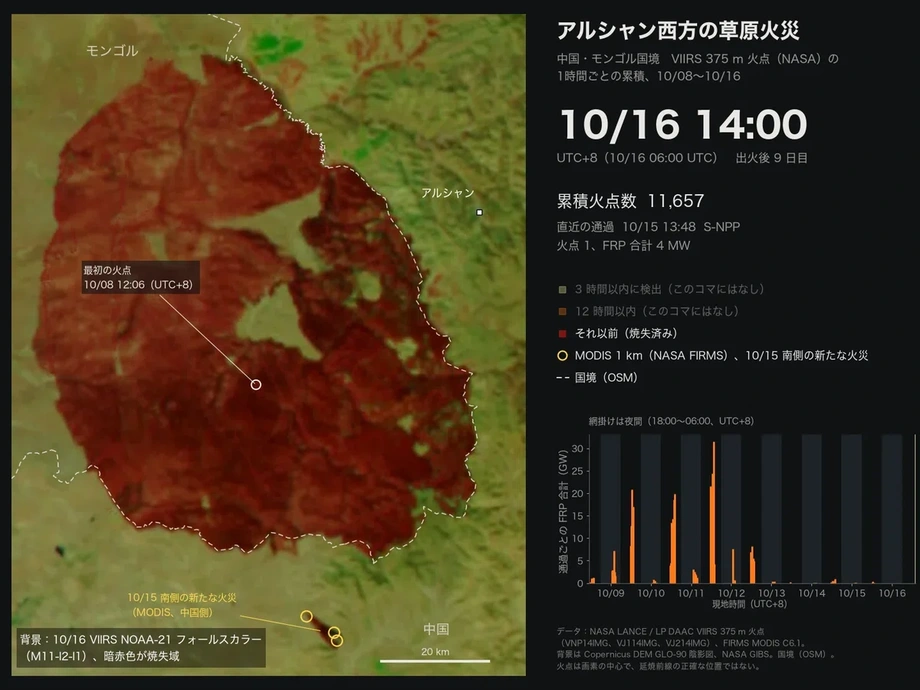
A fire that began on October 8, 2026, burned 528,765.5 hectares in eastern Mongolia, including nearly four fifths of the Numrug Strictly Protected Area, according to the Ministry of Environment and Climate Change. Specialists are now assessing damage to wildlife, soil, water and habitats, while police investigate a convoy linked to telecommunications company Mobicom.
Contents
- 528,765 Hectares Burned as Investigators Examine Mobicom Convoy
- How the Fire Began and Spread
- Why Was the Group Inside Numrug?
- Mobicom Apologises and Promises Cooperation
- Compensation Demands Extend Beyond the Convoy
- Firefighting on Both Sides of the Border
- What Satellites Show About the Burned Area
- Measuring Damage to a Living Ecosystem
- A Disaster in an Increasingly Dry Country
- Key Points
The ministry said 468,965.7 hectares inside the reserve were affected, equal to 79.8 percent of its territory. The total burned area, including land outside the reserve, covers about 5,288 square kilometres. Subtracting the two ministry figures puts the affected land outside Numrug at 59,799.8 hectares.
The blaze started in the reserve's core zone in Khalkhgol district, Dornod province, and was declared fully extinguished at 7 a.m. on October 16. Mongolia deployed 606 personnel, while China mobilised more than 3,400 firefighters and other emergency personnel along its neighbouring frontier.
Initial investigations linked the ignition to a vehicle in a group associated with Mobicom, a Mongolian operator controlled by Japan's KDDI. The company said its personnel were carrying out telecommunications work. Allegations that the visit involved unauthorised hunting and fishing have added to public anger.
The police investigation had produced no public conclusion by October 19. The purpose of the journey, the permission required to enter the reserve's core zone and responsibility for the fire remain central issues. The environmental assessment will also help determine the losses for which officials intend to seek compensation.
How the Fire Began and Spread
The first emergency report arrived at 11:55 a.m. on October 8. An independent analysis of observations from Japan's Himawari-9 and South Korea's GK-2A weather satellites placed ignition between 11:41 a.m. and 11:51 a.m., approximately 27 kilometres from the Chinese border.
Accounts of the incident describe dry grass becoming trapped beneath a vehicle and igniting. Mobicom said a vehicle fire spread into the surrounding grassland during work connected with communications facilities at a border guard outpost and the Sumber crossing. Strong winds then drove the flames across the steppe.
The main developments unfolded over more than a week:
- October 6: Participants attended a fibre optic inauguration ceremony at the Sumber crossing, according to the Border Protection Agency.
- October 8: The fire began in Numrug's core zone, and emergency authorities received the alarm at 11:55 a.m.
- October 10 to 12: Satellite analysis identified periods of intense burning as the fire advanced towards the Chinese frontier.
- October 14: Mobicom chief executive Yasuhiro Ochi publicly apologised.
- October 16: Mongolia's emergency agency declared the fire completely extinguished at 7 a.m.
- October 17: Dornod provincial police opened an investigation into the cause.
Satellite observations stopped detecting hotspots after the afternoon of October 15. Authorities nevertheless warned that dry conditions and strong winds could allow remaining heat to ignite vegetation again.
Why Was the Group Inside Numrug?
The Border Protection Agency described a party of 13 people travelling in five vehicles, including Mobicom management, border crossing administrators and local residents. It said they had border area passage permits valid from October 6 to 8.
Mobicom described the journey as official telecommunications business, including a survey for communications infrastructure and checks connected with construction work. Other accounts identified senior Japanese executives among the travellers and said a Japanese national was driving a vehicle in the convoy.
Government officials questioned whether the proposed fibre optic work had sufficient technical and economic justification. Deputy Prime Minister Nomtoibayar said investigators would examine whether the trip was necessary.
Allegations also emerged that the group intended to hunt and fish without authorisation, including an attempt to catch taimen, a fish identified in those allegations as critically endangered. Mobicom maintained that the visit concerned telecommunications work. The Border Protection Agency's statement addressed permission to enter the border area; whether the group had the authorisation required for the reserve's restricted core zone was still unresolved.
Mobicom Apologises and Promises Cooperation
Mobicom chief executive Yasuhiro Ochi apologised on October 14, six days after the fire began. His statement addressed both the company's responsibility and his personal response to the disaster.
Speaking on behalf of Mobicom, as well as in my personal capacity, I offer my sincere and heartfelt apologies," said Ochi. "We firmly believe that we must fully uphold our social responsibilities.
Ochi said Mobicom would cooperate with the authorities and take action according to the investigation's findings and relevant laws. He also committed the company to steps towards restoring the natural environment. A Mongolian television account of his remarks described a promise to compensate fully for damage under the established circumstances and applicable law.
Mobicom became a consolidated subsidiary of KDDI in 2016. Its founding investors included Japan's Sumitomo Corporation and Mongolia's Newcom Group. The investigation concerns the activities of the visiting group and the actions of the authorities responsible for access to the area.
Compensation Demands Extend Beyond the Convoy
Justice and Internal Affairs Minister Temuulen Ganzorig said those involved, along with relevant border administration personnel, would be held responsible and required to compensate for losses. His statement brings the decisions of officials who allowed the journey under scrutiny alongside the conduct of the travellers.
Mongolian criminal law prohibits unauthorised hunting or capture of animals in specially protected areas. Causing a forest or steppe fire can also bring criminal penalties, with responsibility depending on circumstances such as negligence and the damage caused.
The environmental assessment has a practical role in that process. Investigators and officials need a documented account of ecological losses, damaged property and the cost of fighting the fire before compensation demands can be calculated.
Fan Lijun, a researcher at the Inner Mongolia Academy of Social Sciences, criticised the incident as a failure of corporate social responsibility. He also alleged that some foreign backed companies use business connections to get around environmental rules and fire prevention restrictions. Police are responsible for determining what happened in this case.
Firefighting on Both Sides of the Border
Mongolia assembled 60 firefighting teams from three provinces, with 606 personnel and 100 sets of equipment. Another response tally described the deployment as including 100 vehicles. The operation had to reach a remote reserve described as more than 90 kilometres from human settlements.
China mobilised more than 3,400 firefighters and other personnel along the Inner Mongolia section of the frontier. Their work included continuous patrols and measures intended to prevent the approaching flames from entering Chinese territory.
The Hinggan League Forestry and Grassland Bureau said a lookout tower detected the fire inside Mongolia at 12:15 p.m. on October 8. From October 11, crews carried out controlled burning along 131 kilometres of border patrol road, creating a firebreak about 100 metres wide.
Controlled burning removes grass and other fuel ahead of an approaching wildfire. A firebreak is a strip where fuel has been cleared or burned, giving the advancing flames less vegetation to consume. Chinese authorities said the fire had not crossed the border by noon on October 15.
What Satellites Show About the Burned Area
The environment ministry's preliminary total of 528,765.5 hectares is larger than estimates made from satellite imagery. An independent analysis estimated about 4,900 square kilometres, with a range of 4,750 to 5,000 square kilometres, while the China Meteorological Administration estimated approximately 5,050 square kilometres on October 12.
The ministry's figure converts to about 5,288 square kilometres, roughly 388 square kilometres more than the independent central estimate. Officials plan to combine satellite mapping with measurements on the ground as part of the detailed assessment.
The independent satellite analysis also identified about 12 square kilometres of burning on the Chinese side consistent with announced controlled burning operations. It suggested a further patch of approximately 0.9 square kilometres west of Arxan might have resulted from flames crossing the frontier, but assigned low to medium confidence to that interpretation.
Chinese authorities maintained that the advancing fire had been kept out. The uncertain satellite interpretation concerns a small area near the boundary, where emergency crews were also deliberately burning vegetation to protect the frontier.
Measuring Damage to a Living Ecosystem
Environment and Climate Change Minister Ts. Sandag-Ochir and protected areas policy director Ts. Uranchimeg visited Khalkhgol district to direct the assessment. A working group established by the district governor will cooperate with a specialist team from the ministry.
The teams will use satellite mapping, field measurements, research, laboratory tests and other evidence, following methods required by law. They are also tasked with documenting relevant information and assessing property losses and firefighting expenses.
Numrug protects one of eastern Mongolia's best preserved natural ecosystems. Brown bears, wild boars and other wildlife depend on its habitats. The ministry said the assessment must examine soil, water, air, vegetation, animals, rare plant habitats and the way the ecosystem functions.
For wildlife, damage can include the loss of feeding grounds, shelter and breeding areas. For plants and soil, specialists need to examine both the immediate effects of burning and the conditions that will shape regrowth. Animal casualty figures and the full ecological cost had not been announced.
The ministry will assess how much recovery can happen naturally and where protection or restoration work is needed. No completion date or final monetary estimate was given. Its findings are intended to guide habitat protection, support natural recovery and reduce the risk of future fires.
A Disaster in an Increasingly Dry Country
Mongolia's official environmental figures show average temperatures have risen by 2.5 degrees Celsius since 1941. They also show that 81.9 percent of the country's land is affected by desertification and land degradation, while nearly 80 percent of steppe fires are attributed to human activity.
Dry grass and strong winds shaped the Numrug emergency from its early stages. The reserve's access controls, the condition of vehicles entering the area and the arrangements for work during the autumn fire season are concrete issues for the authorities examining the incident.
The immediate firefighting operation has ended, but the work now divides into two connected tasks: police must determine responsibility, while environmental specialists must establish the damage and what the reserve needs to recover. Compensation demands and restoration decisions will depend on those findings.
Key Points
- The ministry says 528,765.5 hectares burned, including 468,965.7 hectares inside Numrug, or 79.8 percent of the reserve.
- The fire began on October 8, 2026, and was declared extinguished on October 16.
- Police are investigating a convoy linked to Mobicom. The company says the journey concerned telecommunications work.
- The Border Protection Agency said the group held border area permits; authorisation for entry into the reserve's core zone remained unresolved.
- Mobicom's chief executive apologised and pledged cooperation and action towards environmental restoration.
- Specialists will assess wildlife and habitat losses, property damage, firefighting costs and the ecosystem's ability to recover.