A Singapore connection behind an unnamed customer
A US$18.8 million Pentagon contract modification announced on October 15 extends work on a specially tailored F-35 configuration through December 2030. The announcement leaves the foreign customer unnamed, but US government spending records connect the contract to Singapore, which expects its first F-35B fighter by the end of 2026.
Contents
- A Singapore connection behind an unnamed customer
- How the development funding accumulated
- What Group A means for an aircraft
- The engineering work Singapore has acknowledged
- From a 2019 request to a mixed fleet
- Why Singapore is buying two versions
- First delivery and the American training base
- Twenty aircraft, two basing locations
- Several schedules lead towards a new fighter force
- Key Points
The link is contract N0001922C0015. The USAspending federal database describes it as Singapore Program Team Support. A US$53.4 million modification awarded in August 2022 carries the description Singapore Group A Integration, matching a Pentagon announcement about work for an unidentified Foreign Military Sales customer.
Four disclosed awards, beginning in December 2021, total approximately US$134.2 million. They cover development and integration work alongside Singapore's purchase of 20 fighters: 12 F-35Bs, capable of short takeoffs and vertical landings, and eight F-35As, which use conventional runways.
The records bring an additional engineering programme into view as the Republic of Singapore Air Force prepares to become an F-35 operator. Singapore is buying aircraft while also funding work to accommodate its particular requirements. Public documents leave the equipment, capabilities and distribution of that work between its two aircraft variants undisclosed.
How the development funding accumulated
Lockheed Martin received the original US$49.1 million contract in December 2021. The Pentagon described its purpose as designing and developing a Joint Strike Fighter aircraft variant tailored for an unspecified Foreign Military Sales customer. Joint Strike Fighter is the programme name associated with the F-35.
Foreign Military Sales, often shortened to FMS, is the arrangement through which the US government manages military equipment sales to other governments. Here, the contract number provides the connection between the Pentagon's unnamed customer and the Singapore descriptions in federal spending records.
The disclosed sequence shows several stages of work rather than a single development payment:
- December 2021: US$49.1 million for the initial design and development contract.
- August 2022: US$53.4 million in additional work, identified in USAspending as Singapore Group A Integration.
- August 2025: A further US$12.9 million awarded to Lockheed Martin.
- October 15: Another US$18.8 million for system development, demonstration and integration, extending work through December 2030.
The latest award carries the engineering schedule about four years beyond the expected delivery of Singapore's first aircraft. Delivery and completion of this development effort therefore sit on different timetables: the air force can begin receiving aircraft while further integration work continues.
What Group A means for an aircraft
The Singapore Group A Integration description offers a useful clue about the nature of the work. In aircraft programmes, Group A generally refers to provisions built into an aircraft so it can accommodate particular equipment or capabilities.
Such provisions can include mounting arrangements, wiring, connections or other supporting changes. They are the aircraft's preparation for a system, rather than necessarily the system itself. Other F-35 procurement documents use terms including Group A hardware kits and Group A enabler provisions for supporting hardware and modifications.
Singapore's original US sale approval covered a broad package: electronic warfare systems, communications and identification equipment, weapons employment capability, access to an F-35 reprogramming centre, and software development and integration. Electronic warfare involves detecting, interpreting or countering electronic signals, including those associated with hostile radar.
Singapore's requirements also involve making the fighter work within the wider Singapore Armed Forces. A fighter's usefulness depends on how well its sensors, communications and weapons connect with the military organisations using its information. That operational integration has been an explicit part of Singapore's evaluation.
The engineering work Singapore has acknowledged
Singapore's Ministry of Defence describes a substantial assessment process in its February 28, 2024 F-35B fact sheet. After the Letter of Offer and Acceptance was signed in 2020, personnel from the air force and Defence Science and Technology Agency gained access to information and facilities reserved for F-35 users.
The joint team held technical and engineering discussions with Lockheed Martin and other F-35 operators to determine how the F-35B would fit into Singapore's warfighting system. Personnel also joined training and professional exchanges, used detailed flight simulators, and attended conferences and focused study activities.
Those steps helped the team assess both the aircraft's capabilities and its compatibility with Singapore's forces before proceeding with the additional eight F-35Bs. The ministry's description places integration at the centre of the purchase decision, alongside aircraft performance.
The sensors are a major part of that calculation. The ministry says the F-35B can collect and combine information, then share it with other friendly forces. In practical terms, the aircraft is intended to help build a shared picture of nearby threats, giving other units information they can use as well.
From a 2019 request to a mixed fleet
Singapore's involvement with the F-35 began well before its purchase. Lockheed Martin's Singapore programme account says the country joined as a Security Cooperation Participant in 2003, selected the fighter in 2019 and received US government approval for the F-35B sale in 2020.
MINDEF's January 10, 2020 congressional notification reply gives the exact request date: April 5, 2019. Singapore sought four F-35Bs, with an option for eight more. The ministry explained that Congress had 30 days to respond to the notification, after which formal purchase terms could be negotiated through a Letter of Offer and Acceptance.
The sequence separates the initial selection and request in 2019 from the formal acceptance signed in 2020. Singapore exercised the option for eight additional F-35Bs in 2023, bringing the B fleet to 12, and announced the acquisition of eight F-35As in 2024.
The resulting 20 aircraft will form part of a future fighter force alongside Singapore's F-15SGs. MINDEF expects its ageing F-16s to begin drawing down from the mid-2030s, making the F-35 programme a transition spanning aircraft purchases, engineering, training and changes to the existing fleet.
Why Singapore is buying two versions
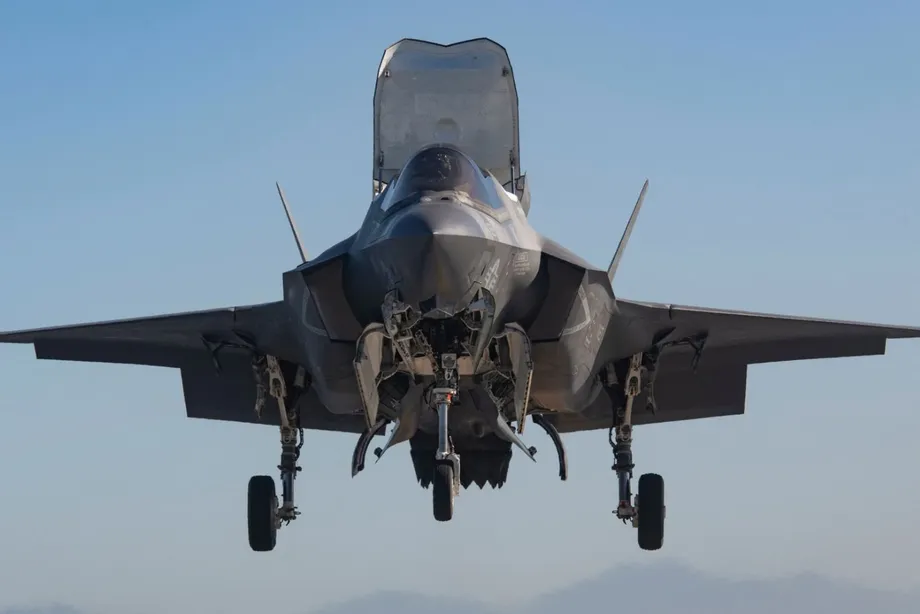
Singapore's limited land makes runway requirements especially relevant. The F-35B can take off over a short distance and land vertically, giving the air force more flexibility in the space needed for aircraft operations. Its lift system takes up room and adds weight, however.
The F-35A uses conventional takeoff and landing. Without the B model's lift fan, it has more room for fuel and greater payload capacity. MINDEF's February 28, 2024 F-35A fact sheet presents the two variants as complementary parts of the future fleet.
The ministry lists 8,278 kilograms of internal fuel for the F-35A against 6,125 kilograms for the F-35B. That gives the A model 2,153 kilograms, or about 35 percent, more internal fuel. Its listed weapons payload is 8,160 kilograms, compared with 6,800 kilograms for the B, a difference of 20 percent.
Published range figures are more than 2,200 kilometres for the F-35A and more than 1,667 kilometres for the F-35B. Both have a listed maximum speed of Mach 1.6. Singapore is therefore choosing different combinations of runway flexibility, endurance and carrying capacity, rather than selecting between a faster and a slower fighter.
Both versions also share stealth features and advanced sensors. MINDEF lists radar, infrared sensing and targeting equipment, and electronic warfare systems for each. Stealth features reduce an aircraft's visibility to hostile detection systems, while the sensors help its crew understand the surrounding airspace.
First delivery and the American training base
Defence Minister Chan Chun Sing visited Lockheed Martin's Fort Worth production facility on September 12, 2025, Singapore time, and signed the wing of Singapore's first aircraft during production. MINDEF's September delivery update confirmed that the first of the 20 fighters remained on track for delivery at the end of 2026.
Chan, accompanied by Chief of Air Force Major-General Kelvin Fan, received briefings on the programme, aircraft capabilities and production process. His visit put the acquisition's industrial progress alongside the work needed to prepare people and facilities.
Chan, Singapore's defence minister, thanked Lockheed Martin, US government partners, the US Air Force and the Ebbing community for helping bring the capability into service. He said:
I want to express my deep appreciation to all of you for making this possible. Without your dedication and support, we will not be here.
The initial aircraft will remain in the United States for training. Singapore plans its F-35 training presence at Ebbing Air National Guard Base in Fort Smith, Arkansas, making the American location part of the operational preparation rather than simply a delivery destination.
Twenty aircraft, two basing locations
A US Department of War acquisition report puts the value of Singapore's 20 F-35s and related equipment at US$4.06 billion, approximately S$5.17 billion. It sets out a basing plan in which the 12 F-35Bs are permanently stationed at Ebbing for training and the eight F-35As are based at Tengah Air Base in Singapore.
That division would place 60 percent of the purchased aircraft at the US training location and 40 percent at Tengah. The arrangement gives the two versions different planned homes as well as different technical strengths.
The US report places local basing in 2029 and expects the F-35A main operating base to be operational in the fourth quarter of US fiscal year 2029. That quarter runs from July through September 2029. MINDEF's position in a February 9 media reply was that local delivery and basing would follow project schedules and training requirements, with details to be shared when firmed up.
Several schedules lead towards a new fighter force
Singapore's F-35 transition has several milestones: the first delivery at the end of 2026, planned local basing in 2029, tailored development work through December 2030, and the progressive F-16 drawdown from the mid-2030s.
Each milestone concerns a different part of building a usable force. Aircraft must be manufactured and accepted, crews trained, bases prepared, and equipment connected to Singapore's military systems. The procurement records add a funded engineering schedule to the production and training plans already described publicly.
The US$134.2 million in disclosed development awards gives that engineering effort a measurable scale. Together with MINDEF's account of technical evaluations and the decision to operate two F-35 variants, it shows how Singapore's acquisition extends beyond receiving aircraft from a production line to preparing a fleet for its own operational requirements.
Key Points
- USAspending records connect contract N0001922C0015 to Singapore, while Pentagon announcements leave the foreign customer unnamed.
- Four disclosed awards total approximately US$134.2 million, with the latest work extending through December 2030.
- A Singapore Group A Integration entry identifies work on aircraft provisions for Singapore's requirements.
- Singapore has ordered 12 F-35Bs and eight F-35As, with its first delivery expected at the end of 2026.
- The US basing plan places the F-35Bs at Ebbing in Arkansas and the F-35As at Tengah, with local operations planned for 2029.
- The future fighter fleet will combine F-35As, F-35Bs and F-15SGs as F-16s begin drawing down from the mid-2030s.