A 5kg satellite puts two technologies to the test
Singapore's CRIMSON-1 satellite is testing flexible perovskite solar cells and artificial intelligence about 520km above Earth, bringing two laboratory technologies into an environment where power, heat and communications capacity are tightly constrained. The spacecraft weighs 5kg, measures 30cm by 10cm by 10cm and is designed for a mission lasting one year.
Contents
- A 5kg satellite puts two technologies to the test
- What makes the solar module different?
- Why durability matters as much as efficiency
- The cost argument needs orbital evidence
- AI will select useful images before transmission
- Computing introduces its own power and heat demands
- Who built, deployed and enabled the mission?
- Singapore's funding programme connects development to space testing
- The milestones and what comes next
- Key Points
Nanyang Technological University, Singapore (NTU) announced that its 14th satellite launched aboard a SpaceX Falcon 9 rocket on the Transporter-18 mission from Vandenberg Space Force Base in California. The launch took place on October 1 in California, corresponding to October 2 in Singapore. CRIMSON-1 was released approximately 55 minutes after liftoff, among 130 space vehicles carried by the rocket.
The mission has two distinct experiments. One will measure the durability and electricity output of perovskite solar cells developed by NTU researchers and Singfilm Solar, a company spun out of the National University of Singapore (NUS). The other will process satellite images aboard the spacecraft, testing whether AI can identify useful information before it is transmitted to Earth.
A crucial distinction is that the experimental perovskite cells do not provide the satellite's main power supply. Conventional gallium arsenide panels power CRIMSON-1 while the new cells are tested alongside them. Launching the experiment establishes an opportunity to collect evidence, rather than proving that perovskites are ready to replace existing spacecraft power systems.
In its CRIMSON-1 mission announcement, NTU says researchers will examine both solar performance in orbit and the computing system's heat management and power consumption under heavy workloads. No results from those experiments have yet been announced.
What makes the solar module different?
Perovskites are materials with a particular crystal structure that can be used to convert sunlight into electricity. Their appeal here is the possibility of making efficient solar cells that are thin, light and manufactured using commonly available materials. For spacecraft, reducing the mass of a power system can leave more capacity for other equipment.
Singfilm Solar's experimental module is flexible and built on ultrathin glass. NUS Assistant Professor Hou Yi, the company's founder, describes CRIMSON-1 as the first spaceflight of that flexible module and the first deployment of a Singapore manufactured solar module in orbit. The mission is also the first spaceflight of Singfilm's technology, according to NTU.
Those claims require a distinction between individual solar cells and a module, which is an assembly of cells designed to work together. NTU previously flew perovskite cells aboard its ARCADE satellite in 2023. CRIMSON-1 therefore should not be described as the university's first attempt to test any perovskite cell in space.
The new experiment extends that work to a flexible module and the technology developed with Singfilm. Its value will depend on the measurements returned from orbit, including whether the module maintains useful electricity output after launch and prolonged exposure to space conditions.
Why durability matters as much as efficiency
Solar cells intended for space must survive two very different tests: the mechanical stresses of a rocket launch and the operating conditions encountered afterward. CRIMSON-1 will assess physical durability, conversion efficiency and actual electrical power generation in low Earth orbit.
The planned assessment includes exposure to radiation, vacuum and thermal cycling. Thermal cycling means repeated changes in temperature as a spacecraft moves through different lighting conditions. Such changes can place stress on materials and their connections, while radiation can affect both solar cells and electronics.
NTU Deputy President and Provost Professor Christian Wolfrum said the mission brings solar research and AI computing into the setting needed to establish whether they work as intended:
These technologies can only be validated under real space conditions, and this is what NTU's satellite programme has been doing for three decades. CRIMSON-1 is our fourteenth mission.
The year of testing is intended to provide evidence about performance over time, rather than a single measurement taken shortly after deployment. NTU has not announced numerical targets for acceptable power output, efficiency loss or material degradation.
The cost argument needs orbital evidence
The financial attraction of perovskites is substantial, but it remains a prospect rather than a demonstrated saving from this mission. Reported prices for gallium arsenide solar cells used in space range from US$250 to US$450 per watt. Conventional silicon cells used on Earth cost less than US$1 per watt.
On those figures, the quoted gallium arsenide prices are more than 250 to 450 times the silicon benchmark. That comparison illustrates the cost gap between the technologies, but it is not a direct comparison of interchangeable products. A low price for a terrestrial cell does not establish that it can meet a spacecraft's operating requirements.
No manufacturing price per watt has been disclosed for the perovskite module aboard CRIMSON-1. The mission therefore cannot yet support a calculation of how much money a satellite operator would save by adopting it. Reliability, usable power output and integration costs would also matter.
Singfilm reported a power conversion efficiency of 22.6% for a perovskite solar panel in 2024. Conversion efficiency describes the share of incoming sunlight turned into electricity. That figure provides context for the company's development work, but it is not an orbital measurement or a stated performance result for the CRIMSON-1 payload.
NTU's research in the field dates to a 2013 paper in Science showing that electrical charges could travel unusually long distances through perovskite materials. That finding helped explain their high solar efficiency. Subsequent work moved toward larger modules and prototypes intended to improve performance and stability. CRIMSON-1 now tests whether the technology can retain useful properties beyond the laboratory.
AI will select useful images before transmission
CRIMSON-1 is described as Singapore's first nanosatellite equipped with AI. Its computing experiment will analyse and filter images aboard the spacecraft, including selecting images without cloud cover and identifying potential forest fires or oil spills.
This is edge AI: computation performed close to where data are collected instead of sending all the raw information to a distant computer. Here, the edge is the satellite itself. The intended benefit is to transmit useful images or possible event alerts rather than sending every image for people on Earth to examine.
Satellite communications have limited capacity. Filtering images in orbit could reduce the volume of raw data transmitted and the amount of manual sorting required on the ground. The mission is testing that approach, not announcing a proven disaster detection service.
No detection accuracy, false alert rate or measured reduction in transmitted data has been announced. An AI indication of a possible fire or spill is not the same as a confirmed event. The experiment's results will be needed to judge whether its selections are sufficiently reliable for operational use.
Computing introduces its own power and heat demands
Processing images aboard a small spacecraft creates a tradeoff. Sending less information to Earth may conserve communications capacity, but running AI uses electricity and produces heat. CRIMSON-1's researchers will examine how the computing system manages both under heavy workloads.
Heat management is especially relevant in vacuum, where a spacecraft cannot cool itself through surrounding air as a computer on Earth can. Its design must move heat through its structures and release it through radiation. The experiment will help establish how the selected computing hardware behaves in that environment.
The solar and computing tests therefore address connected engineering constraints, although they remain separate experiments. Future spacecraft using more onboard computation would need power systems capable of supporting it. CRIMSON-1 is testing a possible future solar technology while using established panels to supply its own operating power.
Hou has identified solar power for future satellites and possible AI data centres in space as areas for further exploration. CRIMSON-1 is not itself an operational AI data centre, and its mission does not establish that the perovskite module could power one. Its role is to return measurements that can inform later designs.
Who built, deployed and enabled the mission?
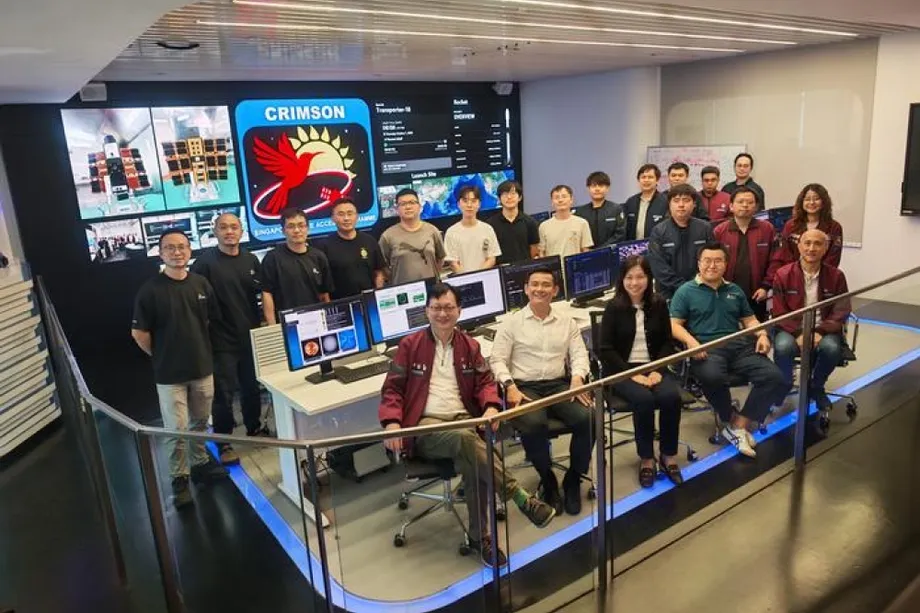
NTU's Satellite Research Centre leads the mission, bringing together spacecraft engineering, launch preparation, mission control and operations in orbit. NTU says its researchers worked with launch integrator Exolaunch, which supplied launch capacity, mission management, integration and deployment services. CRIMSON-1 was deployed using Exolaunch's EXOpod Nova system.
Reports differ in how they describe spacecraft construction. One identifies Singapore company Satoro Space as the builder, with NTU's AI technology and the experimental solar cells incorporated into the spacecraft. Another credits construction to NTU's Satellite Research Centre. NTU's announcement identifies the centre as the mission lead and says local industry partners participated, but does not detail the division of fabrication work.
The Infocomm Media Development Authority (IMDA) supported the mission by securing satellite spectrum and orbital resources through the International Telecommunication Union. Spectrum refers to the radio frequencies used for communications between a satellite and stations on Earth.
The university's record includes the 2011 launch of X-SAT, Singapore's first locally built satellite. Its 13th mission, VELOX-AM, launched in July 2023 and, according to NTU, completed its mission and deorbited in August 2026. CRIMSON-1 follows that programme of building, testing and operating spacecraft.
Singapore's funding programme connects development to space testing
CRIMSON-1 is among the first projects supported by the National Space Agency of Singapore (NSAS) through the Space Access Programme. That scheme sits within the Space Technology Development Programme, under which Singapore has set aside S$210 million since 2022 for space research and national capabilities.
The government's Space Technology Development Programme page, updated on March 17, 2026, says the Office for Space Technology and Industry secured an additional S$60 million in 2024. It describes STDP 2.0 as continuing from 2025. The page does not establish that this S$60 million should be added again to the S$210 million cited for the programme.
The programme has three funding categories: technology development, validation and experimentation, and access to space. The last category supports testing that establishes flight heritage, meaning a documented record of a technology operating in space. Solar cells, advanced materials, computing systems and other payloads are listed as examples.
Local universities, research institutions and industry partners can apply. Foreign entities must seek local partners. Remote sensing and satellite communications are priority areas, while NSAS is also exploring spacecraft servicing in orbit, manufacturing in space and space life sciences.
For CRIMSON-1, flight heritage is the connection between research and possible commercial adoption. A completed launch is one milestone. Evidence that a module or computing system continues working under orbital conditions is a separate milestone that potential customers can assess.
The milestones and what comes next
The mission brings together more than a decade of solar research and satellite development. The main dates show that progression:
- 2011: X-SAT, Singapore's first locally built satellite, launched.
- 2013: NTU researchers published findings on electrical charge transport through perovskite materials in Science.
- 2022 onward: Singapore set aside S$210 million for the Space Technology Development Programme.
- 2023: NTU flew perovskite cells aboard ARCADE; VELOX-AM launched in July.
- 2024: Singfilm reported 22.6% solar panel conversion efficiency, and the government secured an additional S$60 million for space technology development.
- August 2026: VELOX-AM deorbited after completing its mission, according to NTU.
- October 1 in California, October 2 in Singapore: CRIMSON-1 launched for a planned mission lasting one year.
NTU's announcement gives the launch day and month without explicitly stating a launch year. The October 1 and October 2 dates reflect the difference between California and Singapore time, rather than two separate launches.
The next substantive milestone is the return of performance data. There is no announced date for an initial results release, nor a published schedule for reporting solar degradation, AI accuracy or computing power consumption.
Separately, NTU and Japanese technology company Fusic are exploring AI systems on the ground for mission scheduling, allocation of ground stations, routine operations and earlier detection of technical problems. That work addresses satellite management from Earth, while CRIMSON-1 tests image processing aboard a spacecraft.
Key Points
- CRIMSON-1 is NTU's 14th satellite, a 5kg spacecraft deployed about 520km above Earth.
- The planned mission lasts one year and tests perovskite solar cells alongside AI image processing.
- Gallium arsenide panels supply the satellite's main power; the perovskite cells are experimental payloads.
- The flexible Singfilm module uses ultrathin glass. NTU previously tested perovskite cells aboard ARCADE in 2023.
- Researchers will measure solar durability and output, plus computing heat management and electricity use.
- Singapore's Space Access Programme supports the mission as part of a S$210 million space technology development commitment since 2022.
- No orbital performance results or initial publication date have been announced.