A larger harvest puts domestic rice at the centre of supply
Indonesia imported no regular rice for domestic consumption in 2025, when national production reached 34.69 million tonnes, an increase of 13.29 percent from 2024, according to the Government Communications Agency, known as Bakom. The government ended the year with 3.248 million tonnes in rice reserves managed by state logistics company Bulog.
Contents
- A larger harvest puts domestic rice at the centre of supply
- How production moved above the government target
- Fertilizer changes and new fields support the policy
- What the growing reserves mean
- Rice reserves also move out of warehouses
- Cheaper overseas rice tests import enforcement
- Prices and farmer incomes become the next test
- Food security extends to fishing communities
- The milestones and remaining targets
- Key Points
In its assessment of the first two years of President Prabowo Subianto and Vice President Gibran Rakabuming Raka's administration, Bakom presented those figures as evidence that Indonesia could meet its staple food needs through domestic production. The administration took office on October 20, 2024, with food self-sufficiency among its central goals.
For 2026, Bakom projects production of 34.77 million tonnes against estimated national demand of 31.10 million tonnes. Those figures imply a production surplus of 3.67 million tonnes, equivalent to about 11.8 percent of projected demand.
The next task is to turn plentiful rice into reliable supplies for households while keeping farming worthwhile. Government purchases, subsidized fertilizer, storage warehouses and rice assistance all play a part. A national production surplus still requires rice to be collected, stored and moved to the communities that need it.
Bakom's account specifically concerns regular rice for domestic consumption. Its deputy for partnerships and media relations, Kurnia Ramadhana, attributed the production gains to changes in fertilizer distribution, lower subsidized fertilizer prices and support for farming groups across the country.
How production moved above the government target
Statistics Indonesia, known as BPS, estimated production from January through November 2025 at 33.19 million tonnes, compared with 29.47 million tonnes during the same months of 2024. That represented growth of 12.62 percent and the strongest rice output in seven years.
The January to November estimate also exceeded the 31.54 million tonnes recorded in 2022. Bakom's subsequent figure of 34.69 million tonnes covers the whole of 2025, showing how the harvest developed beyond those earlier estimates.
Agriculture Minister Andi Amran Sulaiman had projected output of about 34.7 million tonnes after a parliamentary hearing on November 24, 2025. The final figure cited by Bakom was approximately 2.69 million tonnes, or 8.4 percent, above the government's target of 32 million tonnes.
BPS Deputy for Production Statistics M. Habibullah linked the stronger harvest to more secure supplies and household purchasing power. During a briefing in Jakarta, he described the expected effect on the staple food market:
"With rice production projected to exceed 33 million tons, the availability of our staple food is increasingly secure. Rice is no longer a driver of inflation but rather a stabilizer of prices and purchasing power," he said.
International forecasts also pointed to a large harvest. The United States Department of Agriculture estimated 2025 production at 34.6 million tonnes, while the Food and Agriculture Organization projected as much as 35.6 million tonnes for the 2025/2026 planting season. The planting season spans a different period from the calendar year used in Bakom's figure.
Fertilizer changes and new fields support the policy
Kurnia said the government removed 145 regulations that had obstructed subsidized fertilizer distribution and reduced its maximum retail price by 20 percent. The intended benefit was straightforward: farmers would face fewer administrative steps to obtain fertilizer and pay less for a major production input.
Subsidized fertilizer is fertilizer sold with government support to reduce the cost to farmers. A maximum retail price sets the highest permitted selling price under the scheme. Lowering that ceiling can reduce cultivation expenses when farmers receive their allocation at the prescribed price.
Amran also cited irrigation rehabilitation, new rice fields and programs supporting farmer welfare. Irrigation repairs help deliver water to existing fields, while opening new fields expands the area available for cultivation.
Papua is one focus of that expansion. At a rice distribution launch in Jayapura, Amran outlined a target of 20,000 hectares of new rice fields within a broader plan covering up to 100,000 hectares. The expansion plan was valued at about Rp3 trillion, or US$195 million.
The government was supporting the work with hand tractors and storage warehouses. Amran launched the supply and price stabilization distribution program across six provinces in the Papua region, connecting efforts to grow more rice locally with the task of getting affordable supplies to residents.
What the growing reserves mean
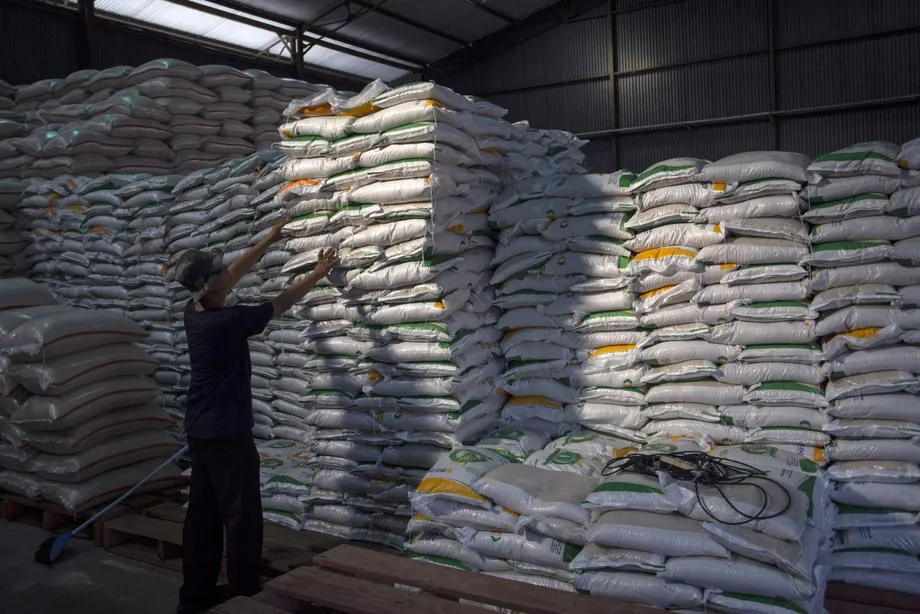
Bulog's reserves provide a buffer between harvests and household needs. The agency buys rice, stores it and releases supplies through assistance and market programs. Annual production measures how much rice the country produces over a period; a reserve figure measures how much is held at a particular time.
At the Jayapura launch, Amran cited a stockpile of 3.7 million tonnes, which he described as the largest since Bulog's establishment in 1967. He compared it with a usual ceiling of around 2 million tonnes and said rice circulating in the market was domestically produced.
The dated figures show reserves continuing to grow after the end of 2025. Bulog held 5.2 million tonnes as of June 18, 2026, while domestic procurement since the start of that year had reached 3.18 million tonnes. Procurement means purchases for the reserve, mainly from Indonesian farmers and suppliers.
Amran, who also headed the National Food Agency, described how the stock increase had expanded storage requirements:
"Our warehouse capacity is 3 million tons. We have rented an additional 2.3 million tons, the highest level since independence. We are now in surplus. We have achieved self-sufficiency," Amran said.
The FAO's June 2026 Food Outlook projected Indonesia's closing rice stocks at 7.5 million tonnes for 2025/2026 and 7.8 million tonnes for 2026/2027. Those national stock projections have a broader scope than the government reserve managed by Bulog.
Rice reserves also move out of warehouses
The National Food Agency said Indonesia distributed 7.75 million tonnes of government rice reserves during 2023 to 2025. Annual releases were 2.76 million tonnes in 2023, 3.37 million tonnes in 2024 and 1.62 million tonnes in 2025.
The rice supported the supply and price stabilization program, known as SPHP, food assistance covering 33.2 million beneficiary families, designated budget allocations and emergency responses. SPHP puts government rice into distribution channels to help maintain supply and restrain price pressure.
In 2025, SPHP accounted for 802,900 tonnes of reserve distribution, while food assistance received 710,780 tonnes. Together, those two channels represented about 93 percent of the year's stated total. Another 92,100 tonnes went to budget allocation groups and 13,160 tonnes to emergency response.
By June 18, 2026, releases under the 2026 budget had reached 946,800 tonnes, including 550,100 tonnes for food assistance and 348,500 tonnes for SPHP. The government also decided to extend rice food assistance by three months during the second half of 2026.
I Gusti Ketut Astawa, the National Food Agency's deputy for food availability and stabilization, said domestic harvest purchases would continue to strengthen reserves. For farmers, those purchases provide a buyer; for households, subsequent distribution provides another route to obtaining rice when budgets are tight or supplies are disrupted.
Cheaper overseas rice tests import enforcement
Indonesia's decision to stop regular rice imports faced an enforcement test in Sabang, Aceh. Police sealed a warehouse linked to PT MSG containing a shipment of 250 tonnes of Thai rice that authorities described as an alleged illegal import.
After the November 24, 2025 parliamentary hearing, Amran said Sabang's status as a free trade zone did not exempt it from the national rice import prohibition. A free trade zone gives businesses special trading arrangements, but authorities said the rice restriction still applied there.
Siti Hediati Hariyadi, known as Titiek Soeharto, who chaired Parliament's Commission IV, called for strict legal action against those responsible. The subsequent legal outcome of the case was not given.
Amran attributed the commercial incentive to cheaper rice abroad. He said international prices had fallen from about US$650 to US$340 per tonne after Indonesia stopped purchasing, and that Indonesia had imported seven million tonnes two years earlier. His figures describe a price decline of about 48 percent.
The minister argued that Indonesia's withdrawal removed a major buyer from the international market. For the government, maintaining the import restriction also protects domestic farmers from competition at those lower overseas prices while local production is abundant.
Prices and farmer incomes become the next test
Government figures showed rice inflation easing from 1.35 percent in July 2025 to 0.38 percent in May 2026. A lower inflation rate means prices are rising more slowly; it does not necessarily mean a bag of rice costs less than before.
BPS recorded a rice farmer price index of 147.97 in May 2026, the highest in seven years. The index tracks prices received by rice farmers relative to a reference period. It provides information about selling prices, while the cost of fertilizer, labour and other inputs also affects what farmers earn.
The Food Crops Farmer Exchange Rate stood at 113.79 in May, its highest level in 2026. This measure compares prices farmers receive with prices they pay. A reading above 100 means their selling prices have increased more than their measured expenses relative to the index's base period.
The National Food Agency said the FAO ranked Indonesia as Southeast Asia's largest rice producer and fourth globally in 2025, behind India, China and Bangladesh. It also cited an estimated production increase exceeding four million tonnes between 2024/2025 and 2025/2026, compared with increases of 1.7 million tonnes in India, 1.5 million in Brazil and 1.1 million in Bangladesh.
The USDA's May 2026 Rice Outlook put global production for 2025/2026 at 542.8 million tonnes, an upward revision from 541.3 million tonnes in April. Indonesia was among the countries recording the largest annual production increases. At home, the practical balance is between affordable rice for consumers and prices that keep farmers planting.
Food security extends to fishing communities
Bakom's assessment also included the Red and White Fishing Villages program, known in Indonesia as Kampung Nelayan Merah Putih. The Ministry of Marine Affairs and Fisheries implemented it at 100 locations in 2025, with 65 entering operational trials.
The government aims to expand the program to 1,386 locations by the end of 2026. Its stated goals are stronger fisheries infrastructure, higher fisher productivity and economic growth in coastal communities. The planned reach is almost 14 times the number of locations covered in 2025.
Fish adds a protein component to a food agenda heavily focused on rice. Rice supplies much of a meal's energy, while fish provides protein needed for growth and tissue repair. The fishing village program therefore addresses a different part of the national food supply.
The wider nutrition agenda includes Prabowo's free meals program, which received a Rp335 trillion allocation for 2026 and sought to reach nearly 83 million people. Its expansion has faced cost and food safety concerns, making the delivery of safe meals another test alongside the availability of ingredients.
The milestones and remaining targets
Indonesia's shift developed through policy changes, a larger harvest and continued purchases for public reserves. The main dates show the difference between completed results and targets still being pursued:
- October 20, 2024: Prabowo and Gibran took office, beginning the administration whose food policies Bakom reviewed.
- During 2025: Rice production reached 34.69 million tonnes, and Indonesia imported no regular rice for domestic consumption.
- November 24, 2025: Amran reaffirmed the import prohibition after a parliamentary hearing addressing the Sabang shipment.
- End of 2025: Government rice reserves stood at 3.248 million tonnes.
- June 18, 2026: Bulog held 5.2 million tonnes, with domestic procurement reaching 3.18 million tonnes since the start of the year.
- End of 2026: The government targets 1,386 fishing village program locations, while annual rice production is projected at 34.77 million tonnes.
The projected rice surplus gives the government room to supply assistance programs and maintain reserves. Keeping those supplies useful requires continued storage and distribution, while the fishing village expansion must move more locations from construction into operation.
Key Points
- Indonesia imported no regular rice for domestic consumption in 2025, according to Bakom.
- Rice production reached 34.69 million tonnes in 2025, up 13.29 percent from 2024.
- Projected 2026 production exceeds estimated demand by 3.67 million tonnes.
- Bulog's stocks reached 5.2 million tonnes by June 18, 2026.
- Government reserves support price stabilization, family food assistance and emergency response.
- Fertilizer reforms, irrigation repairs and new fields form part of the production strategy.
- The government targets 1,386 Red and White Fishing Village locations by the end of 2026.